TEL:+86 132 6656 7067


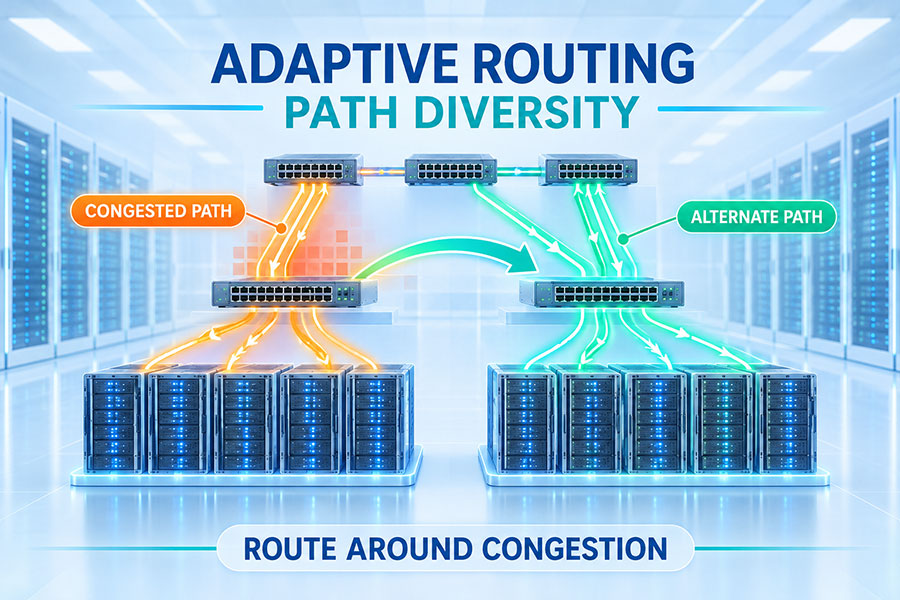
High-performance AI fabrics must move large volumes of data between accelerators while maintaining predictable communication performance. During distributed training, collective operations such as AllReduce, AllGather, ReduceScatter and All-to-All generate traffic across many servers and switches. These transfers can create uneven link utilization, transient congestion and long-tail delays, even when the network has substantial aggregate bandwidth.
Adaptive routing and path diversity help address these conditions. Path diversity gives traffic multiple possible routes through the fabric, while adaptive routing selects paths according to current network conditions rather than relying exclusively on fixed forwarding decisions. Their effectiveness depends on topology, congestion visibility, packet-ordering behavior, transport protocols and the ability of endpoints and switches to coordinate.
1. Why AI Fabrics Need Adaptive Routing
AI training traffic is often highly synchronized. A group of GPUs may exchange data at nearly the same time during a collective communication phase. When many flows converge on the same switch output port, the resulting queue can increase latency and reduce effective throughput.
The problem is not necessarily a shortage of total network capacity. A fabric may have several available paths, but static routing or flow hashing can place a disproportionate amount of traffic on a subset of links. Other links remain underused while the congested paths become bottlenecks.
Adaptive routing allows the network to respond to changing traffic conditions. Depending on the implementation, a switch or endpoint can select an alternative path, redistribute traffic across eligible links or reduce the amount of traffic assigned to a congested route.
Traffic imbalance: Multiple large flows may collide on the same uplink.
Collective communication bursts: Synchronized GPU transfers can create short-lived congestion hotspots.
Incast: Many senders may transmit toward one receiver or destination port at the same time.
Changing workload phases: The traffic matrix can change significantly between training, checkpointing and inference operations.
Link and switch failures: A route may become unavailable or lose capacity while a workload is running.
Adaptive routing is therefore a network-level mechanism for using available capacity more effectively. It does not create additional physical bandwidth, but it can reduce the performance penalty caused by uneven traffic distribution.
2. What Path Diversity Means in an AI Fabric
Path diversity refers to the availability of multiple network routes between two endpoints. In a high-performance fabric, these routes may use different switch ports, uplinks, spine switches or network planes while connecting the same source and destination.
A well-designed Clos or fat-tree topology provides multiple equal-cost routes between many server pairs. Dragonfly and mesh-based designs can also provide alternative routes, although their path structures and routing constraints differ.
Physical path diversity
Physical path diversity is created through the underlying cabling and switching topology. Multiple links between leaf and spine switches, separate network planes and independent switch paths provide alternative physical connections.
For stronger fault isolation, alternative paths should avoid sharing the same critical component wherever practical. Two logical routes that both depend on one cable tray, switch, power domain or upstream device may not provide meaningful protection against a common failure.
Logical path diversity
Logical path diversity is created by routing and forwarding mechanisms that expose multiple usable routes through the physical fabric. A network may have several physical paths but still use only one of them for a particular flow if its routing policy pins traffic to a single next hop.
Conversely, multiple logical routes do not necessarily represent independent physical paths. Network operators must understand how forwarding entries map to actual links and switches.
| Path-diversity dimension | What it provides | Engineering consideration |
|---|---|---|
| Parallel links | Multiple connections between adjacent switches | Verify link distribution and failure behavior |
| Multiple spine switches | Alternative routes between leaf switches | Check topology symmetry and available capacity |
| Independent network planes | Traffic separation and fault isolation | Avoid shared dependencies between planes |
| Multiple equal-cost routes | Several forwarding choices for a destination | Confirm routing and hashing behavior |
| Alternative optical connections | Additional physical connectivity between network devices | Validate fiber routing, transceiver compatibility and optical budgets |
3. Static Routing, ECMP and Adaptive Routing
Static routing, Equal-Cost Multi-Path (ECMP) and adaptive routing represent different ways to distribute traffic through a network.
Static routing
Static routing uses predetermined forwarding paths. It can provide predictable behavior and is relatively straightforward to operate, but it does not automatically respond to short-term congestion. If a selected path becomes heavily loaded while another route remains available, traffic may continue using the original path until the forwarding configuration changes.
ECMP load balancing
ECMP provides multiple equal-cost next hops toward a destination. A common implementation hashes selected packet-header fields, such as source and destination addresses and transport-layer identifiers, to choose a path. Packets belonging to the same flow are usually assigned consistently to one path.
This flow-based approach helps preserve packet ordering, but it can produce hash collisions. Two or more large flows may be assigned to the same path even when alternative paths have spare capacity. This is particularly relevant to AI traffic, where large RDMA flows can dominate link utilization.
Adaptive routing
Adaptive routing uses information about current network conditions to influence forwarding decisions. Depending on the system, the decision may be made by a switch, an endpoint or a combination of both. Available information can include output-port utilization, queue occupancy, congestion notifications, latency measurements and link status.
| Routing method | Path selection | Response to congestion | Main trade-off |
|---|---|---|---|
| Static routing | Predetermined route | Limited unless configuration changes | Simple and predictable, but less flexible |
| ECMP | Hash-based selection among equal-cost paths | Usually indirect; depends on routing updates or hashing changes | Preserves flow affinity but can suffer hash collisions |
| Adaptive routing | Uses current network conditions to select eligible paths | Can move traffic away from congested paths | Requires telemetry, coordination and ordering management |
| Packet spraying | Distributes packets across multiple paths | Can react at finer granularity when combined with feedback | Can introduce packet reordering |
These approaches are not mutually exclusive. A fabric may use ECMP for baseline forwarding, adaptive routing for congestion-aware decisions and separate mechanisms for recovery when a physical link fails.
4. How Adaptive Routing Makes Path Decisions
An adaptive routing system needs information about which paths are eligible and how heavily they are being used. The exact decision process varies by vendor, protocol and switching architecture.
Local switch-based decisions
A switch can compare the congestion state of eligible output ports for a destination. If one port has a deeper queue or higher utilization than another, the switch may select the less congested alternative. This can respond quickly to local traffic changes without requiring a centralized controller to calculate every packet route.
Source-based path selection
An endpoint or NIC can select among available paths before transmitting traffic. It may use congestion feedback, acknowledgments, ECN markings or telemetry to adjust the distribution of packets or flows. Source-based approaches can incorporate information gathered from multiple switches along the path.
Network-wide visibility
More advanced designs combine local switch measurements with endpoint feedback and network telemetry. This provides a broader view of congestion than a decision based only on one output port.
However, telemetry must be timely and sufficiently accurate. If routing decisions are based on stale measurements, traffic may be redirected toward a path that has already become congested. Excessively frequent path changes can also create unstable behavior.
5. Adaptive Routing Techniques: Flow-Based, Flowlet-Based and Packet-Based
Adaptive routing can operate at different traffic granularities. The choice determines how quickly traffic can move between paths and how much packet-ordering complexity the transport must handle.
Flow-based adaptive routing
Flow-based routing assigns an entire flow to a selected path. If congestion changes, the system may move the flow to another route. Keeping a flow on one path helps preserve packet ordering, but moving a large flow can create transient reordering unless the transition is coordinated.
Flowlet-based routing
Flowlet-based routing divides a flow into bursts separated by sufficiently long idle gaps. The network can assign different bursts to different paths while keeping packets within each burst on the same route.
The gap must be long enough to account for differences in path delay. If a later burst takes a faster path while earlier packets remain on a slower path, packets may still arrive out of order. Correct flowlet selection therefore depends on path-delay variation and the implementation's safety margin.
Packet-based adaptive routing
Packet-based routing can select a path independently for individual packets. This provides fine-grained load distribution and can reduce the impact of flow-hash collisions. However, packets from the same flow may arrive in a different order because their paths have different queueing delays.
Packet spraying is one approach to multipath packet transmission. It distributes packets across multiple paths, often using an entropy value or sequence of path choices. Congestion feedback can then reduce traffic assigned to paths that are experiencing bottlenecks.
| Technique | Routing granularity | Ordering behavior | Typical consideration |
|---|---|---|---|
| Flow-based | Entire flow | Generally preserves order while the path remains unchanged | Large flows may still create path imbalance |
| Flowlet-based | Bursts within a flow | Can preserve order when inter-path delay conditions are respected | Requires suitable idle-gap detection and path-delay awareness |
| Packet-based | Individual packets | May reorder packets | Requires transport and receiver mechanisms that tolerate or recover from reordering |
6. Packet Reordering and RDMA Transport Considerations
Packet reordering is one of the most important design considerations when introducing multipath transmission into AI fabrics. Packets sent over different paths can experience different queueing delays. A later packet may therefore reach the receiver before an earlier packet from the same flow.
This matters for high-performance transports because reliable delivery, sequence tracking, retransmission and receiver processing must operate correctly under the expected ordering behavior.
Why reordering matters for RoCEv2
RoCEv2 is widely used for RDMA communication over Ethernet. Its performance depends on the behavior of NICs, switches, congestion-control mechanisms and the configured network. Routing changes that introduce substantial reordering can affect packet processing and recovery behavior, depending on the implementation.
Traditional ECMP generally keeps packets from a flow on the same path to reduce reordering. More aggressive multipath methods need suitable endpoint and transport support to handle packets that arrive out of sequence.
Transport-aware multipathing
Multipath designs can use sequence information, receiver feedback and congestion signals to manage out-of-order delivery. Some approaches use packet spraying together with packet trimming or explicit congestion notifications to help identify congestion and recover efficiently.
These capabilities should not be assumed to exist in every Ethernet NIC or RoCEv2 deployment. The transport, NIC firmware, switch behavior and congestion-control configuration must support the selected routing method.
7. Congestion Control and Adaptive Routing Work Together
Adaptive routing changes where traffic travels. Congestion control determines how much traffic should be sent and how transmission should respond to network pressure. Both are needed for a high-performance AI fabric.
If a sender continues transmitting at an excessive rate, moving packets to another path may simply transfer congestion to that path. Conversely, reducing the sending rate without considering available alternative routes can leave network capacity underused.
Explicit Congestion Notification
ECN allows network devices to mark packets when congestion is developing. The receiving endpoint can return congestion feedback to the sender, which adjusts its transmission behavior according to the configured congestion-control algorithm.
Queue and latency feedback
Queue occupancy and queueing delay provide information about where traffic is accumulating. These measurements can help routing systems identify congested paths and help senders adjust their traffic rates.
Receiver-driven control
Receiver-driven approaches can regulate how much data arrives at a destination. The receiver grants transmission credits or otherwise communicates its ability to accept traffic. This is particularly relevant to incast, where many sources transmit toward a shared destination and can overwhelm its available buffering or processing capacity.
| Mechanism | Primary responsibility | Potential contribution |
|---|---|---|
| Adaptive routing | Path selection | Redirects traffic toward less congested eligible routes |
| ECN | Congestion signaling | Notifies endpoints that congestion is developing |
| Sender-based congestion control | Transmission rate or window | Reduces offered load when network feedback indicates congestion |
| Receiver-based control | Destination admission and credits | Helps prevent receiver-side overload and incast |
| In-band telemetry | Network visibility | Provides path or bottleneck information for routing and control decisions |
8. Path Diversity in Clos and Fat-Tree AI Networks
Clos and fat-tree topologies are widely used in data center fabrics because they provide structured connectivity between large numbers of endpoints. In a typical leaf-spine design, each leaf switch connects to multiple spine switches. Traffic between different leaf switches can therefore use several equal-cost paths.
This topology provides a foundation for ECMP and adaptive routing. However, the number of available routes alone does not guarantee balanced utilization. Hash collisions, unequal link capacity, oversubscription and traffic concentration can still create hotspots.
Leaf-spine path selection
When a server connected to one leaf switch communicates with a server connected to another leaf, the traffic can pass through one of several spine switches. A routing system can distribute flows across these paths or select alternatives based on congestion.
Multi-plane fabrics
Large AI clusters may use multiple network planes to increase aggregate capacity and isolate traffic. Each plane can provide a separate set of links and switches. This improves resilience only when the planes have sufficiently independent physical and operational dependencies.
Topology-aware routing
Routing decisions should reflect the actual fabric structure. A route that appears short in hop count may traverse a heavily loaded uplink, while a slightly longer path may have more available capacity. Topology-aware algorithms consider path eligibility, link state, congestion and the cost of reaching the destination.
9. Path Diversity in Dragonfly, Mesh and Other Topologies
Not every AI or HPC fabric uses a conventional leaf-spine design. Some systems use Dragonfly, Dragonfly+, mesh or torus topologies to connect large numbers of compute nodes with different trade-offs in cable count, hop count and global-link utilization.
In a Dragonfly topology, groups of routers are connected through local links and global links. Adaptive routing can help distribute traffic across eligible global routes, especially when workload communication patterns create uneven demand between groups.
Mesh and torus topologies provide neighboring connections along multiple dimensions. Alternative routes can be selected when a direct dimension link is congested or unavailable, subject to the routing algorithm's deadlock-avoidance and topology constraints.
| Topology | Source of path diversity | Routing consideration |
|---|---|---|
| Clos / Fat Tree | Multiple spine switches and equal-cost paths | ECMP collisions, oversubscription and uplink balance |
| Dragonfly | Alternative global links between groups | Global-link congestion and adaptive route selection |
| Mesh | Alternative routes across dimensions | Hop count, routing restrictions and deadlock avoidance |
| Torus | Wraparound links and multiple dimension routes | Dimension-order routing and congestion distribution |
| Multi-plane fabric | Independent or partially independent network planes | Plane isolation, failure domains and traffic assignment |
The best routing method depends on the topology. An algorithm designed for a fat-tree network cannot automatically be applied to a Dragonfly or torus fabric without considering route constraints and deadlock behavior.
10. Adaptive Routing and AI Collective Communication
AI training workloads generate different traffic patterns at different stages of computation. Adaptive routing is most effective when the network design accounts for these workload characteristics rather than assuming all flows behave similarly.
AllReduce
AllReduce combines values from multiple accelerators and distributes the reduced result. Ring, tree and hierarchical implementations produce different communication patterns. A large number of concurrent transfers can create hotspots on links shared by several communication groups.
AllGather and ReduceScatter
AllGather distributes data from each participant to all other participants, while ReduceScatter combines data and distributes different portions of the result. Their communication patterns can create substantial east-west traffic and change the load on different fabric paths.
All-to-All and mixture-of-experts traffic
All-to-All communication exchanges data between many endpoints. In mixture-of-experts models, tokens may be routed to different expert groups, creating traffic patterns that vary with the distribution of tokens and the placement of experts.
Adaptive routing can help distribute these transfers across available paths, but it cannot eliminate the communication volume or the destination-side bottlenecks inherent in the workload.
| AI communication pattern | Network behavior | Routing implication |
|---|---|---|
| AllReduce | Synchronized exchanges among many participants | Balance traffic across shared uplinks and collective paths |
| AllGather | Data from multiple participants is distributed broadly | Manage concurrent flows and avoid path concentration |
| ReduceScatter | Data is reduced and distributed in partitions | Account for changing source-destination traffic patterns |
| All-to-All | Many-to-many communication | Provide path diversity and manage incast or hotspot conditions |
| Checkpoint transfer | Large transfers toward storage or designated services | Prevent bulk transfers from interfering with latency-sensitive traffic |
11. Adaptive Routing in InfiniBand and RoCEv2 Fabrics
Adaptive routing is available in high-performance InfiniBand environments and is also an active area of development for Ethernet-based AI networks. The mechanisms and configuration requirements differ between the two environments.
InfiniBand adaptive routing
InfiniBand fabrics can use multiple paths between endpoints. Supported switches can select less-congested output paths based on current network conditions. The Subnet Manager and fabric configuration determine whether adaptive routing is available and enabled for the relevant traffic classes.
NVIDIA documentation describes adaptive routing as a mechanism for moving traffic away from overloaded paths toward less-congested alternatives. It also distinguishes adaptive routing from static path balancing, which assigns paths without direct knowledge of current workload conditions.
RoCEv2 and Ethernet fabrics
RoCEv2 deployments commonly use ECMP in Clos networks. Because ECMP hashes flows to paths, large RDMA flows can collide and create uneven utilization. Alternative strategies include enhanced ECMP, flow pinning, flowlet-based distribution and multipath packet transmission.
The appropriate method depends on the capabilities of the switches and NICs, transport behavior, congestion-control design and operational requirements. A feature supported by one vendor's InfiniBand platform should not be assumed to be available in every RoCEv2 Ethernet network.
Ultra Ethernet developments
The Ultra Ethernet Consortium's transport design addresses multipath transmission and congestion management for AI and HPC workloads. Its published material describes packet spraying across multiple paths, congestion feedback and sender- or receiver-based control mechanisms. The October 2026 Specification 1.1 announcement also introduces Congestion Signaling (CSIG) and Programmable Congestion Management (PCM), extending congestion telemetry and endpoint control capabilities.
These developments illustrate a broader direction in AI networking: routing, transport reliability, congestion control and telemetry are increasingly designed as coordinated functions rather than independent features.
12. Optical Connectivity and Physical Path Diversity
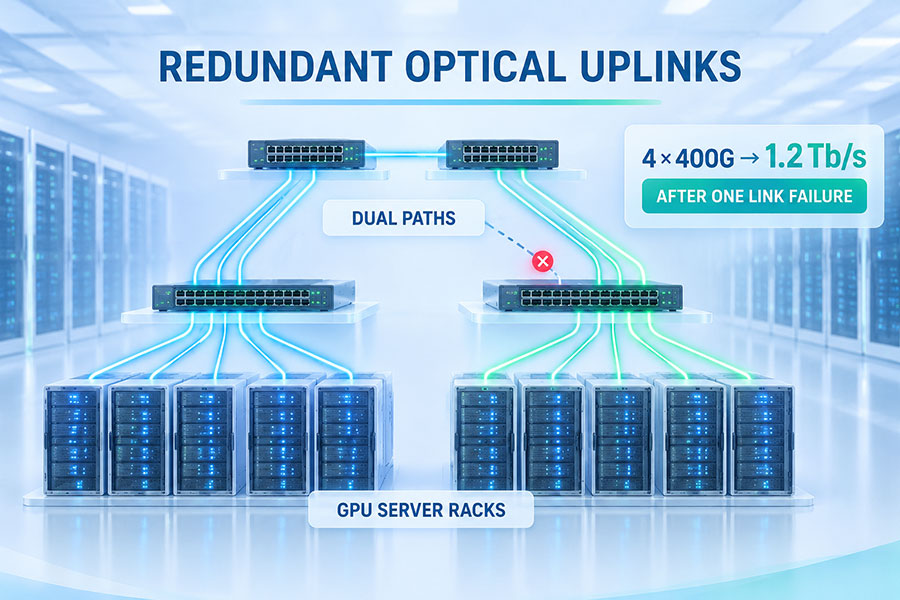
High-speed optical links provide the physical connectivity between switches in large AI fabrics. However, installing multiple optical links does not automatically create effective path diversity. The links must connect to different forwarding options and, where resilience is required, avoid common failure points.
For example, multiple 800G or 400G links between leaf and spine switches can increase available capacity. If these links are distributed across independent spine switches and correctly exposed to the routing system, they can also provide alternative routes.
Fiber routing and cable infrastructure
Physical diversity should be considered during cabling design. Separate fiber paths may be useful when links need protection against cable damage or infrastructure failures. If redundant optical links share the same vulnerable cable route, their failure independence is limited.
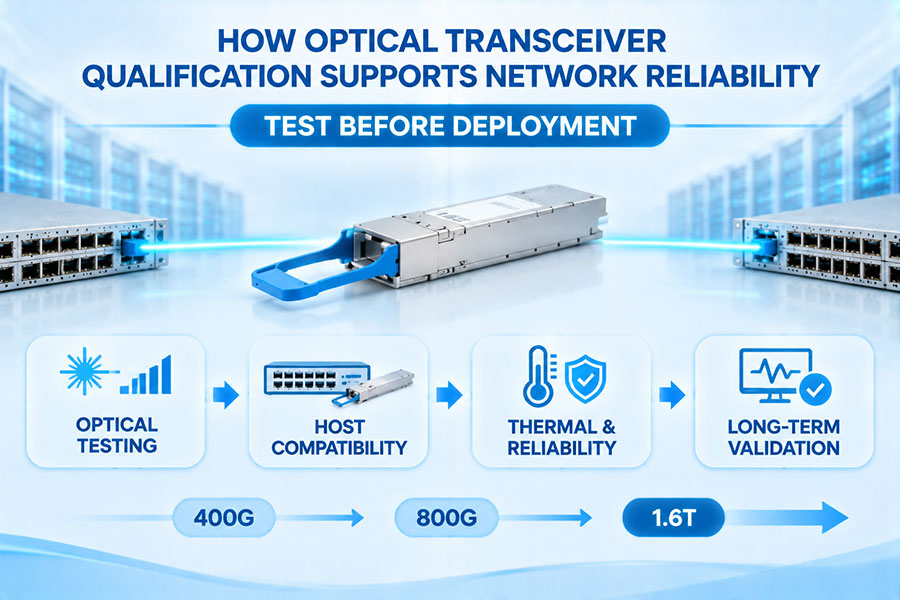
Transceiver and link qualification
Each optical connection must meet its physical-layer requirements. Relevant checks include:
Transceiver speed, form factor and host compatibility.
Optical reach and supported fiber type.
Connector type, polarity and fiber mapping.
Transmit power, receiver sensitivity and link budget.
Fiber cleanliness, insertion loss and bend radius.
Link monitoring, fault detection and recovery behavior.
Adaptive routing can only use paths that are operational and recognized by the network. A physically installed link that is not configured, qualified or exposed to the forwarding system does not contribute usable path diversity.
13. Failure Recovery and Network Resilience
Path diversity improves resilience by providing alternative routes when a link or switch becomes unavailable. Adaptive routing can help the fabric move traffic away from failed or degraded paths, but congestion response and failure recovery are different functions.
A congestion event may require traffic to be redistributed while all links remain operational. A hard link failure requires the routing system to remove an unavailable path and select a valid alternative. A degraded link may remain active while delivering lower performance or generating errors, making fault detection and health monitoring important.
Network resilience should be evaluated across multiple failure scenarios:
Single-link failure: Can traffic use another path without losing connectivity?
Switch failure: Are alternative routes available through other switches?
Network-plane failure: Can workloads continue through an independent plane?
Congestion hotspot: Can traffic shift away from a heavily loaded path?
Degraded optical link: Can monitoring identify deteriorating signal quality before the link becomes unusable?
Failover behavior also affects application performance. A network may remain connected after a failure but still experience packet loss, retransmissions, temporary congestion or a reduction in available bandwidth. Recovery time and post-failure capacity should therefore be measured.
14. Performance Metrics for Adaptive Routing Evaluation
Adaptive routing should be evaluated using application-level performance and network-level measurements. A lower average link utilization does not necessarily mean that distributed training will complete faster.
| Metric | What it measures | Why it matters |
|---|---|---|
| Link utilization | Traffic carried relative to link capacity | Identifies underused links and overloaded paths |
| Queue depth | Packets or bytes waiting in switch queues | Shows where congestion is accumulating |
| Queueing latency | Time spent waiting in network queues | Helps identify delay caused by congestion |
| Flow completion time | Time required to complete a transfer | Measures performance for individual communications |
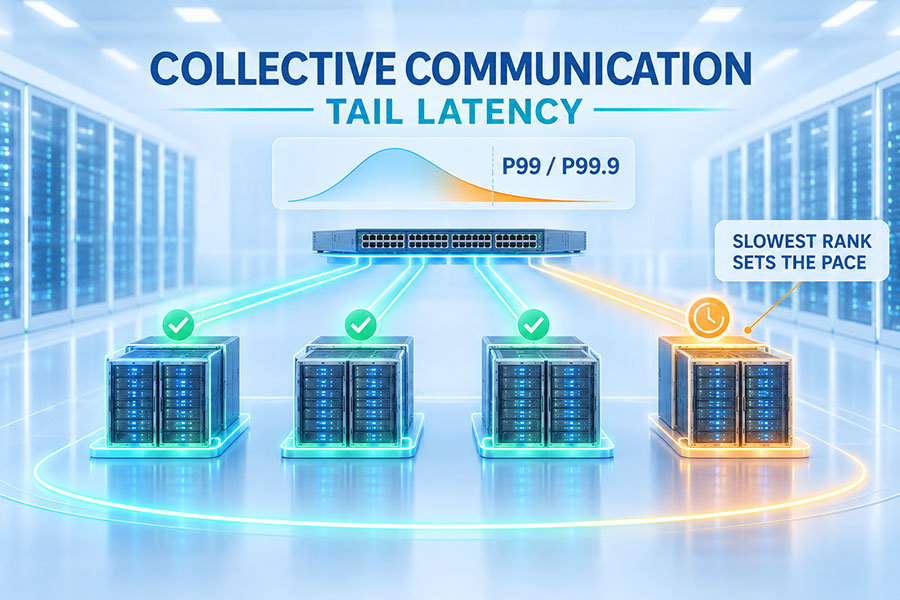
| Tail latency | High-percentile communication delay | Important when slow transfers delay collective operations |
| Packet reordering | Out-of-sequence packet arrival | Reveals transport and receiver processing impact |
| Packet loss and retransmissions | Delivery failures and recovery activity | Indicates reliability and congestion-control behavior |
| Collective completion time | Time for an AI communication operation to finish | Connects network behavior to training performance |
| Job iteration time | Time for one model-training iteration | Measures the end-to-end effect on the workload |
Testing should include both steady-state traffic and bursty workload phases. A routing scheme that performs well with uniform synthetic traffic may behave differently under All-to-All communication, incast or concurrent checkpoint transfers.
15. Common Design Challenges
Hash collisions and uneven traffic distribution
ECMP can assign several large flows to the same path. More granular distribution can reduce this problem, but the additional routing and transport complexity must be evaluated.
Packet reordering
Using multiple paths at packet granularity can improve load distribution but may cause out-of-order arrival. The selected transport and receiver must be capable of handling the expected reordering behavior.
Stale congestion information
Congestion telemetry has a time dimension. Delayed feedback may cause routing decisions to reflect a previous traffic condition rather than the current state of the fabric.
Route oscillation
If many flows react to the same congestion signal at the same time, they may all move to an alternative path and create a new hotspot. Damping, thresholds, path diversity and coordinated control help reduce this risk.
Deadlock and routing constraints
Some topologies require routing restrictions to prevent cyclic resource dependencies and deadlock. Adaptive route selection must respect these constraints rather than choosing any physically available path.
Operational complexity
Advanced routing introduces additional dependencies among switch software, NIC firmware, transport protocols, telemetry and monitoring. Configuration consistency and troubleshooting procedures become increasingly important as the fabric scales.
16. Practical Design Considerations for AI Fabric Deployment
A high-performance AI fabric should be designed around the communication patterns, failure requirements and operational capabilities of the complete system. Adaptive routing should be introduced as part of a broader network design process.
Map the workload traffic: Identify the expected AllReduce, AllGather, ReduceScatter, All-to-All and storage traffic patterns.
Establish physical path diversity: Provide sufficient parallel links, alternative switches and independent network paths for the required capacity and resilience.
Choose a routing strategy: Determine whether static routing, ECMP, flow-based adaptation, flowlet routing or packet spraying is supported and appropriate.
Verify transport compatibility: Confirm that NICs, switches and transport protocols can handle the expected path changes and packet-ordering behavior.
Coordinate congestion control: Align routing decisions with ECN, queue feedback, sender rate control and receiver-side protection.
Validate failure behavior: Test link, switch and network-plane failures, including recovery time and remaining capacity.
Measure application performance: Compare collective completion time, training iteration time, tail latency and link utilization under representative workloads.
Maintain operational visibility: Monitor path distribution, congestion indicators, optical link health, retransmissions and routing changes.
For large deployments, it is also useful to separate baseline connectivity qualification from adaptive-routing performance testing. First establish that all physical links and forwarding paths operate correctly. Then evaluate how routing decisions affect traffic distribution and application behavior under realistic load.
17. Conclusion
Adaptive routing and path diversity are important capabilities for high-performance AI fabrics because distributed training generates large, dynamic and often synchronized traffic flows. Path diversity provides multiple possible routes through the network, while adaptive routing uses network conditions to distribute traffic more effectively and respond to congestion or failures.
ECMP remains a useful baseline for distributing flows across equal-cost paths, but hash collisions can limit its effectiveness for large RDMA workloads. Flowlet routing, packet spraying and congestion-aware path selection offer additional options, each with different implications for packet ordering, transport support and operational complexity.
For high-speed optical connectivity, data center interconnect components or customized transceiver compatibility requirements, Contact C-LIGHT.
 >

 >
 >
 >
 >
 >
 >
 >