TEL:+86 132 6656 7067


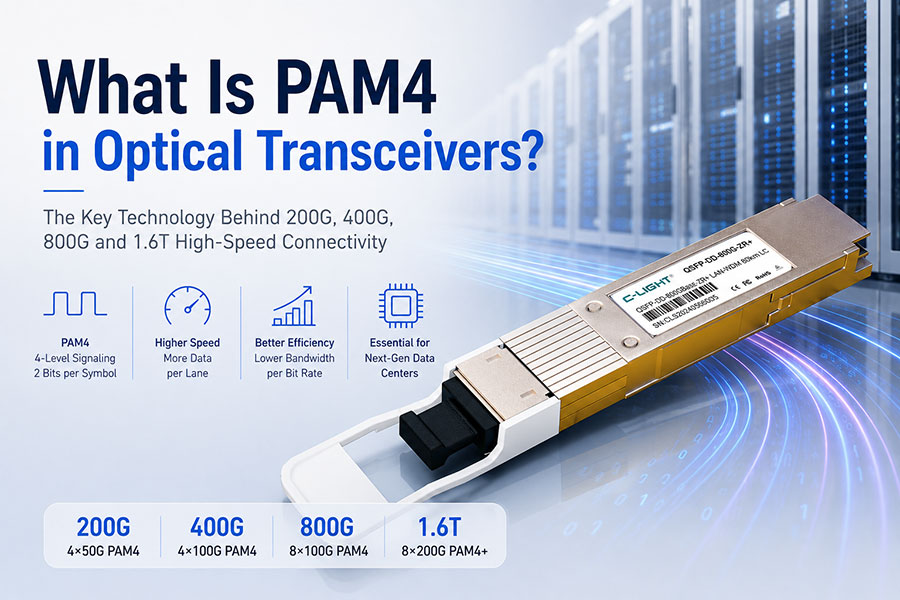
PAM4, or four-level pulse amplitude modulation, is a multi-level signaling technology widely used in modern high-speed optical transceivers. It enables higher data rates per electrical or optical lane by transmitting two bits of information per symbol instead of one.
PAM4 has become an important technology for 200G, 400G, 800G and emerging 1.6T optical connectivity, particularly in data centers, AI clusters, cloud computing networks, and high-performance computing systems.
1. What Is PAM4?
PAM4 stands for Pulse Amplitude Modulation with 4 levels. Unlike NRZ signaling, which uses two signal levels to represent one bit per symbol, PAM4 uses four different amplitude levels.
Each PAM4 symbol can represent two bits of information:
Level 0: Represents one two-bit combination.
Level 1: Represents another two-bit combination.
Level 2: Represents another two-bit combination.
Level 3: Represents the fourth two-bit combination.
Because each symbol carries two bits, PAM4 can theoretically double the bit rate of a lane at the same symbol rate compared with NRZ.
2. PAM4 vs NRZ
The key difference between PAM4 and NRZ is the number of signal levels used for data transmission.
| Feature | NRZ | PAM4 |
|---|---|---|
| Signal Levels | 2 | 4 |
| Bits per Symbol | 1 | 2 |
| Data Efficiency | Lower | Higher |
| Required Bandwidth per Bit Rate | Higher | Lower |
| Signal Complexity | Lower | Higher |
| Noise Margin | Higher | Lower |
| Typical High-Speed Use | Lower-speed legacy systems | 200G, 400G, 800G and higher-speed systems |
The four PAM4 levels are closer together than the two levels used by NRZ. This increases the sensitivity to noise and signal distortion, making transmitter, receiver, equalization, and testing performance more important.
3. Why Is PAM4 Used in Optical Transceivers?
As network speeds increase, simply increasing the electrical bandwidth of every individual lane becomes increasingly challenging. PAM4 provides a way to increase the amount of data transmitted per symbol without requiring the same proportional increase in symbol rate.
For example, a PAM4 lane operating at approximately 53.125 GBaud can carry a gross signaling rate of approximately 106.25 Gb/s before accounting for encoding and other overhead. This signaling approach is widely associated with 100G-class electrical or optical lanes used in modern 400G and 800G architectures.
Higher-speed generations continue to increase the per-lane data rate, placing greater demands on PAM4 signal integrity and the underlying optical and electrical components.
4. How Does PAM4 Work?
PAM4 converts binary data into four amplitude levels. Since four levels can represent four different states, each symbol carries two bits.
A simplified mapping can be represented as:
| Signal Level | Example Symbol |
|---|---|
| Level 0 | 00 |
| Level 1 | 01 |
| Level 2 | 10 |
| Level 3 | 11 |
In a practical optical transceiver, the electrical data is processed by the transmitter circuitry and converted into an optical signal. At the receiving end, the optical signal is detected and converted back into an electrical signal, where the PAM4 levels are recovered and decoded.
5. PAM4 in 400G Optical Transceivers
400G optical transceivers are an important application of PAM4 technology. Many 400G architectures use multiple 100G-class lanes, with PAM4 enabling approximately 100 Gb/s signaling per lane.
For example, an 8-lane electrical architecture can use 8 × 50+ GBaud PAM4 lanes to support a 400G-class interface, while optical implementations can use different lane configurations depending on the transceiver standard and optical design.
Common 400G form factors include QSFP-DD and OSFP, with different optical reaches and fiber configurations available for data center and networking applications.
6. PAM4 in 800G Optical Transceivers
800G optical transceivers further increase the bandwidth requirements of data center networks. Many 800G implementations use eight 100G-class lanes based on PAM4 signaling.
800G transceivers can be designed for different applications, including short-reach multimode links, single-mode data center interconnects, and longer-reach optical connections.
As the number of 800G links increases in AI and high-performance computing environments, PAM4 signal quality becomes increasingly important for maintaining reliable high-speed connectivity.
7. PAM4 and 1.6T Optical Transceivers
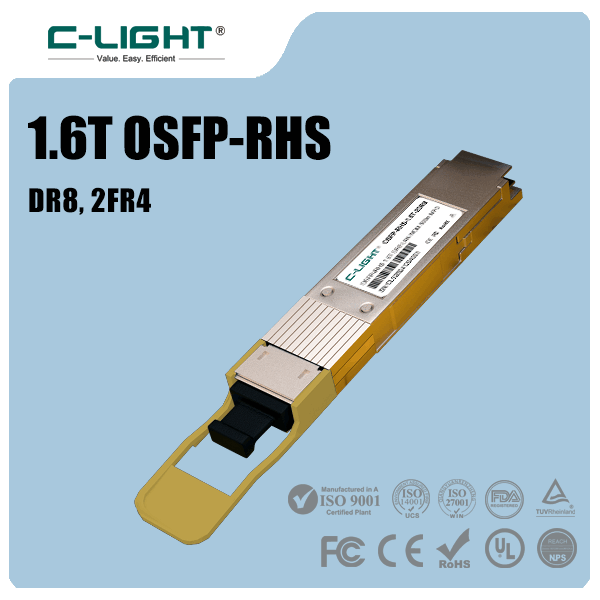
1.6T optical connectivity represents another step in the evolution of high-speed data center networking. To achieve higher aggregate bandwidth, optical transceivers need to increase the data rate per lane, the number of lanes, or both.
PAM4 remains an important signaling technology in the development of higher-speed interfaces. However, 1.6T implementations can use different electrical and optical architectures depending on the standard, platform, lane rate, and transceiver design.
The transition toward higher per-lane speeds creates additional requirements for electrical channels, optical engines, DSPs, lasers, photodetectors, connectors, and thermal management.
8. Advantages of PAM4
PAM4 provides several important advantages for high-speed optical communication.
Higher bits per symbol: PAM4 carries two bits per symbol compared with one bit per symbol for NRZ.
Higher lane efficiency: It enables higher data rates without requiring the same proportional increase in symbol rate.
Reduced bandwidth requirement: For a given bit rate, PAM4 can reduce the required signaling bandwidth compared with NRZ.
Scalable high-speed networking: PAM4 supports the development of 400G, 800G and higher-speed optical interfaces.
Suitable for data centers: PAM4 is widely used in high-bandwidth optical connectivity for modern data center networks.
9. Challenges of PAM4
PAM4 improves bandwidth efficiency, but it also introduces additional technical challenges.
Because four signal levels are packed into the same voltage range, the distance between adjacent levels is smaller than in a comparable NRZ signal. This reduces the available noise margin and increases sensitivity to signal impairments.
Lower signal margin: The smaller spacing between signal levels makes PAM4 more sensitive to noise.
Higher sensitivity to distortion: Loss, reflections, crosstalk, and other channel impairments can affect the eye opening.
More complex signal processing: High-speed PAM4 systems often require advanced equalization and signal processing.
Higher testing requirements: PAM4 links require careful validation of eye diagrams, BER, jitter, and other parameters.
Thermal considerations: Higher-speed DSPs and other components can increase system power and thermal requirements.
10. PAM4 Eye Diagram
An eye diagram is an important method for evaluating PAM4 signal quality. Unlike the two-level eye structure of NRZ, PAM4 produces three eye openings because four signal levels create three adjacent level transitions.
The eye diagram can reveal signal integrity problems such as excessive noise, insufficient eye opening, jitter, inter-symbol interference, and unequal signal levels.
For high-speed optical transceivers, PAM4 eye measurements are commonly combined with other electrical and optical tests to evaluate overall link performance.
11. PAM4 and DSP
Digital signal processing plays an important role in many high-speed PAM4 optical transceivers. A DSP can perform functions such as equalization, signal conditioning, clock recovery, and other processing required by the specific transceiver architecture.
The DSP helps compensate for signal impairments introduced by the host electrical channel, connectors, PCB traces, optical components, and transmission path.
However, DSP processing also introduces power consumption, latency, thermal requirements, and design complexity. These factors are particularly important as data rates move toward 800G and 1.6T.
12. PAM4 Testing for Optical Transceivers
Testing is essential for validating the performance of PAM4-based optical transceivers. Both electrical and optical characteristics need to be evaluated.
Eye Diagram: Evaluates the opening and quality of the PAM4 signal eyes.
BER: Measures bit error performance under defined test conditions.
Jitter: Evaluates timing variations that can affect signal recovery.
Insertion Loss: Measures signal loss through the electrical channel or optical path as applicable.
Return Loss: Evaluates reflections caused by impedance or optical interface discontinuities.
Crosstalk: Measures interference between high-speed lanes.
TDECQ: An important optical transmitter metric used for evaluating PAM4 optical signal quality in applicable Ethernet interfaces.
Receiver Sensitivity: Evaluates the minimum optical power required for the receiver to achieve the specified performance.
13. PAM4 and AI Data Center Networks
AI data centers require high-bandwidth connections between GPUs, switches, NICs, storage systems, and other infrastructure. The increasing number of high-speed links has accelerated the adoption of technologies capable of supporting higher bandwidth per lane.
PAM4 is well suited to this environment because it can increase the data carried by each symbol and support higher-speed electrical and optical interfaces.
400G and 800G optical transceivers are already important building blocks for high-speed data center networks, while 1.6T connectivity is being developed for future bandwidth requirements.
14. PAM4 in Optical Transceiver Form Factors
PAM4 technology can be implemented across different optical transceiver form factors. The form factor itself does not define whether a module uses PAM4; the signaling architecture, data rate, optical technology, and host interface determine the specific implementation.
| Form Factor | Typical High-Speed Applications | PAM4 Relevance |
|---|---|---|
| QSFP-DD | 400G and other high-speed networking | Widely used with multi-lane PAM4 architectures |
| OSFP | 400G, 800G and higher-speed networking | Supports high-speed multi-lane architectures |
| QSFP112 | 400G-class connectivity | Designed around four 112G-class electrical lanes in applicable implementations |
15. PAM4 vs Higher-Speed Signaling
The evolution from NRZ to PAM4 has significantly improved the efficiency of high-speed interfaces. However, simply increasing the number of signal levels is not the only path toward future bandwidth.
As networks progress beyond 800G, engineers must consider higher baud rates, improved optical components, advanced DSP technologies, co-packaged optics, linear-drive architectures, and other approaches to increase bandwidth while controlling power consumption and system complexity.
Therefore, PAM4 should be viewed as one important part of the high-speed optical connectivity technology stack rather than a standalone solution.
16. PAM4 Frequently Asked Questions
Q1: What does PAM4 mean in optical transceivers?
Answer: PAM4 means four-level Pulse Amplitude Modulation. It uses four signal amplitude levels, allowing each symbol to represent two bits of information.
Q2: What is the difference between PAM4 and NRZ?
Answer: NRZ uses two signal levels and carries one bit per symbol, while PAM4 uses four signal levels and carries two bits per symbol. PAM4 therefore provides greater data efficiency at a comparable symbol rate.
Q3: Is PAM4 used in 400G optical transceivers?
Answer: Yes. PAM4 is widely used in 400G-class optical connectivity. Many 400G architectures use multiple 100G-class PAM4 lanes, although the exact lane configuration depends on the applicable standard and transceiver design.
Q4: Is PAM4 used in 800G optical transceivers?
Answer: Yes. PAM4 is an important signaling technology for 800G optical transceivers. Many 800G implementations use eight 100G-class lanes based on PAM4 signaling.
Q5: What are the main advantages of PAM4?
Answer: The main advantage is that PAM4 carries two bits per symbol, allowing higher data rates without requiring the same proportional increase in symbol rate. This makes it suitable for high-speed networking applications.
Q6: What are the main challenges of PAM4?
Answer: PAM4 has smaller voltage differences between adjacent signal levels than NRZ, resulting in lower noise margin and greater sensitivity to signal distortion, crosstalk, jitter, and other impairments.
Q7: Does PAM4 require a DSP?
Answer: Many high-speed PAM4 optical transceivers use DSP technology for functions such as equalization and signal processing. However, the exact architecture depends on the module design, host interface, data rate, and application.
Q8: Is PAM4 suitable for AI data centers?
Answer: Yes. PAM4 is widely used in high-speed optical connectivity relevant to AI and data center networks, including 400G and 800G-class interfaces. Its ability to increase data per symbol makes it valuable for scaling network bandwidth.
17.Summary
PAM4 is a key signaling technology for modern high-speed optical transceivers. By using four amplitude levels and carrying two bits per symbol, PAM4 enables higher data rates while controlling the required symbol rate and channel bandwidth.
The technology is widely associated with 400G and 800G optical connectivity and is also relevant to the development of 1.6T and future high-speed networking. At the same time, PAM4 introduces greater sensitivity to noise, jitter, crosstalk, and signal distortion, making advanced signal processing and comprehensive testing essential.
For data centers, AI clusters, cloud networks, and high-performance computing systems, understanding PAM4 is important for evaluating the performance, architecture, and future evolution of high-speed optical interconnects.
 >
>

 >
>
 >
>
 >
>
 >
>
 >
>
 >
>
 >
>