TEL:+86 132 6656 7067


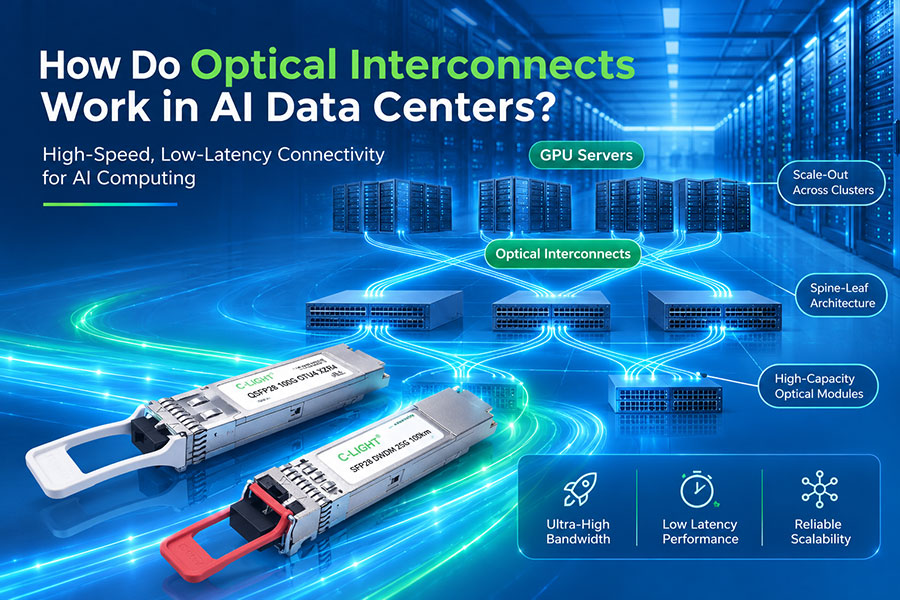
The rapid expansion of Artificial Intelligence (AI), cloud computing, and hyperscale data centers is driving unprecedented demand for network bandwidth. As networks transition from 400G to 800G and prepare for future 1.6T architectures, power consumption has become one of the most significant challenges facing data center operators.
Traditional optical transceivers rely heavily on Digital Signal Processors (DSPs) to perform signal compensation, equalization, and error correction. While DSP-based optics have enabled the growth of high-speed networking, they also contribute substantially to power consumption, latency, and system cost.
To address these challenges, the industry is increasingly exploring Linear Pluggable Optics (LPO), an emerging technology designed to deliver high-speed optical connectivity with significantly lower power consumption.
What Is Linear Pluggable Optics (LPO)?
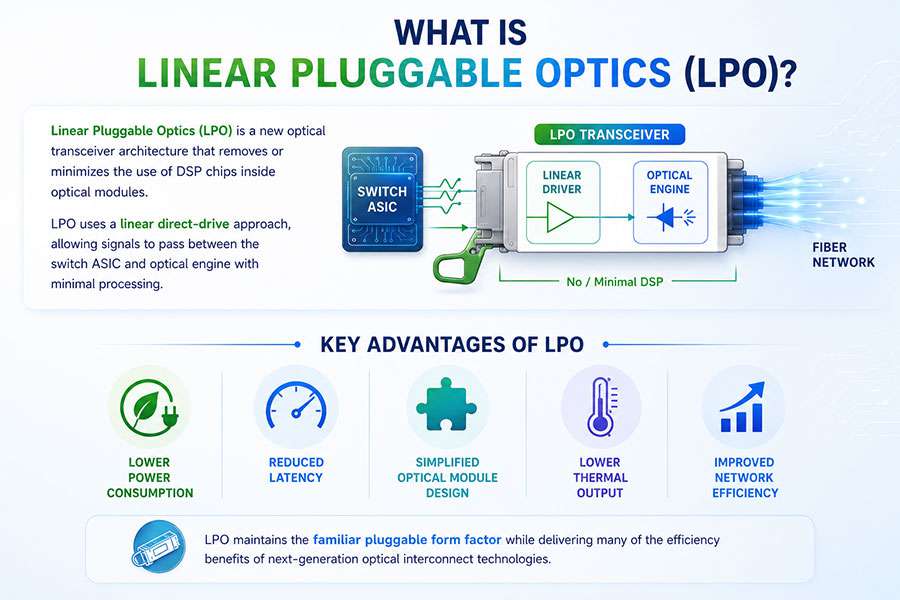
Linear Pluggable Optics (LPO) is a new optical transceiver architecture that removes or minimizes the use of DSP chips inside optical modules.
Instead of relying on complex digital signal processing within the transceiver, LPO modules use a linear direct-drive approach, allowing signals to pass between the switch ASIC and optical engine with minimal processing.
This architecture offers several advantages:
Lower power consumption
Reduced latency
Simplified optical module design
Lower thermal output
Improved network efficiency
LPO maintains the familiar pluggable form factor while delivering many of the efficiency benefits associated with next-generation optical interconnect technologies.
Why Is LPO Gaining Attention?
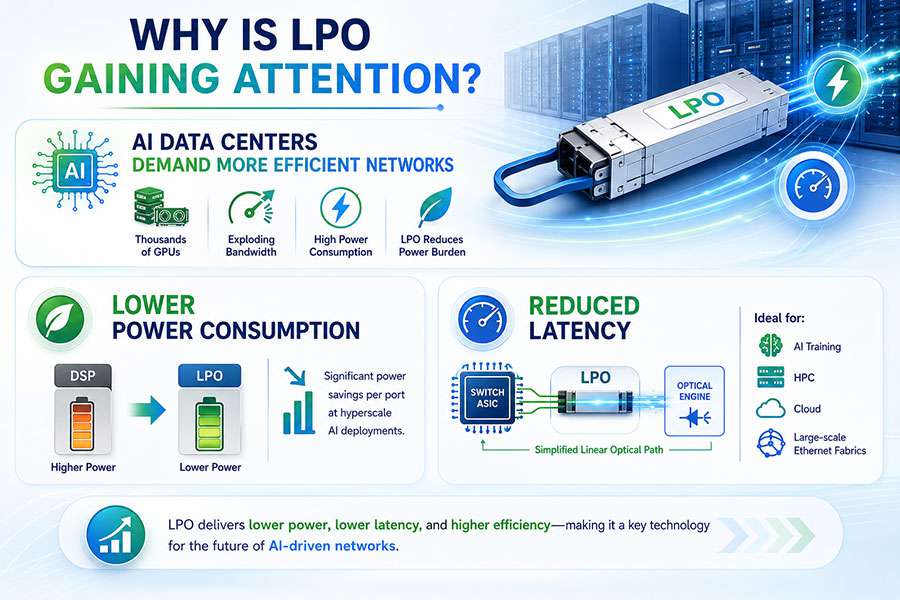
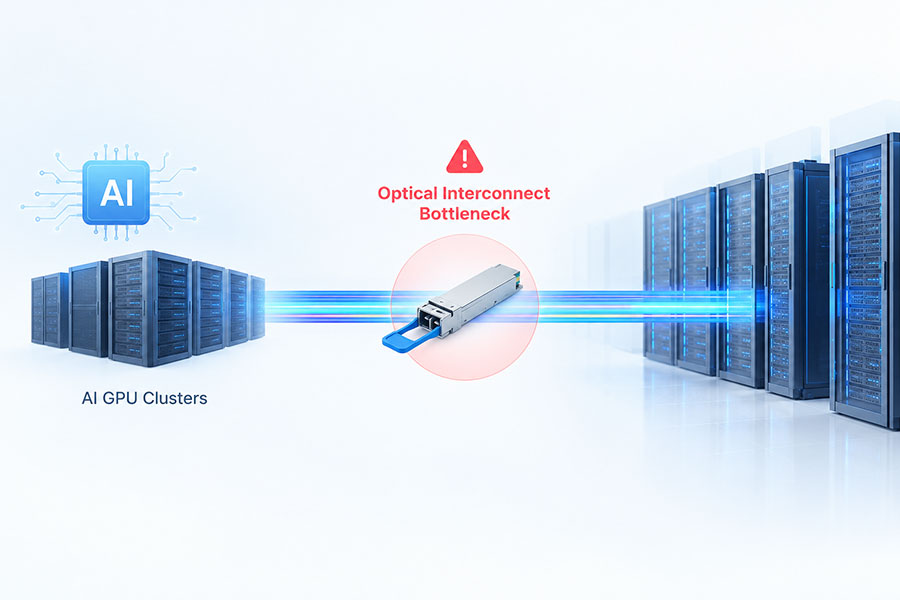
AI Data Centers Demand More Efficient Networks
Modern AI clusters may contain thousands of GPUs interconnected through ultra-high-speed networks.
As bandwidth requirements continue to grow, the power consumed by networking equipment becomes a significant operational concern.
In some large-scale AI deployments, networking infrastructure can account for a substantial percentage of total data center energy consumption.
LPO helps reduce this burden by eliminating power-hungry DSP components.
Lower Power Consumption
One of the primary motivations behind LPO development is energy efficiency.
Compared with conventional DSP-based optical modules, LPO solutions can significantly reduce power consumption per optical port.
For hyperscale AI operators, even small improvements in power efficiency can translate into substantial cost savings across thousands of network connections.
Reduced Latency
Because signals travel through a simplified linear optical path, LPO modules introduce less processing delay.
This can improve communication performance in latency-sensitive applications such as:
Distributed AI training
High-performance computing (HPC)
Cloud infrastructure
Large-scale Ethernet fabrics
How LPO Differs from Traditional Optical Modules
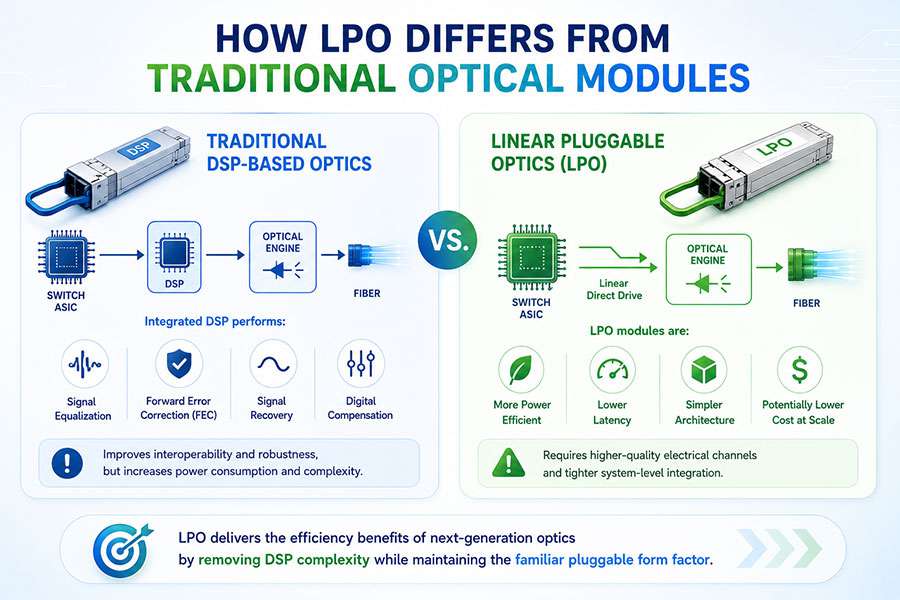
Traditional DSP-Based Optics
Conventional optical modules include integrated DSP chips that perform:
Signal equalization
Forward Error Correction (FEC)
Signal recovery
Digital compensation
While these features improve interoperability and transmission robustness, they increase power consumption and complexity.
Linear Pluggable Optics
LPO removes much of the internal signal processing and relies on the host switch or system ASIC to manage signal quality.
As a result, LPO modules are:
More power efficient
Lower latency
Simpler in architecture
Potentially lower cost at scale
However, LPO requires higher-quality electrical channels and tighter system-level integration.
LPO vs CPO: Complementary Technologies
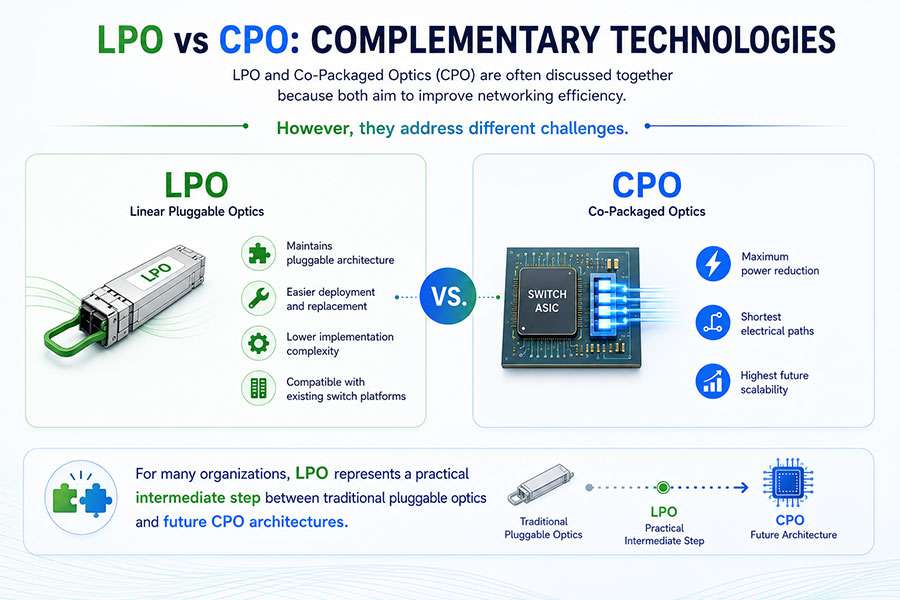
LPO and Co-Packaged Optics (CPO) are often discussed together because both aim to improve networking efficiency.
However, they address different challenges.
LPO Advantages
Maintains pluggable architecture
Easier deployment and replacement
Lower implementation complexity
Compatible with existing switch platforms
CPO Advantages
Maximum power reduction
Shortest electrical paths
Highest future scalability
For many organizations, LPO represents a practical intermediate step between traditional pluggable optics and future CPO architectures.
Applications of LPO Technology
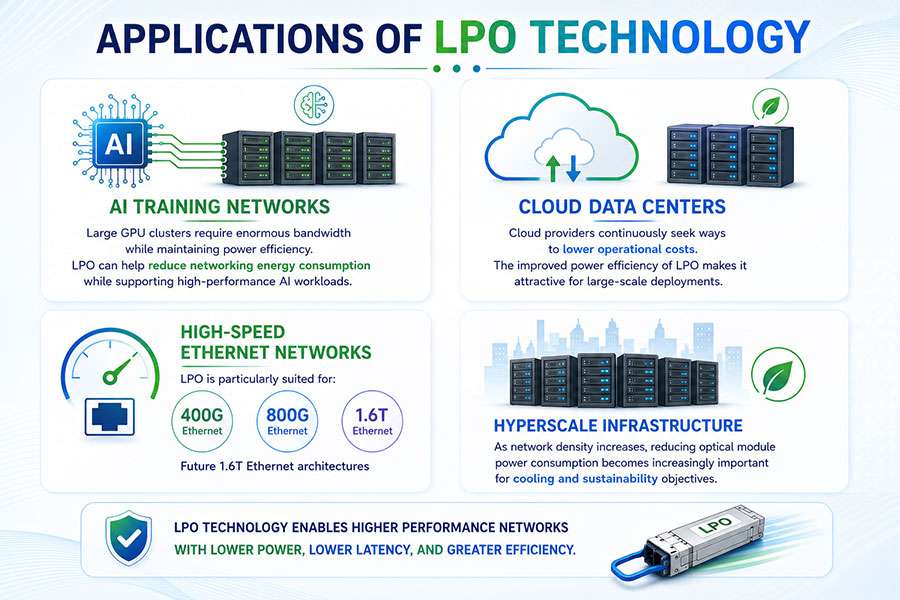
AI Training Networks
Large GPU clusters require enormous bandwidth while maintaining power efficiency.
LPO can help reduce networking energy consumption while supporting high-performance AI workloads.
Cloud Data Centers
Cloud providers continuously seek ways to lower operational costs.
The improved power efficiency of LPO makes it attractive for large-scale deployments.
High-Speed Ethernet Networks
LPO is particularly suited for:
400G Ethernet
800G Ethernet
Future 1.6T Ethernet architectures
Hyperscale Infrastructure
As network density increases, reducing optical module power consumption becomes increasingly important for cooling and sustainability objectives.
C-LIGHT High-Speed Optical Solutions
While LPO technology continues to mature, current AI and cloud data center deployments rely heavily on advanced pluggable optical solutions.
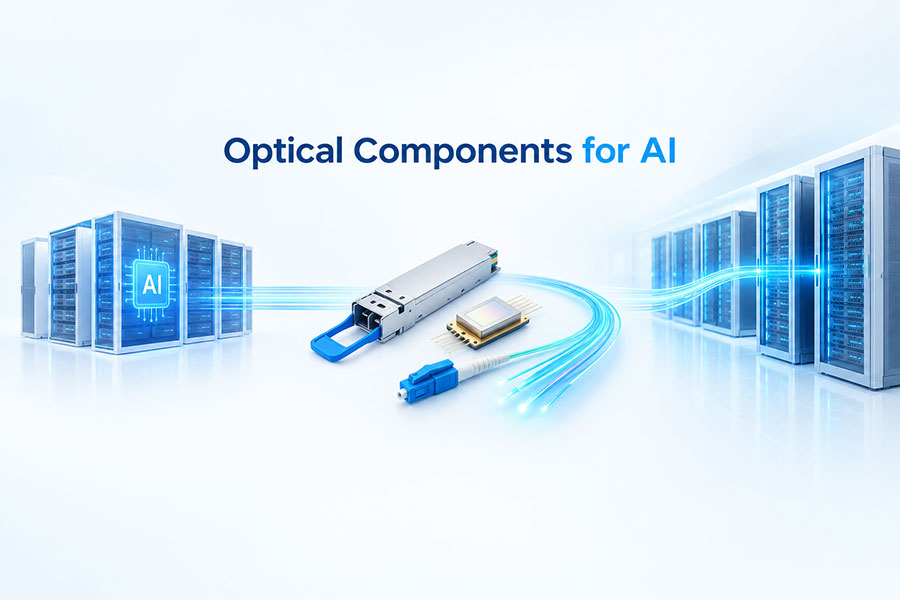
C-LIGHT provides a comprehensive portfolio of high-performance optical products, including:
400G Optical Transceivers
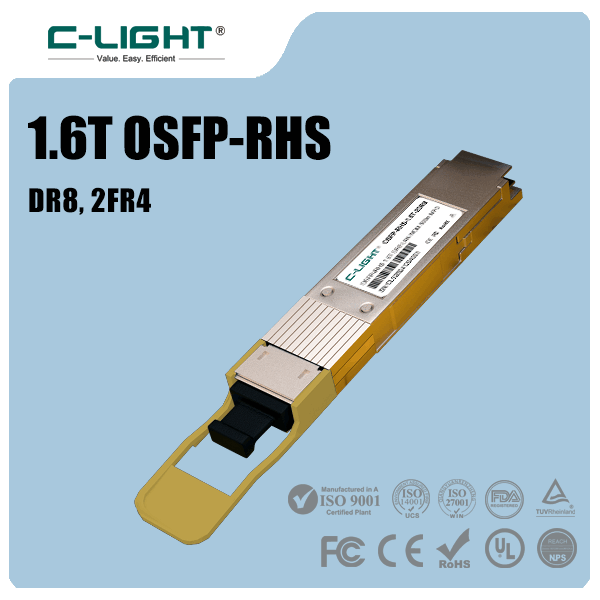
800G Optical Transceivers
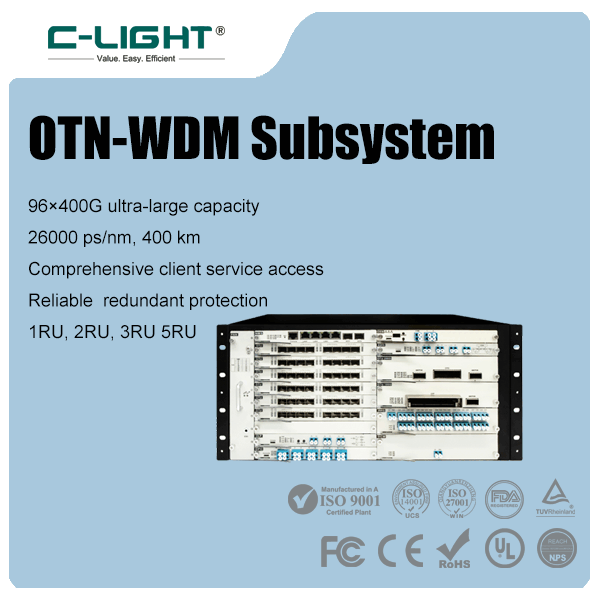
High-Density Connectivity Solutions
To support AI networking infrastructure, C-LIGHT also offers:
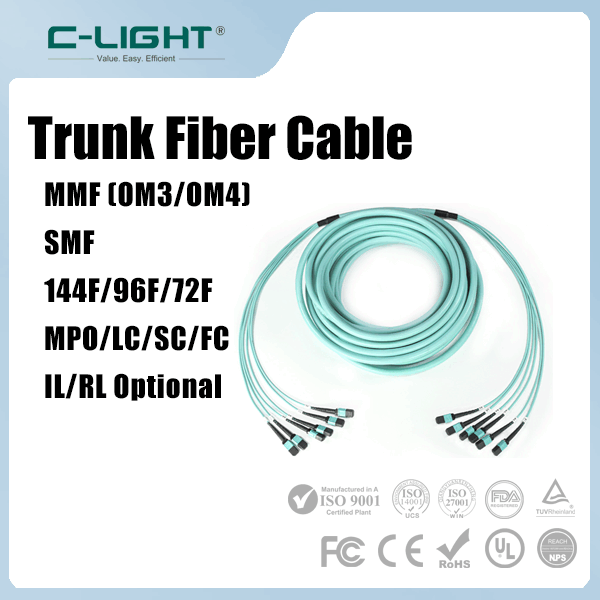
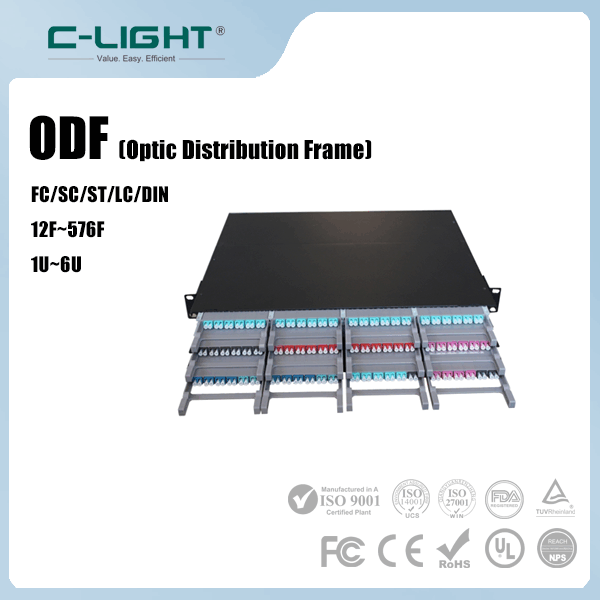
Data center fiber management solutions
These products help customers build scalable, efficient, and future-ready network architectures.
Future Outlook
As AI workloads continue to scale, reducing networking power consumption will become increasingly important.
Industry analysts expect LPO adoption to accelerate alongside the deployment of 800G and future 1.6T networks.
Although traditional DSP-based optics will remain dominant for many years, LPO is emerging as a compelling option for organizations seeking higher efficiency and lower operational costs.
Conclusion
Linear Pluggable Optics (LPO) represents an important evolution in optical networking technology.
By reducing dependence on DSP chips, LPO delivers lower power consumption, reduced latency, and improved efficiency while maintaining the flexibility of pluggable optics.
As AI data centers continue to expand, LPO is expected to play a critical role in enabling the next generation of high-speed, energy-efficient network infrastructures.
Linear Pluggable Optics (LPO) FAQ
Lower power consumption
Reduced transmission latency
Simplified optical module design
Lower thermal output
Improved network efficiency
Lower networking power consumption
Better thermal management
Higher rack density
More efficient AI cluster operation
Signal equalization
Signal recovery
Digital compensation
Forward Error Correction (FEC)
Module power usage
Heat generation
System complexity
| Feature | Traditional DSP Optical Module | LPO Optical Module |
| Signal Processing | Internal DSP | Linear direct-drive |
| Power Consumption | Higher | Lower |
| Latency | Higher | Lower |
| Module Complexity | More complex | Simplified |
| Thermal Output | Higher | Lower |
Answer: LPO optical transceivers provide several advantages for modern data center networks:
1. Lower Power Consumption
Removing DSP processing reduces optical module energy requirements.
2. Lower Latency
A simplified signal path reduces processing delays.
3. Better Thermal Efficiency
Lower power consumption helps reduce cooling pressure.
4. Higher Network Efficiency
More power-efficient optical connections allow larger-scale deployments.
These advantages make LPO especially suitable for AI clusters, cloud data centers, and high-performance computing environments.
Answer: LPO technology is mainly designed for high-speed data center networking applications.
Typical applications include:
AI training clusters
GPU server networks
400G Ethernet
800G Ethernet
Hyperscale cloud data centers
High-performance computing (HPC)
Answer: Although LPO offers significant advantages, it also introduces new system design requirements.
Key challenges include:
Higher requirements for signal integrity
More precise electrical channel design
Host device compatibility
Network system optimization
Because LPO removes some internal signal processing functions, the entire system must be carefully designed to maintain reliable transmission performance.
Therefore, LPO adoption requires cooperation between optical modules, switches, and system platforms.
400G optical deployment
800G Ethernet expansion
1.6T optical interconnect development
More energy-efficient AI infrastructure
LPO provides a practical evolution path between traditional pluggable optics and future technologies such as CPO (Co-Packaged Optics).
By balancing low power consumption, low latency, and deployment flexibility, LPO may play an important role in next-generation AI data center architectures.
 >
>

 >
>
 >
>
 >
>
 >
>
 >
>
 >
>
 >
>