TEL:+86 132 6656 7067


Large-scale AI training clusters depend on continuous, high-bandwidth communication between GPUs, switches, accelerators, and storage systems. As the number of GPUs increases, the network must move enormous volumes of distributed training traffic while maintaining low latency, predictable performance, and high availability.
Optical interconnects provide the bandwidth density and reach required for these environments. From short-reach rack connections to longer switch-to-switch and data center interconnects, optical transceivers, AOCs, DACs, AECs, and emerging silicon photonics technologies form an important part of the physical layer of modern AI fabrics.
1. Why Optical Interconnects Matter in AI Training Clusters
AI training workloads generate highly synchronized communication patterns. GPUs frequently exchange gradients, parameters, activations, and other intermediate data during collective operations. When network links become congested, accelerator utilization can decrease even when the GPUs themselves have substantial compute capacity.
Optical interconnects address several physical limitations of large copper-based deployments, particularly at higher bandwidths and longer distances. Fiber provides lower transmission loss, electromagnetic immunity, and a practical path toward high port density as link speeds move from 400G to 800G and 1.6T.
For large AI clusters, the network is therefore not simply a connectivity layer. It is part of the system architecture that determines how efficiently distributed compute resources can operate together.
2. How AI Training Traffic Moves Through the Network
A large AI training cluster can contain several communication layers. GPU-to-GPU traffic may stay within a server or rack, while other traffic must traverse multiple network switches before reaching another group of GPUs.
| Traffic Scope | Typical Purpose | Interconnect Focus |
|---|---|---|
| Scale-Up | GPU/XPU communication within a tightly coupled system | Very high bandwidth, extremely low latency, short reach |
| Scale-Out | Communication between servers and GPU nodes | High-radix switching, RDMA, optical and copper links |
| Scale-Across | Communication between separate facilities or large AI sites | Longer-reach optics, DWDM, coherent optics, engineered DCI links |
The physical interconnect selected for each layer should therefore reflect the required distance, bandwidth, topology, power budget, and serviceability requirements.
3. Scale-Up, Scale-Out, and Scale-Across Optical Connectivity
Scale-up communication is generally associated with highly localized accelerator fabrics. Electrical links, high-speed copper, active copper, or specialized optical connections may be used depending on the system architecture.
Scale-out networks connect many independent servers or accelerator nodes through switches. This is where 400G and 800G optical interconnects become particularly important, especially when links extend between racks or across larger sections of an AI data hall.
Scale-across extends the concept beyond a single data hall or facility. Longer optical links, WDM systems, and coherent technologies can connect separate AI computing sites when the training architecture requires distributed resources.
4. The Move from 400G to 800G and 1.6T
AI cluster bandwidth requirements are pushing optical connectivity toward increasingly higher port rates. 400G remains important in existing AI and high-performance data center deployments, while 800G is becoming a major interface speed for newer high-density fabrics. 1.6T optical connectivity is emerging as the next step for systems built around 200G-per-lane electrical interfaces.
| Interface Speed | Typical Signaling Direction | Representative Applications |
|---|---|---|
| 400G | 100G-class PAM4 lanes | Server-to-switch, switch-to-switch, AI scale-out |
| 800G | 200G-class PAM4 lanes or equivalent architectures | High-density AI fabrics, switch interconnects, DCI |
| 1.6T | 200G-class or emerging 400G-class lane architectures | Next-generation AI clusters and high-bandwidth Ethernet/InfiniBand fabrics |
The transition to higher rates does not simply double or quadruple optical bandwidth. It also increases requirements for signal integrity, thermal management, optical power efficiency, connector density, DSP performance, and manufacturing consistency.
5. 800G Optical Interconnects in AI Clusters
800G has become an important optical interface class for large AI networking systems. It can be implemented in different form factors and optical architectures depending on the switch, NIC, fiber type, and required reach.
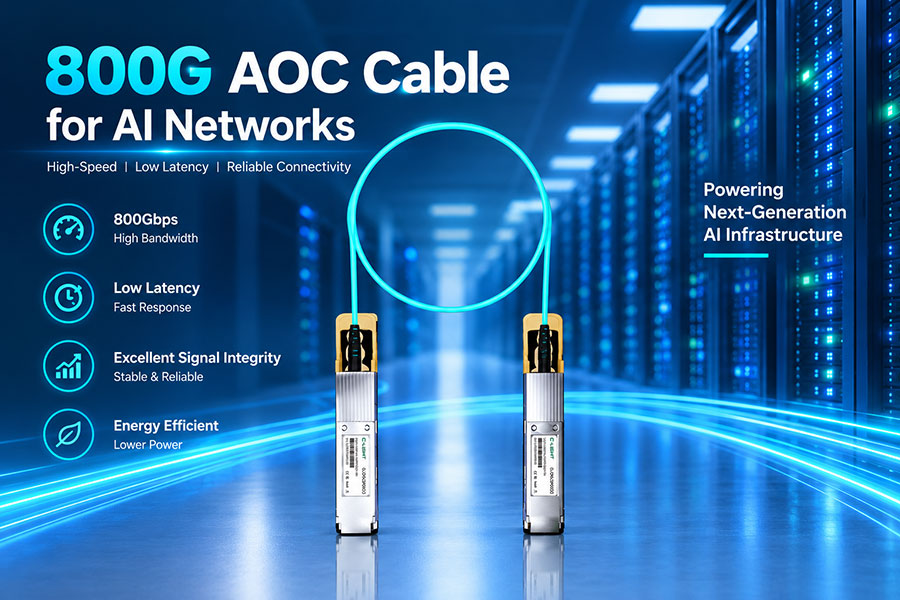
For short and medium data center connections, 800G parallel optical designs such as DR-type architectures can connect high-speed switch and server interfaces over single-mode fiber. Other designs can use multimode fiber for selected short-reach environments.
800G optics are also being extended into longer-reach applications. Coherent 800G technologies can provide significantly longer transmission distances than typical intra-data-center direct-detect links, making them relevant to data center interconnect and distributed AI infrastructure.
6. 1.6T Optical Interconnects for Next-Generation AI Fabrics
1.6T optical connectivity is closely associated with 200G-per-lane electrical interfaces and the increasing bandwidth of next-generation switch ASICs and AI accelerators.
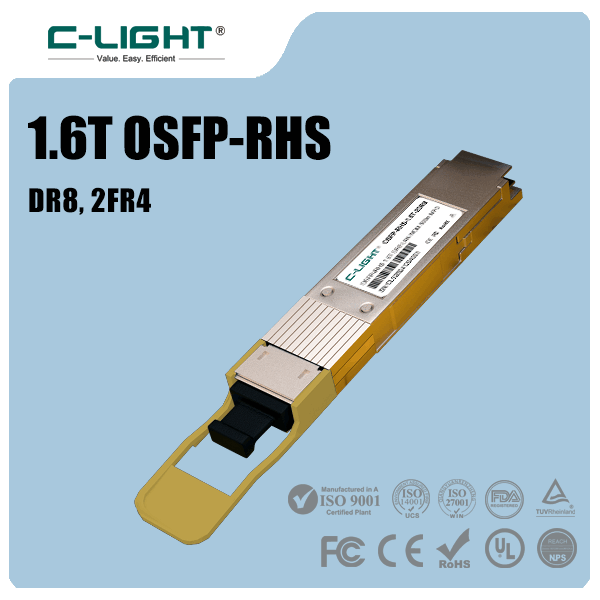
Pluggable 1.6T modules can use multiple PAM4 optical lanes, while new packaging approaches are being developed to reduce the electrical distance between the switch silicon and optical engine.
Short-reach 1.6T designs are particularly important because AI clusters can contain extremely large numbers of high-speed links. Even a small reduction in power per port can become significant when multiplied across thousands of switch and NIC ports.
7. Choosing Fiber Reach for AI Cluster Links
Optical reach should be selected according to the physical topology rather than simply choosing the module with the longest advertised distance.
| Reach Category | Typical Environment | Common Interconnect Options |
|---|---|---|
| Very Short Reach | Within rack or adjacent equipment | DAC, AEC, AOC, short-reach optics |
| Short Reach | Rack-to-rack and data hall connections | SR/DR-class optics, AOC, AEC |
| Medium Reach | Data hall and campus-scale connectivity | FR/LR-class optics and engineered links |
| Long Reach | Metro and DCI environments | Coherent optics, DWDM, long-reach optical transceivers |
Fiber attenuation, connector loss, patch panels, temperature, optical budget, dispersion, and FEC behavior all need to be considered when determining whether a particular link design is appropriate.
8. DAC, AEC, AOC, and Optical Transceivers
Large AI training clusters commonly require several types of physical interconnects rather than a single cable technology.
| Technology | Transmission Medium | Typical Advantage | Typical Use |
|---|---|---|---|
| DAC | Copper | Low power and simple architecture | Very short rack and top-of-rack links |
| AEC | Active copper | Extends copper reach with signal conditioning | Short AI fabric connections |
| AOC | Optical fiber with integrated modules | Pre-terminated optical connection | Short and medium data center links |
| Optical Transceiver | Fiber with pluggable optics | Flexible reach and serviceability | Server-to-switch and switch-to-switch links |
DAC and AEC can be attractive for very short connections where copper provides sufficient reach. Optical modules become increasingly useful as distance, bandwidth, density, and cabling flexibility requirements increase.
9. Single-Mode and Multimode Fiber in AI Infrastructure
Multimode fiber remains relevant for selected short-reach applications because of its established ecosystem and suitability for short optical paths. Single-mode fiber provides greater reach and a broader path toward higher-speed and longer-distance optical architectures.
At 800G and 1.6T, the choice between multimode and single-mode fiber depends on module architecture, transmission distance, optical budget, connector design, and overall data center cabling strategy.
For large clusters expected to evolve over several technology generations, fiber infrastructure planning should consider future bandwidth upgrades rather than optimizing only for the initial port speed.
10. PAM4 Enables Higher Optical Bandwidth
High-speed AI optical interconnects increasingly use PAM4 signaling. NRZ provides two signal levels and carries one bit per symbol, while PAM4 uses four signal levels and can carry two bits per symbol.
This allows a higher bit rate to be transmitted without simply doubling the symbol rate. The tradeoff is increased sensitivity to noise, insertion loss, linearity, crosstalk, and eye closure.
As AI networking moves from 100G-class lanes toward 200G and eventually higher lane rates, PAM4 and advanced equalization become increasingly important parts of the optical link architecture.
11. DSP and FEC in High-Speed AI Optical Links
DSP technology is used to compensate for electrical and optical impairments in high-speed PAM4 links. Depending on the module architecture, a DSP can perform functions such as equalization, clock recovery, signal conditioning, monitoring, and gearbox or retiming operations.
FEC provides additional tolerance against transmission errors by adding redundant information that allows certain errors to be detected and corrected.
These technologies become particularly important as lane rates increase, because maintaining acceptable bit-error performance becomes more difficult as electrical and optical margins shrink.
12. Silicon Photonics and Optical Engines
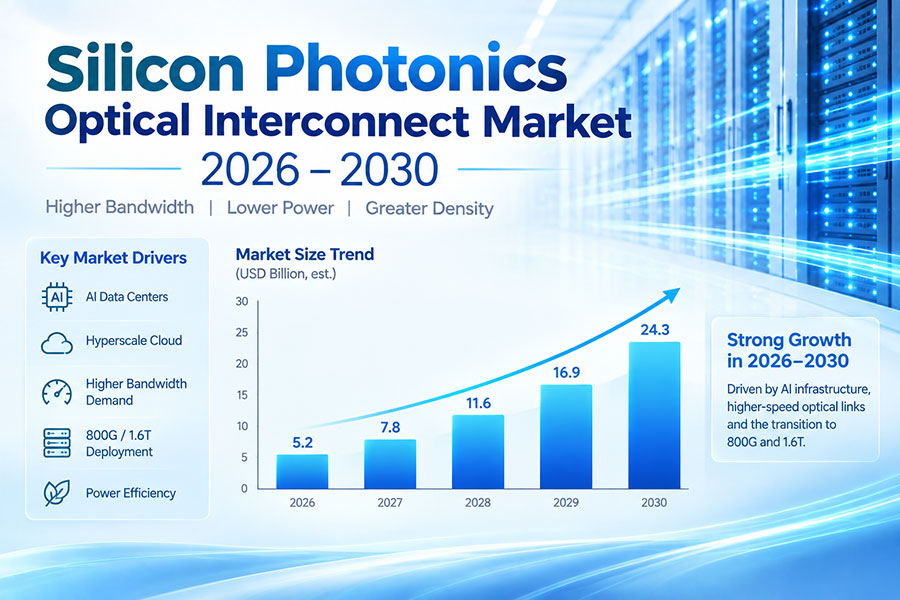
Silicon photonics integrates optical functions such as waveguides, modulators, and photodetection onto silicon-based photonic integrated circuits. It provides a path toward dense optical integration as the number of high-speed interfaces in AI systems continues to rise.
Optical engines can place the optical conversion functions closer to the switch ASIC or accelerator package. Reducing the electrical distance between high-speed SerDes and optical components can help address power and signal-integrity constraints.
Silicon photonics is therefore relevant not only to pluggable transceivers but also to the next generation of AI switching architectures.
13. Pluggable Optics vs CPO for Large AI Clusters
| Factor | Pluggable Optics | Co-Packaged Optics |
|---|---|---|
| Serviceability | Individual modules can be replaced | Optical engines are integrated with the switch |
| Electrical Reach | Longer electrical path between ASIC and module | Very short electrical path |
| Power Scaling | Module power increases with bandwidth | Designed to reduce the electrical and optical power burden at high density |
| Deployment Model | Flexible and modular | Highly integrated |
| Best Fit | Broad range of current data center links | Very high-density next-generation switch systems |
Pluggable optics remain important because they provide flexibility, interoperability, and serviceability. CPO becomes increasingly relevant when the electrical and power constraints of very high-radix switches make traditional front-panel pluggables more difficult to scale.
14. InfiniBand and Ethernet Optical Fabrics
Large AI training clusters can be built around different networking architectures, including InfiniBand and Ethernet-based fabrics.
InfiniBand is designed as a high-performance switched fabric with native RDMA capabilities and mechanisms intended for predictable communication in tightly coupled computing environments. Ethernet-based AI fabrics can use technologies such as RoCE to provide RDMA over Ethernet, together with congestion-management mechanisms designed for high-performance distributed workloads.
At the physical layer, both architectures can use high-speed optical transceivers and fiber interconnects. The module therefore needs to match not only the optical parameters but also the protocol, form factor, lane rate, connector, and host interface requirements of the platform.
15. Optical Power and Thermal Management
Power consumption becomes a major design factor when an AI factory contains thousands or tens of thousands of high-speed optical ports.
A few watts of difference at the transceiver level can translate into substantial aggregate power and cooling requirements at cluster scale. Thermal density is particularly important for high-speed 800G and 1.6T modules, where DSPs, laser drivers, photonic components, and module electronics operate within a compact mechanical package.
For this reason, optical module selection should consider total power consumption, thermal design, airflow or liquid-cooling conditions, and switch port density rather than bandwidth alone.
16. Cabling Density and Fiber Management
AI clusters can generate extremely high cable counts because each GPU server may require multiple high-speed network connections. Connector density and cable routing therefore become practical engineering constraints.
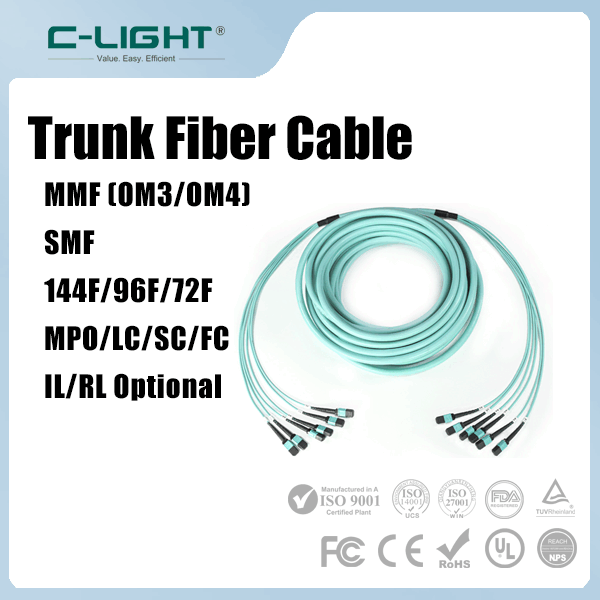
MPO/MTP® and other high-density fiber systems can simplify multi-fiber connections in parallel-optics deployments. Breakout architectures can also connect one high-speed switch port to multiple lower-rate interfaces when required by the network topology.
Good fiber management should minimize bend stress, maintain polarity and lane mapping, provide accessible patching, and leave enough physical capacity for future upgrades.
17. Reliability and Interconnect Validation
Large AI clusters amplify small reliability problems. A single unstable optical link can affect a network path, while repeated link faults can disrupt distributed training jobs across many GPUs.
Validation should therefore cover optical power, receiver sensitivity, BER, FEC behavior, temperature performance, connector quality, host interoperability, and link stability.
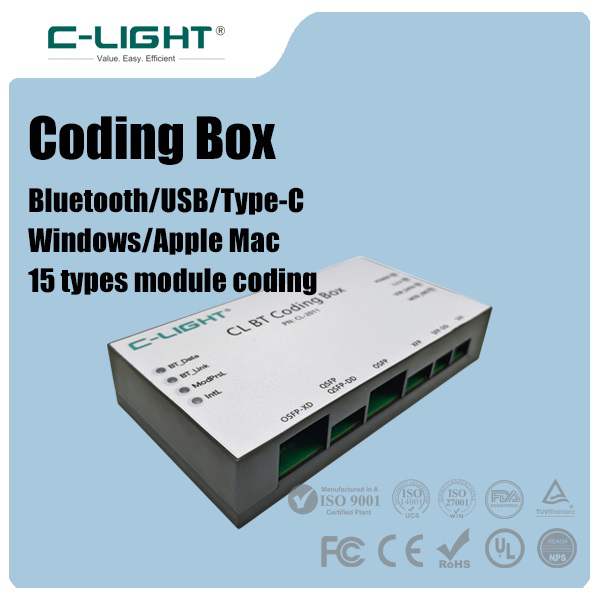
For multi-vendor environments, compatibility testing is especially important because the optical module must operate correctly with the specific switch ASIC, NIC, firmware, coding, and host electrical interface used in the deployment.
18. How to Select Optical Interconnects for an AI Cluster
A practical selection process starts with the physical topology and then works backward toward the required optical specification.
| Selection Item | Key Question |
|---|---|
| Bandwidth | Is the interface 400G, 800G, 1.6T, or another rate? |
| Distance | What is the actual fiber path, including patching? |
| Fiber Type | Is the infrastructure based on SMF or MMF? |
| Protocol | Does the link use InfiniBand, Ethernet, or another interface? |
| Form Factor | Is the platform designed for QSFP-DD, OSFP, QSFP112, or another package? |
| Power | Can the switch and cooling system support the module power level? |
| Architecture | Should the deployment use DAC, AEC, AOC, pluggable optics, or CPO? |
| Compatibility | Has the optical solution been validated with the actual switch and NIC platform? |
| Future Upgrade | Can the installed fiber and cabling support the next bandwidth generation? |
C-LIGHT's AI-oriented interconnect portfolio can be considered across these different requirements, including 400G and 800G optical transceivers, 1.6T optical connectivity, DAC and AEC solutions, and high-speed InfiniBand and Ethernet interconnects. The appropriate product should be selected according to the actual host platform, reach, fiber infrastructure, and network topology.
19. The Road Ahead for AI Optical Interconnects
AI networking is moving toward higher lane speeds, higher port density, and deeper optical integration. 800G is becoming an important high-speed interface class, while 1.6T architectures are being developed around 200G-per-lane and emerging 400G-per-lane technologies.
At the same time, silicon photonics, optical engines, CPO, advanced DSPs, and higher-efficiency lasers are becoming increasingly important for managing power and signal-integrity constraints.
The next stage of AI cluster networking will therefore involve more than simply increasing the data rate of a pluggable module. Optical technology will increasingly be integrated into the overall architecture of the switch, accelerator, rack, and data center.
 >
>

 >
>
 >
>
 >
>
 >
>
 >
>
 >
>
 >
>