TEL:+86 132 6656 7067


1、AI Foundation Models Are Driving the Rapid Expansion of Hyperscale GPU Clusters
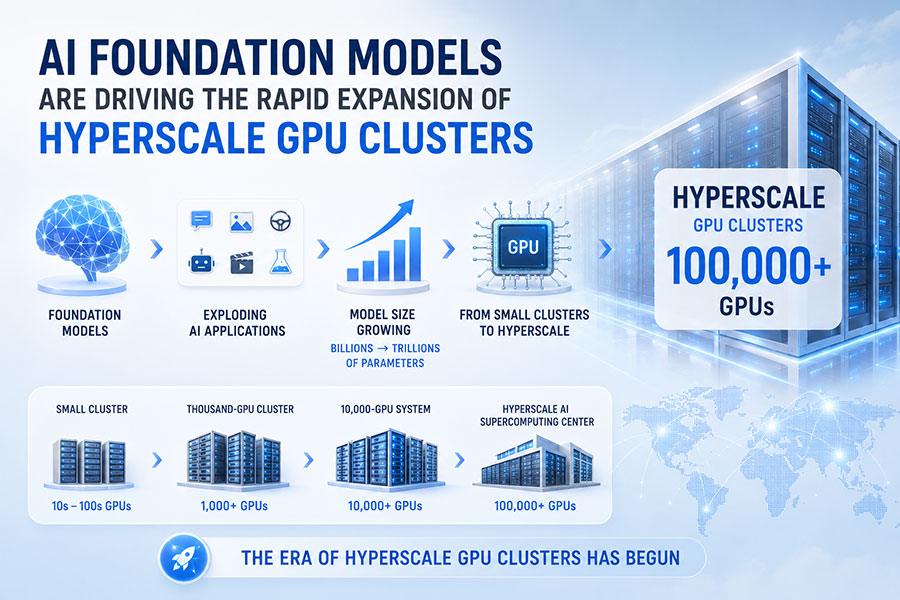
The explosive growth of generative AI, large language models (LLMs), autonomous driving, AI inference, and high-performance computing (HPC) is fueling an unprecedented expansion of global AI infrastructure.
As GPT-based models, multimodal AI, AI agents, video generation models, and AI-powered scientific computing continue to evolve, model sizes have grown from tens of billions to hundreds of billions—and are now approaching trillions of parameters. Traditional small-scale GPU clusters are no longer sufficient to support these increasingly demanding AI training workloads.
To meet these requirements, leading technology companies are rapidly deploying AI infrastructure ranging from thousand-GPU clusters to 10,000-GPU systems and even hyperscale AI supercomputing centers with over 100,000 GPUs. As a result, AI data centers have officially entered the era of hyperscale GPU clusters.
2、Why Are Hyperscale GPU Clusters Growing So Rapidly?
AI Models Continue to Scale
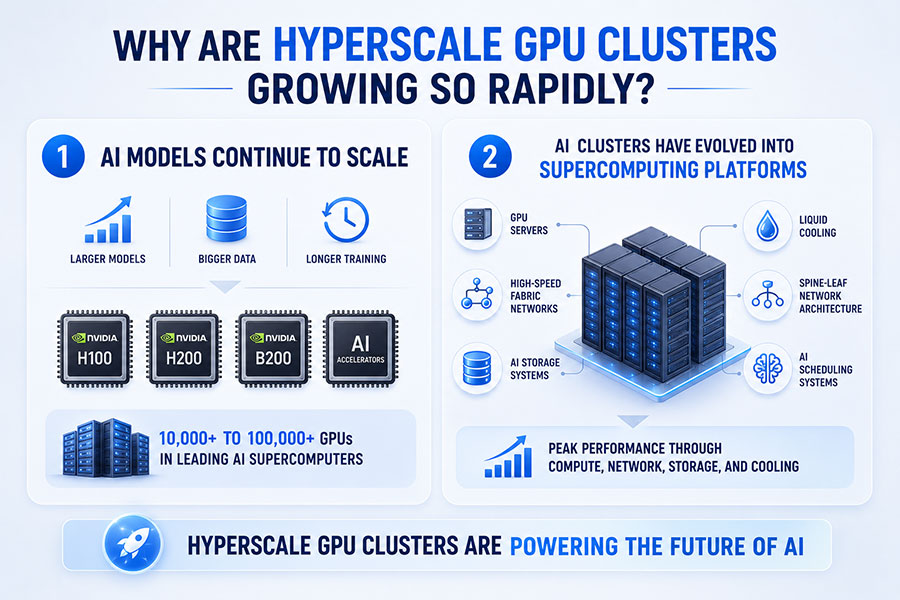
The performance of AI models is closely linked to training scale. Larger parameter counts, bigger datasets, and longer training cycles generally produce more capable AI systems.
To keep pace, AI companies are continuously expanding GPU resources for distributed training. Today's leading AI clusters widely deploy NVIDIA H100, NVIDIA H200, NVIDIA B200, and various AI accelerators to support large-scale parallel computing.
Some of the world's most advanced AI supercomputing platforms now operate clusters containing more than 10,000, 30,000, or even 100,000 GPUs.
3、AI Clusters Have Evolved into Supercomputing Platforms
Modern AI clusters are no longer simply collections of GPU servers.
Instead, they have evolved into highly integrated supercomputing platforms composed of:
GPU Servers
High-Speed Fabric Networks
AI Storage Systems
Liquid Cooling Infrastructure
Spine-Leaf Network Architecture
AI Scheduling Systems
Overall AI training performance depends on the combined efficiency of GPU computing power, network interconnects, storage throughput, and thermal management.
4、Key Challenges of Hyperscale GPU Clusters
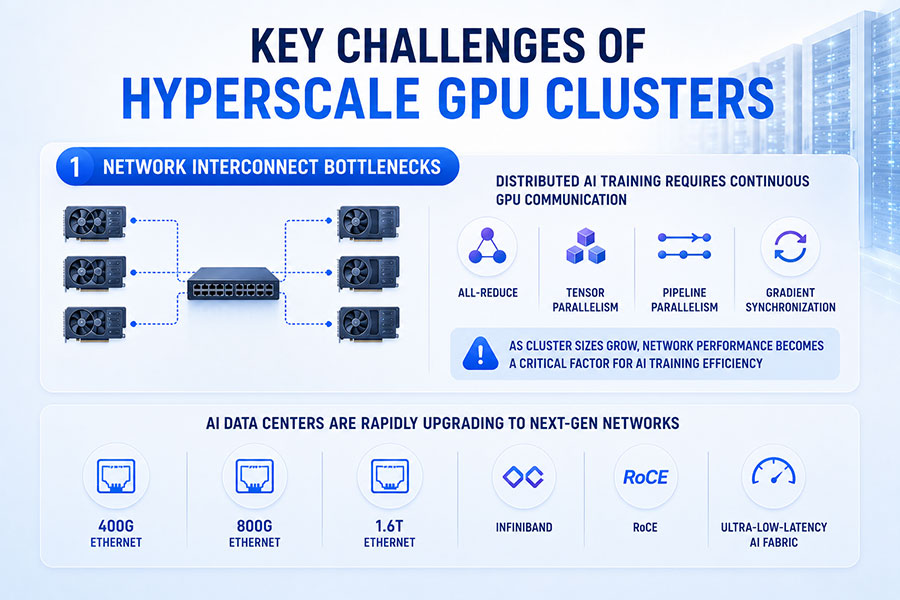
Network Interconnect Bottlenecks
During distributed AI training, thousands of GPUs continuously exchange model parameters through operations such as:
All-Reduce
Tensor Parallelism
Pipeline Parallelism
Gradient Synchronization
As cluster sizes increase, network performance becomes one of the most critical factors affecting AI training efficiency.
To eliminate communication bottlenecks, AI data centers are rapidly upgrading to:
400G Ethernet
800G Ethernet
1.6T Ethernet
InfiniBand
RoCE
Ultra-low-latency AI Fabric architectures
5、Demand for High-Speed Optical Transceivers Continues to Grow
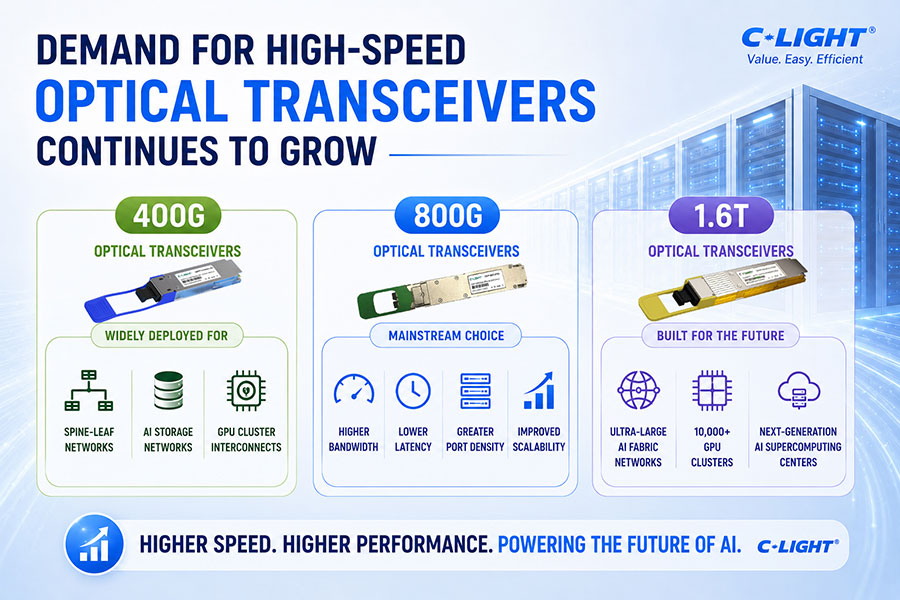
As GPU clusters become larger, demand for high-speed optical interconnects is increasing rapidly.
400G Optical Transceivers
Widely deployed for:
Spine-Leaf Networks
AI Storage Networks
GPU Cluster Interconnects
800G Optical Transceivers
800G has become the mainstream choice for next-generation AI data centers by providing:
Higher bandwidth
Lower latency
Greater port density
Improved scalability
1.6T Optical Transceivers
1.6T optical modules represent the next major step in AI networking and are designed for:
Ultra-large AI Fabric networks
10,000+ GPU clusters
Next-generation AI supercomputing centers
6、AI Fabric Is Becoming the Core of Modern AI Data Centers
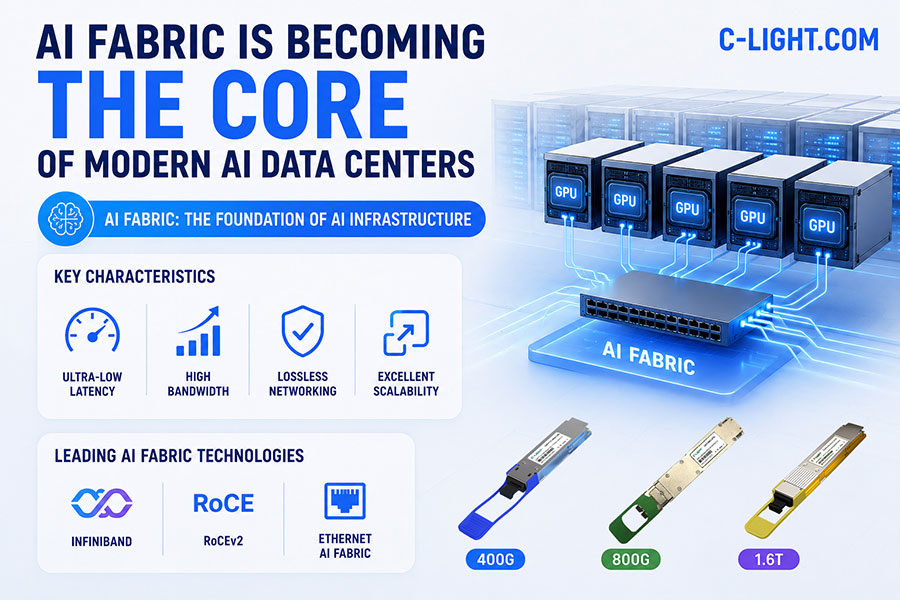
Traditional data centers primarily focused on compute and storage resources.
In contrast, AI data centers place much greater emphasis on GPU-to-GPU communication.
As a result, AI Fabric has become a fundamental component of AI infrastructure.
Key characteristics include:
Ultra-low latency
High bandwidth
Lossless networking
Excellent scalability
Today's leading AI Fabric technologies include:
InfiniBand
RoCEv2
Ethernet AI Fabric
7、Liquid Cooling Becomes Standard for Hyperscale GPU Clusters
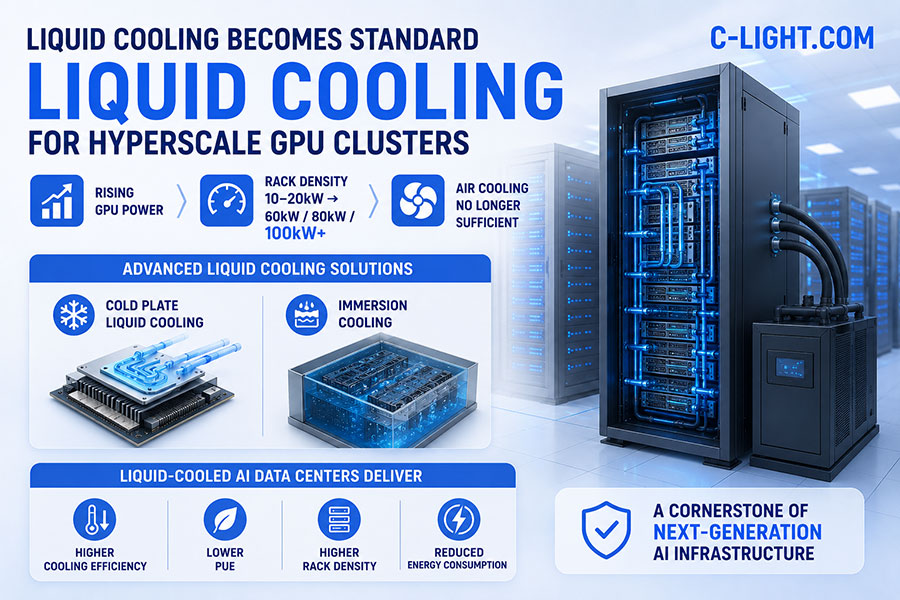
GPU power consumption continues to rise rapidly.
Rack power density has increased from approximately 10–20 kW to 60 kW, 80 kW, and even more than 100 kW per rack.
Traditional air cooling can no longer efficiently dissipate heat in ultra-dense AI environments.
Consequently, advanced liquid cooling technologies—including Cold Plate Liquid Cooling and Immersion Cooling—are being widely adopted.
Liquid-cooled AI data centers provide several important advantages:
Higher cooling efficiency
Lower Power Usage Effectiveness (PUE)
Higher rack density
Reduced energy consumption
Liquid cooling is becoming a cornerstone of next-generation AI infrastructure.
8、Hyperscale GPU Clusters Are Reshaping Data Center Architecture
Compared with traditional cloud data centers, AI data centers have undergone significant architectural changes.
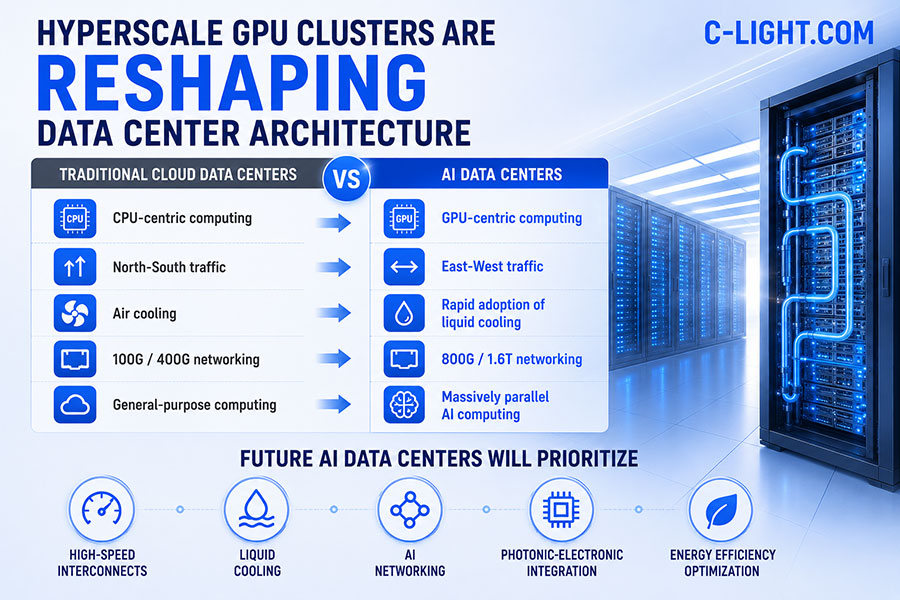
Future AI data centers will increasingly prioritize:
High-speed interconnects
Liquid cooling
AI networking
Photonic-electronic integration
Energy efficiency optimization
9、Global Investment in AI Infrastructure Continues to Rise
Major technology companies—including NVIDIA, Microsoft, Google, Meta, Amazon, and OpenAI—continue to invest aggressively in AI infrastructure.
A new wave of hyperscale AI data center construction is underway worldwide, with particularly strong growth in North America, China, the Middle East, and Southeast Asia.
10、C-LIGHT's High-Speed Interconnect Solutions for AI GPU Clusters
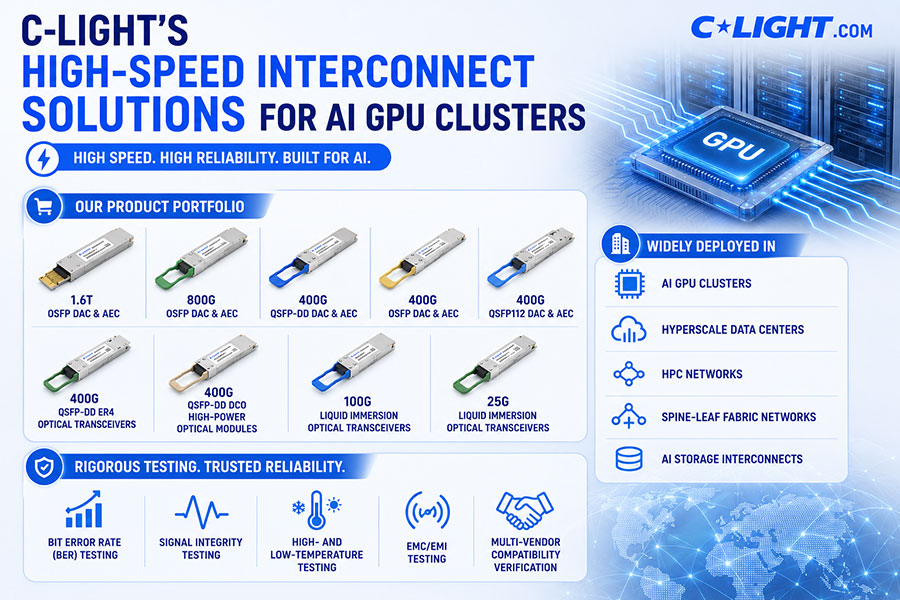
As a professional provider of high-speed optical communication solutions, C-LIGHT continues to expand its portfolio for AI data center networking.
Current product offerings include:
1.6T OSFP DAC & AEC
400G QSFP-DD DAC & AEC
400G OSFP DAC & AEC
400G QSFP112 DAC & AEC
400G QSFP-DD ER4 Optical Transceivers
400G QSFP-DD DCO High-Power Optical Modules
These products are widely deployed in:
AI GPU Clusters
Hyperscale Data Centers
HPC Networks
Spine-Leaf Fabric Networks
AI Storage Interconnects
To ensure long-term reliability in hyperscale AI environments, C-LIGHT performs comprehensive validation, including:
Bit Error Rate (BER) Testing
Signal Integrity Testing
High- and Low-Temperature Testing
EMC/EMI Testing
Multi-Vendor Compatibility Verification
11、Future Outlook: AI Data Centers Move Toward the 100,000-GPU Era
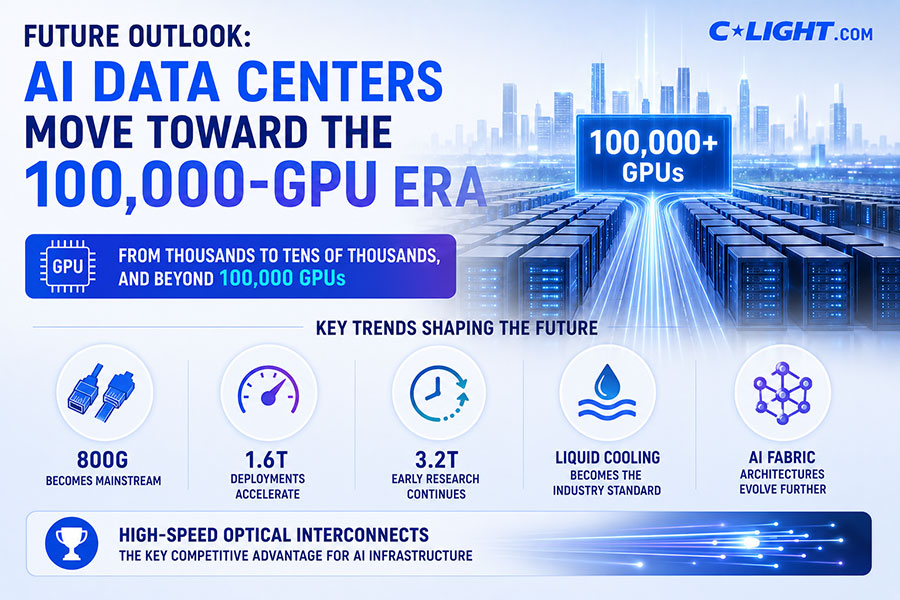
Over the coming years, AI cluster sizes will continue to expand—from thousands of GPUs to tens of thousands and ultimately to hyperscale AI supercomputing platforms with over 100,000 GPUs.
At the same time:
800G networking will become mainstream.
1.6T deployments will accelerate.
Early research into 3.2T networking will continue.
Liquid cooling will become the industry standard.
AI Fabric architectures will evolve further.
High-speed optical interconnects will remain a key competitive advantage for AI infrastructure.
12、Conclusion
The rapid deployment of hyperscale GPU clusters reflects the accelerating global race for AI computing power.
Future AI data centers will compete not only on GPU count but also on network bandwidth, communication efficiency, cooling capability, high-speed interconnect performance, and energy efficiency.
High-speed optical transceivers, Active Optical Cables (AOCs), Direct Attach Cables (DACs), Active Electrical Cables (AECs), and advanced AI Fabric networks will form the foundation of next-generation AI infrastructure, enabling the continued growth of hyperscale AI computing.
10,000+ GPU Clusters Reshaping AI Data Centers FAQ
Q1: What are 10,000+ GPU clusters in AI data centers?
Answer: 10,000+ GPU clusters are hyperscale AI computing infrastructures that connect thousands of GPUs into a single high-performance computing system.
Unlike traditional data centers focused mainly on servers and storage, hyperscale AI clusters are designed for:
Large Language Model (LLM) training
Distributed AI computing
AI inference workloads
High-performance computing (HPC)
A large AI cluster typically includes:
GPU servers
High-speed network fabrics
AI storage systems
Liquid cooling infrastructure
Spine-leaf network architecture
These components work together as an integrated AI supercomputing platform.
Q2: Why are AI companies building 10,000+ GPU clusters?
Answer: AI models continue to grow in size and complexity, requiring significantly more computing resources.
Modern AI workloads such as:
Generative AI
Large Language Models
Multimodal AI
AI agents
Scientific computing
require massive parallel processing.
Larger GPU clusters provide:
Higher training performance
Faster model development
Greater AI workload scalability
Improved computational efficiency
As AI models approach trillion-parameter scale, hyperscale GPU infrastructure has become essential for advanced AI development.
Q3: What are the major challenges of hyperscale AI GPU clusters?
Answer: Building large GPU clusters introduces several infrastructure challenges.
The main challenges include:
1. Network Communication Bottlenecks
Thousands of GPUs need continuous data exchange through:
All-Reduce operations
Tensor parallelism
Pipeline parallelism
Gradient synchronization
2. Power Consumption
High-density GPU systems require advanced power management.
3. Thermal Management
Traditional cooling methods struggle with increasing rack power density.
4. Infrastructure Scalability
Large AI clusters require efficient networking, storage, and interconnect solutions.
These challenges make network architecture a critical factor in AI system performance.
Q4: Why are high-speed optical interconnects important for AI clusters?
Answer: High-speed optical interconnects provide the bandwidth and scalability required for communication between GPUs, switches, and storage systems.
AI clusters generate massive east-west traffic, requiring:
High bandwidth
Low latency
Stable signal transmission
Energy-efficient connectivity
Optical solutions such as:
400G optical transceivers
800G optical modules
1.6T optical interconnects
help AI data centers overcome network limitations as cluster sizes continue increasing.
Q5: How do 400G, 800G, and 1.6T networks support AI infrastructure?
Answer: Different network speeds support different stages of AI data center evolution.
400G Optical Networking
Used for:
AI storage networks
Spine-leaf connections
Medium-scale GPU clusters
800G Optical Networking
Provides:
Higher bandwidth density
Lower latency
Better scalability
It has become a key solution for next-generation AI data centers.
1.6T Optical Networking
Designed for:
Ultra-large AI fabrics
10,000+ GPU clusters
Future AI supercomputing platforms
The evolution from 400G to 800G and 1.6T enables AI infrastructure to continue scaling.
Q6: What is AI Fabric and why is it important for large GPU clusters?
Answer: AI Fabric is a high-performance network architecture designed specifically for AI workloads.
Unlike traditional enterprise networks, AI Fabric focuses on:
Ultra-low latency
High bandwidth communication
Lossless networking
Large-scale GPU connectivity
AI Fabric technologies include:
InfiniBand
RoCEv2
AI optimized Ethernet networks
For hyperscale GPU clusters, network performance directly affects GPU utilization and overall AI training efficiency.
Q7: How are AI data centers changing compared with traditional data centers?
Answer: AI data centers are shifting from server-centric architectures to GPU-centric computing platforms.
Traditional data centers mainly focus on:
CPU computing
Storage access
General network traffic
AI data centers prioritize:
GPU-to-GPU communication
High-speed optical networking
Advanced cooling systems
AI workload optimization
Key infrastructure changes include:
Higher bandwidth interconnects
Liquid cooling deployment
AI Fabric networking
Photonic technologies
These changes enable large-scale AI model training and inference.
Q8: What is the future of 10,000+ GPU AI clusters?
Answer: Future AI infrastructure will continue evolving from thousands of GPUs toward even larger AI supercomputing systems.
Future trends include:
100,000+ GPU clusters
Mainstream 800G networking
Expansion of 1.6T optical connectivity
Advanced AI Fabric architectures
Wider adoption of liquid cooling
As AI workloads continue growing, high-speed optical interconnects will remain a fundamental technology supporting hyperscale AI data centers.
 >
>

 >
>
 >
>
 >
>
 >
>
 >
>
 >
>
 >
>