TEL:+86 132 6656 7067


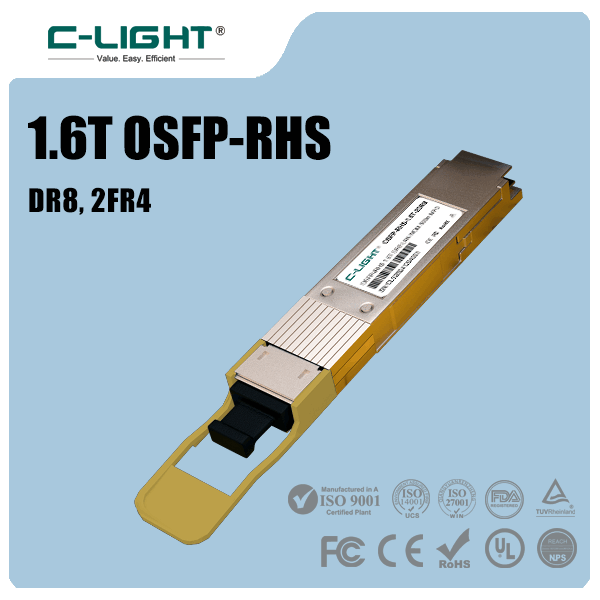
The optical transceiver market has already begun to take off in 2026. The market is clearly shifting towards higher-capacity optical connections, with robust demand for 1.6T wavelengths.

●Market Drivers: AI Computing Demand Reshapes the Optical Module Landscape
The optical module market in 2026 stands at an unprecedented inflection point for growth. The total addressable market (TAM) for global optical transceiver modules has been significantly revised upward by 43% and 46% for 2026 and 2027, respectively.
The continued expansion of AI servers serves as the primary engine for this growth. According to the latest assessments, the implied AI chip shipments for AI servers in 2026 and 2027 have been revised upward by 14% and 22%, respectively.
This growth is not merely quantitative but also structural. Market expectations for ASIC penetration in AI servers have risen accordingly, projected to reach 50% by 2027, up from the previous estimate of 45%. This trend reflects a fundamental shift: the AI infrastructure investment cycle continues, chip platforms are diversifying, collectively laying a solid foundation for the medium- to long-term growth in optical transceiver module demand.
●Technology Evolution: Silicon Photonics and CPO Usher in a New Era of "Optics Replacing Copper"
2026 is regarded as a critical turning point for silicon photonics and co-packaged optics (CPO) technologies transitioning from the lab to commercial scale. The core driver of this technological shift stems from traditional copper interconnects approaching their physical limits, while AI computing demand grows exponentially.
Tech giants like NVIDIA are actively promoting the commercial application of CPO technology. According to their roadmap, the company plans to launch a CPO-based optical interconnect platform in 2026, supporting both Ethernet and InfiniBand technologies.
Compared to traditional pluggable optical modules, CPO designs can reduce the power consumption of a single module from approximately 30W to about 9W at 1.6T transmission bandwidth, achieving a 3.5x improvement in power efficiency.
This revolutionary improvement in energy efficiency is crucial for large-scale AI data centers. As CPO is integrated into switches, the average selling price (ASP) of overall optical communication products is expected to see a multiple-fold increase. The ultimate goal is to achieve optical I/O, pushing transmission speeds beyond 12.8T.
In 2026, 800G coherent pluggable modules are expected to become the standard optical connectivity solution for AI networks.
●Supply Chain Dynamics: Capacity Expansion and Technological Innovation Proceed in Parallel
Facing explosive market demand, the optical module supply chain is undergoing profound adjustments. Key challenges come from upstream core components. Industry sources indicate that supply for the most advanced key component, EML (Electro-absorption Modulated Laser), remains quite tight. Production capacity for EML laser components from major photonics suppliers for next year has already been fully booked, indicating a significant market gap.
This supply tightness is catalyzing the rise of alternative technologies. Cloud service giants like Google, Meta, and Amazon AWS are beginning to seek alternatives to EML, with the relatively lower-cost Continuous Wave (CW) Laser emerging as the preferred choice.
Demand for CW Laser-related optical communication modules is projected to double in 2026 compared to 2025, presenting new growth opportunities for related companies in the optical communication industry chain.
●Emerging Applications: Automotive Optical Communication Opens a New Frontier
As vehicle intelligence continues to advance, the demand for high-speed data transmission in automotive networks is growing, opening up a brand-new application scenario for optical communication technology.
At CES 2026, Autolink and ReinOCS announced a strategic partnership to jointly develop automotive optical communication solutions based on an Optical-Electrical Integrated E/E Architecture.
This innovative technology demonstrates several advantages: supporting lossless transmission of 8K@60Hz ultra-high-definition video, transmission distances up to 100 meters, operation within an automotive-grade temperature range of -40°C to 85°C, and resistance to high-intensity electromagnetic interference.
Both the modules and wiring for the in-vehicle optical communication system are specially designed to withstand high-acceleration shocks and full-spectrum continuous vibration in vehicle environments, fully meeting the reliability standards for automotive wiring harnesses and interconnects.
This empowers the photonic-electronic foundational layer, eliminating key data transmission bottlenecks that limit the advancement of higher-level vehicle intelligence.
●Industry Outlook: A Pivotal Year from Technological Breakthrough to Commercial Deployment
Looking ahead to 2026 and beyond, the optical module industry is entering a golden period of structural growth. Multiple industry research institutions predict that the compound annual growth rate (CAGR) for the silicon photonics industry will maintain a high level of 25%-30% over the next 5 to 10 years.
Market penetration of CPO technology will accelerate significantly. According to industry survey data, global CPO ports numbered only 50,000 in 2023, but are expected to exceed 4.5 million by 2026, representing 90-fold annual growth. The market size is projected to leap from $46 million in 2024 to $3.51 billion in 2026.
The technology evolution path is also becoming clearer. Industry observations show that CPO technology is developing along two major camps, led by Broadcom and NVIDIA respectively.
Broadcom is entering the market with its Tomahawk series switches integrating CPO technology; NVIDIA is accelerating the volume shipment of CPO products through its Spectrum-X ecosystem and next-generation Quantum Photonics silicon photonic network switches.
The 2026 optical communication market sets the tone: the next wave of AI innovation will focus on efficient data movement between GPUs, with interconnect technology becoming a key factor for scaling.
Rising global AI server shipments, surging data center traffic, and supply chain technological innovations together weave the growth narrative for the optical module industry in 2026.
The large-scale commercial adoption of silicon photonics begins this year, officially heralding the revolutionary era of "Optics Replacing Copper." The predicted rapid scaling of 800G by industry giants like Ciena and Nokia aligns with the planned commercialization timelines for CPO products from tech companies like NVIDIA, converging on the year 2026.
The optical module market is no longer just a story of technological upgrade; it is a core chapter in the infrastructure reshaping of the AI era.
 >
>

 >
>
 >
>
 >
>
 >
>
 >
>
 >
>
 >
>