TEL:+86 132 6656 7067


1. Introduction: The Role of Optical Interconnect in AI Data Centers
The rapid development of Artificial Intelligence (AI), Large Language Models (LLMs), and high-performance computing (HPC) is reshaping modern data center architectures. Traditional data center networks designed for general workloads are facing increasing challenges in bandwidth capacity, latency control, and power efficiency.
AI training and inference workloads require thousands of GPUs and accelerators to exchange massive amounts of data in real time. The communication efficiency between computing nodes directly impacts AI model training speed and overall system performance.
In this new AI era, AI Data Center Optical Interconnect has become a critical technology for building high-speed, scalable, and energy-efficient network infrastructures.
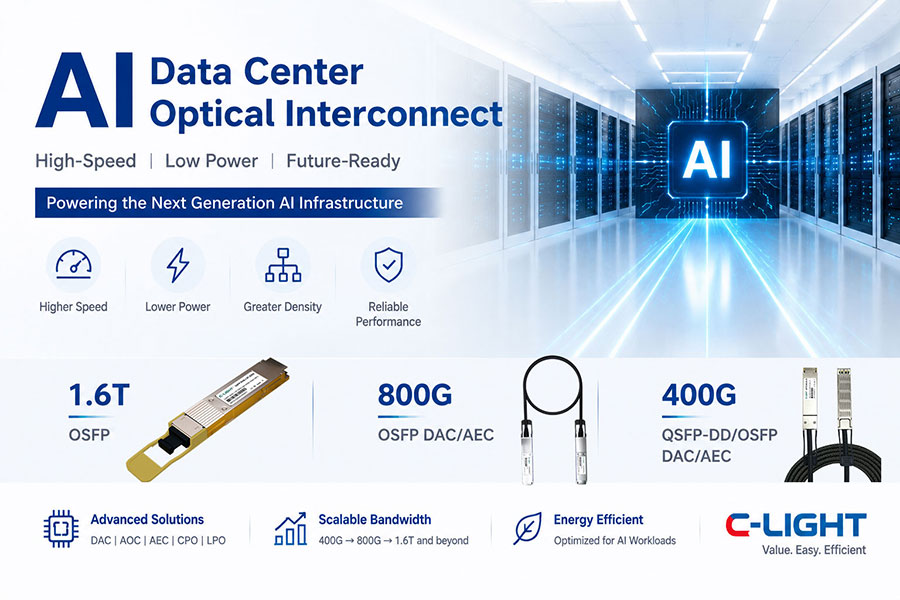
From 400G, 800G to 1.6T optical connectivity, optical interconnect solutions are enabling next-generation AI clusters with higher bandwidth density, lower power consumption, and improved network scalability.
C-LIGHT provides advanced optical connectivity solutions, including 400G, 800G, 1.6T optical transceivers, DAC, and AEC products, supporting the evolving requirements of AI data centers and high-performance computing networks.
2. What Is AI Data Center Optical Interconnect?
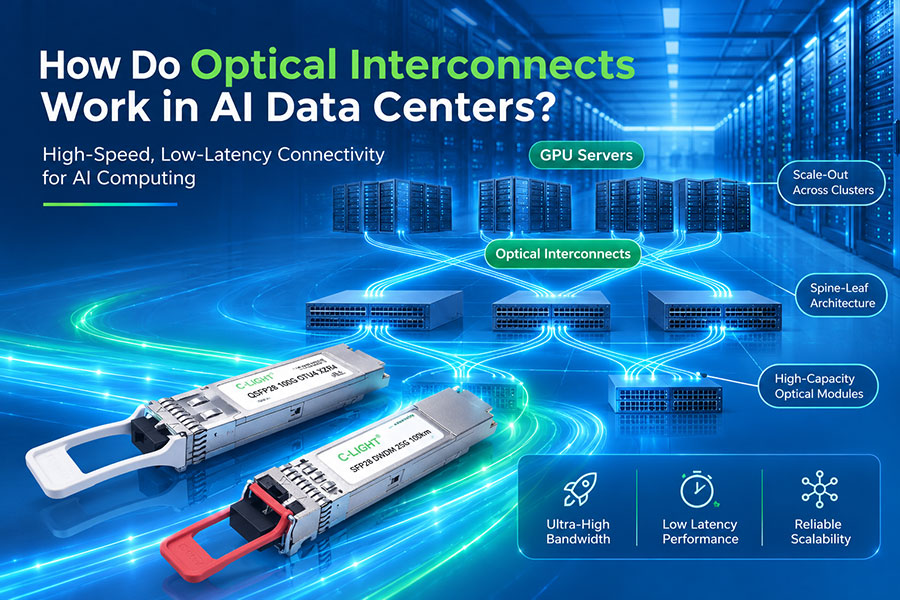
AI Data Center Optical Interconnect refers to the high-speed optical communication technologies used to connect:
AI servers
GPU clusters
Network switches
Storage systems
Data center fabrics
Unlike traditional electrical interconnects, optical interconnects use light transmission technology to achieve:
Higher bandwidth
Longer transmission distance
Lower signal loss
Better scalability
As AI workloads continue growing, optical connectivity has become the foundation for large-scale AI infrastructure.
3. Why AI Data Centers Need Optical Interconnect Solutions
3.1 Massive Bandwidth Requirements
Modern AI models require enormous computing resources. During AI training, GPUs continuously exchange:
Model parameters
Training data
Intermediate results
A single AI cluster may contain thousands of GPUs, creating extremely high east-west traffic inside the data center.
High-speed optical interconnects provide the bandwidth required for:
GPU-to-GPU communication
Server-to-switch connections
Switch-to-switch networking
3.2 Low Latency Communication
AI applications depend on fast communication between computing nodes.
Optical interconnect solutions help reduce:
Network latency
Data transmission delays
Communication bottlenecks
This improves:
AI training efficiency
Distributed computing performance
Real-time AI inference capability
3.3 Lower Power Consumption
As AI clusters expand, network power consumption becomes a major challenge.
Optical technologies help reduce energy consumption through:
Higher bandwidth per port
Improved transmission efficiency
Advanced optical engines
Future technologies such as:
LPO (Linear-drive Pluggable Optics)
CPO (Co-Packaged Optics)
Silicon Photonics
will further improve AI network energy efficiency.
4. AI Data Center Optical Interconnect Architecture
Modern AI data center networks usually consist of several layers.
4.1 Compute Layer
The compute layer includes:
GPU servers
AI accelerators
CPUs
Memory systems
Examples:
NVIDIA GPU platforms
AI accelerator clusters
HPC computing systems
These systems require extremely fast communication between nodes.
4.2 Network Fabric Layer
The network fabric connects thousands of computing nodes.
Common architectures include:
Ethernet AI Fabric
Ethernet-based AI networks use:
400G Ethernet
800G Ethernet
RoCEv2 technology
Advantages:
Open ecosystem
High scalability
Multi-vendor compatibility
InfiniBand AI Network
InfiniBand provides:
Ultra-low latency
High throughput
Advanced RDMA capability
It is widely used in large-scale AI training environments.
5. Optical Interconnect Technology Evolution
The development of AI networking is driving continuous optical speed upgrades.
5.1 400G Optical Interconnect
400G optical solutions are widely deployed in current AI data centers.
Main products include:
400G QSFP-DD
400G OSFP
400G QSFP112
Applications:
Leaf-spine networks
AI cluster connections
Data center backbone links
C-LIGHT provides:
400G QSFP-DD optical transceivers
400G QSFP112 solutions
400G DAC and AEC products
for high-performance networking environments.
5.2 800G Optical Interconnect
800G optical connectivity has become a key solution for next-generation AI networks.
Compared with 400G, 800G provides:
Double bandwidth capacity
Higher switch density
Improved network efficiency
Typical solutions:
800G OSFP optical modules
800G OSFP DAC
800G AEC
C-LIGHT 800G optical solutions are designed for:
AI data centers
Hyperscale networks
High-performance computing applications
5.3 1.6T Optical Interconnect
With increasing AI computing requirements, 1.6T optical connectivity is becoming the next major technology milestone.
1.6T solutions enable:
Higher bandwidth aggregation
Lower port complexity
Future-ready AI networks
Applications include:
AI supercomputers
Large-scale GPU clusters
Next-generation Ethernet networks
C-LIGHT provides:
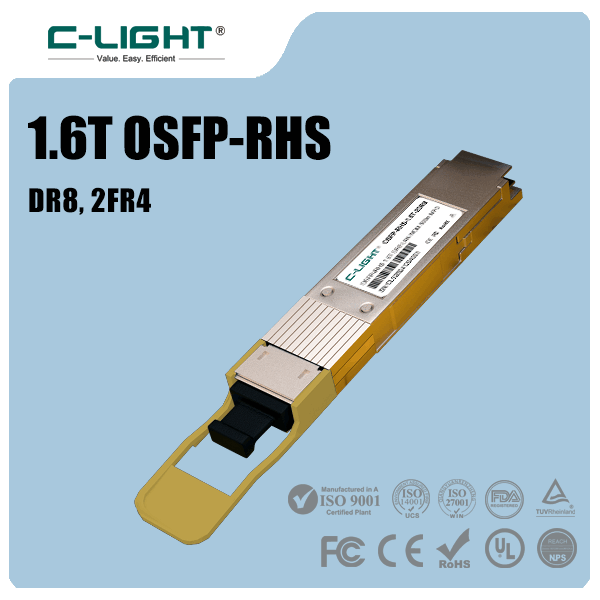
1.6T OSFP optical modules
1.6T OSFP DAC
1.6T AEC solutions
supporting future AI infrastructure expansion.
6. Main Optical Interconnect Solutions for AI Data Centers
6.1 Optical Transceivers
Optical transceivers convert electrical signals into optical signals and enable long-distance communication.
Key technologies include:
PAM4 modulation
Silicon photonics
High-speed optical engines
Applications:
Switch-to-switch links
Data center backbone
AI fabric connections
6.2 DAC (Direct Attach Cable)
DAC is a cost-effective short-distance interconnect solution.
Advantages:
Low cost
Low power consumption
Simple deployment
Applications:
Rack-level connections
Server-to-switch links
C-LIGHT provides high-speed DAC solutions supporting:
400G
800G
1.6T applications
6.3 AEC (Active Electrical Cable)
AEC integrates active signal processing technology to improve transmission performance.
Advantages:
Longer reach than DAC
Better signal integrity
Lower cost compared with optical modules
AEC is suitable for:
AI server racks
Data center switching systems
High-density connections
6.4 AOC (Active Optical Cable)
AOC uses optical fiber transmission with integrated optical engines.
Advantages:
Longer distance
High bandwidth
Low electromagnetic interference
Applications:
AI clusters
HPC systems
Data center networks
7. Optical Interconnect Challenges in AI Data Centers
7.1 Thermal Management
AI systems generate significantly higher heat compared with traditional servers.
Challenges include:
High rack power density
Optical module temperature management
Cooling efficiency
Advanced cooling technologies include:
Cold plate liquid cooling
Immersion cooling
7.2 Signal Integrity
Higher speeds introduce challenges such as:
Insertion loss
Return loss
Crosstalk
Jitter
Advanced testing methods are required:
Eye diagram testing
BER testing
TDECQ measurement
7.3 Compatibility Testing
AI networks require interoperability testing with:
Network switches
GPU platforms
Different optical ecosystems
C-LIGHT performs comprehensive validation to ensure reliable operation in AI data center environments.
8. Future Trends of AI Optical Interconnect
8.1 3.2T Optical Connectivity
Future AI clusters will require even higher bandwidth solutions.
The evolution path:
400G
800G
1.6T
3.2T
8.2 Co-Packaged Optics (CPO)
CPO integrates optical components closer to switching ASICs.
Benefits:
Lower power consumption
Higher bandwidth density
Reduced electrical distance
8.3 Silicon Photonics
Silicon photonics technology enables:
High integration
Lower cost
Better scalability
It is expected to play an important role in future AI networking.
9.Conclusion
AI Data Center Optical Interconnect is becoming the foundation of next-generation computing infrastructure. As AI models continue growing in complexity, high-speed optical solutions will play a critical role in enabling faster communication, lower latency, and more efficient data center operations.
With comprehensive solutions covering 400G, 800G, 1.6T optical modules, DAC, AEC, and AOC products, C-LIGHT is committed to supporting the global evolution of AI data center networks.
10. Why Choose C-LIGHT AI Data Center Optical Interconnect Solutions
C-LIGHT focuses on advanced optical connectivity technologies for AI and high-performance computing applications.
Product portfolio includes:
400G optical transceivers
800G OSFP solutions
1.6T optical interconnect products
DAC solutions
AEC solutions
AOC solutions
C-LIGHT advantages:
Advanced optical technology development
High-speed product capability
Reliable quality control
Customized solutions
Professional technical support
By combining innovation and manufacturing expertise, C-LIGHT helps global customers build next-generation AI data center networks.
AI Data Center Optical Interconnect Q&A
Q1: What is AI Data Center Optical Interconnect?
Answer: AI Data Center Optical Interconnect refers to optical communication technologies used to connect GPUs, servers, switches, and storage systems in AI computing environments. It provides high bandwidth, low latency, and efficient data transmission.
Q2: Why do AI data centers use optical interconnect instead of traditional cables?
Answer: Optical interconnect provides higher bandwidth, longer transmission distance, lower signal loss, and better scalability compared with traditional electrical connections.
Q3: What optical speeds are used in AI data centers?
Answer: Current AI networks mainly use 400G and 800G optical solutions, while 1.6T optical connectivity is becoming the next-generation technology for advanced AI clusters.
Q4: What AI optical interconnect products does C-LIGHT provide?
Answer: C-LIGHT provides:
400G QSFP-DD and QSFP112 optical modules
800G OSFP optical transceivers
1.6T OSFP optical solutions
DAC, AEC, and AOC high-speed cables
Q5: What is the difference between DAC, AEC, and AOC?
Answer: DAC is suitable for short-distance low-cost connections. AEC provides extended electrical transmission with signal enhancement. AOC uses optical fiber technology for longer-distance high-speed communication.
Q6: Why are 800G and 1.6T important for AI networking?
Answer: AI workloads require massive bandwidth between GPUs and switches. 800G and 1.6T solutions increase network capacity while improving data center efficiency.
Q7: How does C-LIGHT ensure optical product reliability?
Answer: C-LIGHT conducts optical performance testing, BER testing, signal integrity testing, thermal testing, and compatibility verification to ensure stable operation in demanding AI environments.
Q8: What is the future of AI Data Center Optical Interconnect?
Answer: Future AI networks will continue moving toward 1.6T, 3.2T optical connectivity, CPO, LPO, and silicon photonics technologies to achieve higher bandwidth and lower power consumption.
 >
>

 >
>
 >
>
 >
>
 >
>
 >
>
 >
>
 >
>