TEL:+86 132 6656 7067


1. What Is an 800G DCO?
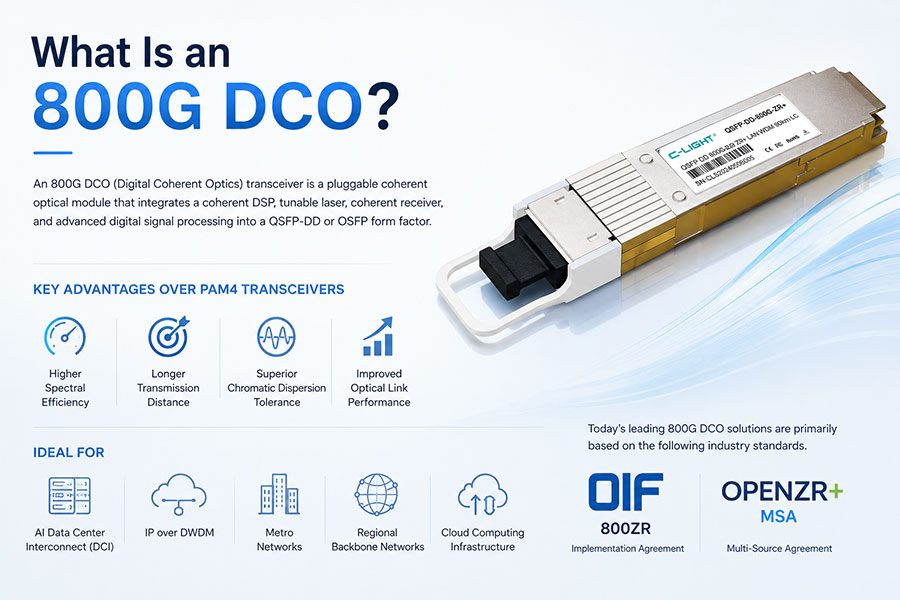
An 800G DCO (Digital Coherent Optics) transceiver is a pluggable coherent optical module that integrates a coherent DSP, tunable laser, coherent receiver, and advanced digital signal processing into a QSFP-DD or OSFP form factor.
DCO 800G/400G/200G/100G DWDM Coherent Transceiver丨C-LIGHT
Compared with conventional PAM4 Ethernet optical transceivers, 800G DCO technology provides:
Higher spectral efficiency
Longer transmission distance
Superior chromatic dispersion tolerance
Improved optical link performance
These capabilities make 800G DCO an ideal solution for:
AI Data Center Interconnect (DCI)
IP over DWDM
Metro Networks
Regional Backbone Networks
Cloud Computing Infrastructure
Today's leading 800G DCO solutions are primarily based on the OIF 800ZR implementation agreement and the OpenZR+ MSA specification.
2. Which Industry Standards Does 800G DCO Support?
800G DCO transceivers comply with multiple industry standards to ensure interoperability across coherent optical networks.
| Standard | Purpose |
|---|---|
| OIF 800ZR | Defines single-wavelength 800G coherent DCI transmission |
| OpenZR+ MSA | Extends transmission distance and supports multiple data rates |
| CMIS | Module management, monitoring, and configuration interface |
| IEEE 802.3 | Client-side Ethernet interface |
| ITU-T DWDM Grid | DWDM wavelength planning and channel allocation |
Among these standards:
OIF 800ZR is designed primarily for DCI links up to approximately 120 km.
OpenZR+ extends transmission reach for metro and regional networks while supporting multiple modulation formats, flexible baud rates, and enhanced FEC schemes.
3. C-LIGHT 800G DCO Key Specifications
3.1 Product Information
C-LIGHT 800ZR+ Pro QSFP-DD Coherent Transceiver
Part Number
CL800GQDDZR+
Supported Modulation Formats
DP-16QAM
DP-PCS-16QAM
DP-QPSK
C-LIGHT 800ZR+ Pro OSFP Coherent Transceiver
Part Number
CL800GOSFPZR+
Supported Modulation Formats
DP-16QAM
DP-PCS-16QAM
DP-QPSK
3.2 Transmission Reach by Modulation Format
| Modulation Format | Operating Mode | Maximum Reach | Notes |
|---|---|---|---|
| DP-16QAM | 800ZR+ 118 GBd 16QAM | 320 km | Chromatic dispersion supports up to 500 km |
| DP-PCS-16QAM | 800ZR+ 124 GBd PCS-16QAM | 480 km | Chromatic dispersion supports up to 850 km |
| DP-QPSK | 400ZR++ 118 GBd QPSK | 2,400 km | 400G coherent transmission |
3.3 Receiver OSNR Performance
| Modulation | Baud Rate | FEC | OSNR (dB / 12.5 GHz) | Pre-FEC BER | Post-FEC BER |
|---|---|---|---|---|---|
| 16QAM | 118 GBd | OFEC | 25.5 typ. / 27 max. | 1.6E-2 typ. | <1e-15<> |
| PCS-16QAM | 124 GBd | SD-FEC | 23.8 typ. /25.5 max. | 2.0E-2 typ. | <1e-15<> |
| QPSK | 118 GBd | OFEC | 16.8 typ. /17.8 max. | 1.9E-2 typ. | <1e-15<> |
Measurement Condition
Back-to-back optical link with OSNR referenced to a 12.5 GHz optical bandwidth.
3.4 Optical Performance
Transmitter
Adjustable optical output power from –10 dBm to +1 dBm
Suitable for single-span and amplified multi-span optical links
Tunable wavelength across the Extended C-band
Supports 150 GHz grid spacing
Fine wavelength tuning resolution of 0.1 GHz
Receiver
The coherent DSP provides advanced compensation for:
Chromatic dispersion (CD)
Polarization mode dispersion (PMD)
Optical impairments introduced by long-haul transmission
The optimized receiver sensitivity and dynamic range allow seamless deployment in ROADM-based optical transport networks.
3.5 Form Factor and Power Consumption
C-LIGHT 800G DCO modules are available in:
QSFP-DD800
OSFP
Key features include:
OIF 800ZR IA compliant
OpenROADM MSA Version 7.0 compatible
CMIS management interface
Hot-pluggable design
Power consumption below 29 W
4. Internal Architecture of an 800G DCO Module
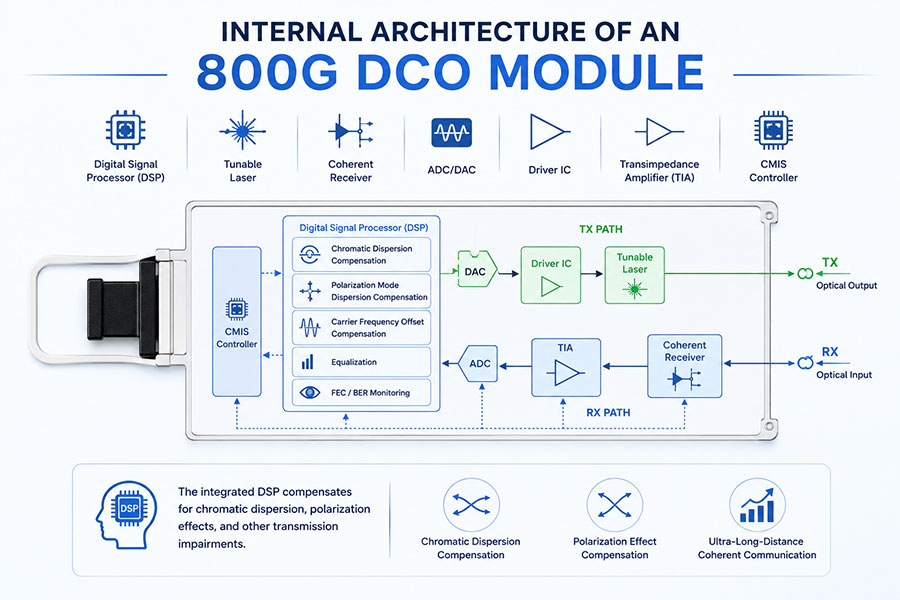
A typical 800G DCO transceiver integrates:
Digital Signal Processor (DSP)
Tunable Laser
Coherent Receiver
ADC/DAC
Driver IC
Transimpedance Amplifier (TIA)
CMIS Controller
The integrated DSP compensates for chromatic dispersion, polarization effects, and other transmission impairments, enabling reliable ultra-long-distance coherent communication.
5. Typical Applications
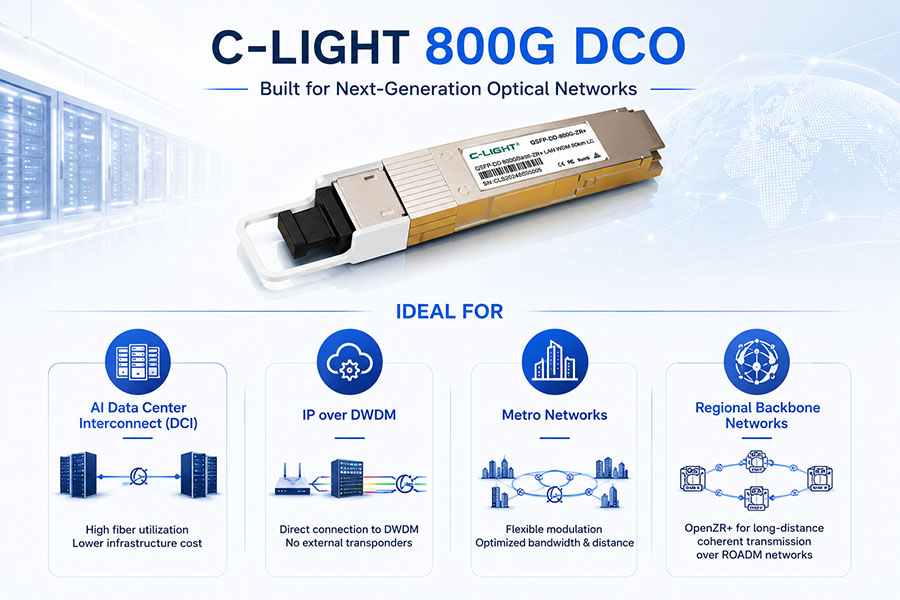
C-LIGHT 800G DCO transceivers are ideal for:
AI Data Center Interconnect (DCI)
Single-wavelength 800G transmission increases fiber utilization while reducing infrastructure costs.
IP over DWDM
Routers can connect directly to DWDM transport networks without requiring external transponders.
Metro Networks
Flexible modulation formats enable optimization of bandwidth and transmission distance.
Regional Backbone Networks
OpenZR+ enables long-distance coherent transmission across ROADM-based optical transport networks.
6. Conclusion
The C-LIGHT 800G DCO coherent transceiver integrates a high-performance DSP, tunable laser, coherent receiver, and CMIS management into compact QSFP-DD and OSFP form factors. By supporting OIF 800ZR, OpenZR+, and other industry standards, it delivers high-capacity, long-distance optical transmission for AI data center interconnects, IP over DWDM, metro networks, and regional backbone infrastructures.
With flexible modulation formats, multiple host interface rates, and advanced coherent technology, C-LIGHT 800G DCO modules provide a scalable and future-ready solution for next-generation 800G optical networking.
7.Frequently Asked Questions (FAQ)
Q1. Is an 800G DCO the same as an 800ZR transceiver?
Answer: Not exactly. 800G DCO is a broader category referring to pluggable coherent optical modules with integrated digital coherent technology. OIF 800ZR is one of the standardized implementations designed primarily for DCI applications up to approximately 120 km. Most commercial 800G DCO modules support both 800ZR and OpenZR+ for extended reach.
Q2. What is the difference between 800ZR and OpenZR+?
Answer: 800ZR targets DCI links of up to approximately 120 km. OpenZR+ extends transmission distance while supporting multiple modulation formats, flexible data rates, and stronger Forward Error Correction (FEC), making it suitable for metro and regional optical networks.
Q3. Which host interface rates are supported?
Answer: C-LIGHT 800G DCO supports multiple configurable host-side rates, including:
| Operating Mode | Host Interface |
|---|---|
| 800ZR 118 GBd 16QAM | 1×800G, 2×400G, 4×200G, 8×100G |
| 800ZR+ 124 GBd PCS-16QAM | 1×800G, 2×400G, 4×200G, 8×100G |
| 800ZR+ 118 GBd 16QAM | 1×800G, 2×400G, 4×200G, 8×100G |
| 400ZR++ 118 GBd QPSK (56G SerDes) | 1×400G, 2×200G, 4×100G |
| 400ZR++ 118 GBd QPSK (112G SerDes) | 1×400G, 2×200G, 4×100G |
Q4. Which management interface does an 800G DCO use?
Answer: Most 800G DCO modules implement the CMIS (Common Management Interface Specification) for configuration, monitoring, diagnostics, and firmware management.
Q5. Which optical connector does an 800G DCO use?
Answer: Standard 800G DCO modules typically use a Duplex LC connector, single-mode fiber (SMF), and tunable DWDM wavelengths.
Q6. What are the primary applications of 800G DCO?
Answer: Typical deployment scenarios include AI data center interconnect (DCI), IP over DWDM, metro optical networks, regional backbone infrastructure, cloud computing networks, and high-capacity transport systems.
Q7. What are the differences between OFEC and C-FEC?
Answer: OFEC provides higher coding gain and is well suited for long-haul or challenging optical links. C-FEC generally offers lower complexity and slightly reduced power consumption, making it suitable for shorter and more controlled DCI environments. Many DCO modules allow the FEC mode to be selected via software to optimize performance for different transmission distances.
Q8. Can an 800G DCO replace a traditional DWDM transponder?
Answer: In many metro and regional transport networks, an OpenZR+-based 800G DCO can replace conventional DWDM transponders, reducing rack space, power consumption, and deployment complexity. For ultra-long-haul applications with demanding optical budgets, however, dedicated high-performance transponders may still provide advantages depending on the specific network design.
 >
>

 >
>
 >
>
 >
>
 >
>
 >
>
 >
>
 >
>