TEL:+86 132 6656 7067


In the fields of data center interconnection (DCI), metropolitan area networks (MAN), and telecommunications transmission, 100G optical transceivers are core components of high-speed networks, with 100G ER4 and 100G LR4 being two mainstream long-distance solutions. While these two module types may appear similar, they have significant differences in transmission distance, technical implementation, and cost structure. Understanding these differences is crucial for building efficient and economical network architectures.
|
|
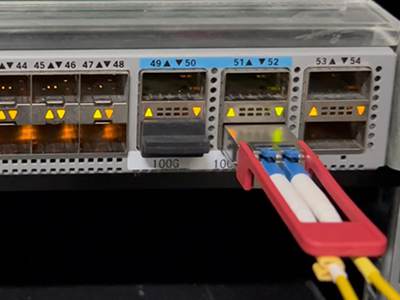
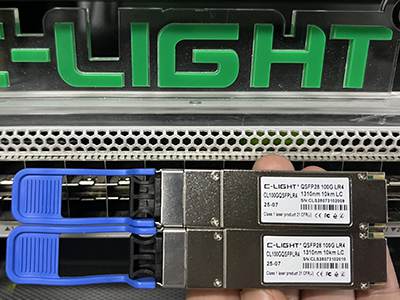
The ultra-long transmission capability of ER4 modules stems from their more advanced laser and receiver design. The use of EML lasers coupled with APD receivers enables them to handle much weaker optical signals.
This high-performance combination also means that the cost of an ER4 module is typically 1.5 to 2 times that of an LR4, and its power consumption is also about 15%-25% higher.
Differences in Technical Implementation
Both 100G ER4 and 100G LR4 transceivers employ Wavelength Division Multiplexing (WDM) technology, combining four 25Gbps channels into a single 100Gbps transmission. This similarity in technical approach belies important differences in implementation details.
The EML lasers used in ER4 modules require a Thermoelectric Cooler (TEC) to stabilize their operating wavelength. This temperature control mechanism ensures the laser wavelength does not drift with ambient temperature changes, which is a fundamental requirement for long-haul transmission.
In contrast, LR4 modules can use simpler DFB lasers, which do not require complex temperature control, directly reducing both cost and power consumption.
The difference at the receiver end is even more pronounced. ER4 utilizes Avalanche Photodiode (APD) receivers, whose internal gain mechanism amplifies weak signals—this is key to achieving 40km transmission. LR4, however, uses standard PIN photodiodes, suitable for signal reception within the 10-20km range.
ER4 modules typically integrate Forward Error Correction (FEC). By using FEC algorithms to correct erroneous bits during transmission, they further enhance the reliability of long-haul links. This feature is often optional in LR4 modules.
100G ER4 vs. LR4 | ||
| Number | CL100GQSFPER4 | CL100GQSFPLR4 |
| Wavelength | LAN WDM 1310nm | LAN WDM 1310nm |
| Connector | LC | LC |
Cable Distance (Max.) | 40km | 10km |
Data Rate | 103.125Gbps | 103.125Gbps |
Transmitter Type | EML | EML |
TX Power | -2dBm~5dBm | > -3dBm |
Receiver Sensitivity | < -21dBm | < -8dBm |
| Power Consumption | ≤ 5.5W | ≤ 3.5W |
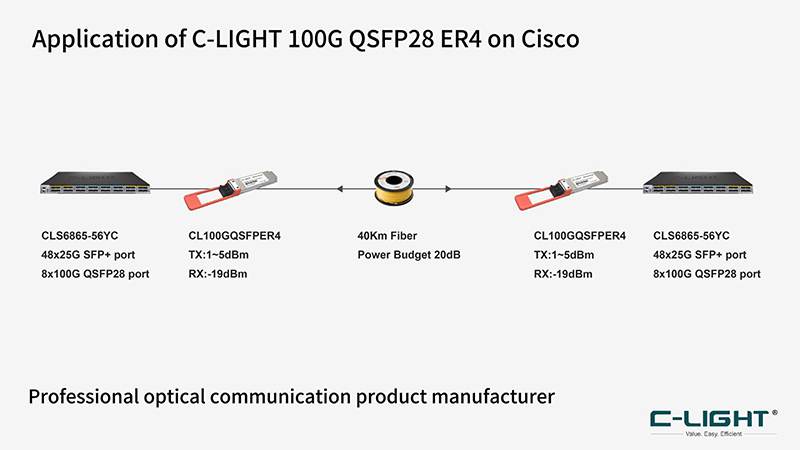
Application of C-LIGHT 100G QSFP28 ER4 on Cisco
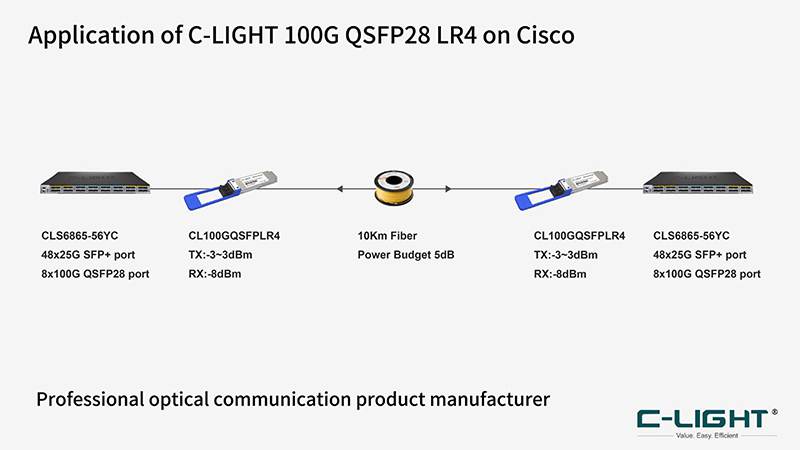
Application of C-LIGHT 100G QSFP28 LR4 on Cisco
Guide for Selection Decision
Choosing between ER4 and LR4 first depends on the required transmission distance. For actual link lengths within 10-20km, LR4 is the more economical choice; for distances exceeding 30km, ER4 is almost the only viable option.
Beyond distance, link budget is a frequently overlooked yet critical parameter. ER4 modules generally offer a higher link budget (optical power margin), allowing them to tolerate more loss from fiber connectors and splices. In complex fiber paths, even if the physical distance isn't long, high loss may necessitate ER4-level performance.
In data center interconnects, ER4 is commonly used for connections between campuses or data centers across cities, while LR4 is better suited for shorter inter-building or intra-campus links within a data center complex.
Regarding budget, the Total Cost of Ownership (TCO) for ER4 must account for higher module prices and power consumption, but it may save costs on repeater equipment. For telecommunications and MAN applications, ER4 can reduce the need for optical amplifiers, simplifying network architecture.
Future upgrade paths should also be considered. If plans include extending transmission distance or increasing data rates in the future, choosing ER4 provides greater headroom. Some ER4 modules support a "Lite" mode, which allows software configuration to adapt to different distance requirements, adding deployment flexibility.
Application Scenarios and Typical Cases
Different application scenarios have clear requirements for transceiver selection. Data center interconnection is a primary application area for both ER4 and LR4.
In a cross-city data center synchronization scenario where two data centers are 35km apart with no intermediate repeaters, ER4 enables direct high-speed interconnection. If the distance is reduced to 15km, LR4 suffices, reducing costs by approximately 40%.
In metropolitan aggregation networks, ER4 is used to connect core nodes to edge nodes, while LR4 is suitable for connections between nodes within the same region. A provincial carrier network, for example, might use ER4 to connect city core hubs and LR4 to connect access points within the same city.
The high-bandwidth demands of 5G mobile backhaul networks are driving the adoption of 100G transceivers. The metropolitan core layer often employs ER4, while the access layer is more likely to use LR4 or more cost-effective solutions.
In a typical case, a large internet company building a multi-data-center architecture across two locations used ER4 for a 50km backbone link and LR4 for 10-15km backup links, optimizing the balance between cost and performance.
Deployment and Compatibility Considerations
In practical deployments, ER4 and LR4 typically use the same fiber infrastructure—single-mode OS2 fiber and LC connectors. This means upgrading from LR4 to ER4 usually requires only swapping the transceiver modules, not the fiber.
Device compatibility is a key consideration. Both module types adhere to the QSFP28 MSA standard, share the same physical dimensions, and support hot-plugging. However, implementations from different vendors may have subtle differences, particularly concerning FEC functionality and diagnostic monitoring.
Digital Diagnostic Monitoring (DDM) functions comply with the SFF-8436 standard, providing real-time monitoring of key parameters like temperature, voltage, and optical power. This is crucial for preventive maintenance and troubleshooting.
Interoperability testing is a necessary step before deployment. Although the standards are the same, when mixing ER4 and LR4 modules from different vendors, end-to-end performance—especially Bit Error Rate (BER) and jitter parameters—should still be verified.
Regarding temperature tolerance, industrial-grade ER4 modules support a wide temperature range from -40°C to 85°C, suitable for outdoor or harsh environments. Standard commercial-grade modules are typically designed for the 0°C to 70°C range found in data center environments.
As optical communication technology continues to evolve, single-wavelength 100G technology is emerging, replacing four wavelengths with one and simplifying optical design. In the future, 400G and even higher-rate modules will also offer longer-distance solutions.
100G ER4 vs LR4 Frequently Asked Questions (FAQ)
Q1. What is the difference between 100G ER4 and LR4 optical transceivers?
Answer: The main difference between 100G ER4 and 100G LR4 optical transceivers is the transmission distance. A 100G LR4 optical module supports up to 10 km transmission, while a 100G ER4 optical module extends the reach up to 40 km. Both use four 25Gbps optical lanes based on LAN-WDM technology, but ER4 provides a higher optical budget for long-distance applications.
Q2. What is a 100G QSFP28 ER4 optical transceiver used for?
Answer: A 100G QSFP28 ER4 optical transceiver is designed for long-reach 100GbE transmission over single-mode fiber (SMF). It is commonly used in Data Center Interconnect (DCI), metropolitan area networks, telecom networks, and enterprise backbone links that require reliable transmission distances up to 40 km.
Q3. How far can a 100G QSFP28 LR4 optical module transmit?
Answer: A 100G QSFP28 LR4 optical module supports transmission distances of up to 10 km over duplex single-mode fiber. It is widely deployed for data center connections, campus networks, and metropolitan network applications where cost-effective 100GbE connectivity is required.
Q4. Why does 100G ER4 support longer distances than 100G LR4?
Answer: 100G ER4 achieves longer transmission distances through higher-performance optical components, including EML lasers and APD receivers. These components provide higher optical output power and improved receiver sensitivity, enabling stable 100GbE transmission over links up to 40 km.
Q5. Should I choose a 100G ER4 or LR4 optical transceiver for DCI applications?
Answer: The choice depends on transmission distance and optical link requirements. For links within 10 km, 100G LR4 is a cost-effective solution. For longer connections between data centers or metropolitan network sites requiring up to 40 km reach, 100G ER4 provides greater optical margin and improved reliability.
Q6. Are 100G ER4 and LR4 compatible with the same fiber infrastructure?
Answer: Yes. Both 100G ER4 and 100G LR4 optical transceivers typically use duplex single-mode fiber and LC connectors. In many network upgrades, existing fiber infrastructure can be reused by replacing only the optical modules, reducing deployment complexity and cost.
Q7. What are the main applications of 100G ER4 optical modules?
Answer: 100G ER4 optical modules are mainly used in long-distance network scenarios, including Data Center Interconnect (DCI), metropolitan area networks (MAN), telecom backbone networks, 5G transport networks, and enterprise networks requiring high-performance 40 km optical connectivity.
Q8. Can 100G ER4 replace 100G LR4 in existing networks?
Answer: Yes. 100G ER4 can replace 100G LR4 when longer transmission distance or higher optical performance is required. Since both modules use the QSFP28 form factor and duplex single-mode fiber, network upgrades can usually be completed without changing the existing fiber cabling.
 >
>

 >
>
 >
>
 >
>
 >
>
 >
>
 >
>
 >
>