TEL:+86 132 6656 7067


Working Principle of 4-Channel Single-Fiber Bidirectional CWDM
The core innovation of the 4-channel single-fiber bidirectional CWDM multiplexer/demultiplexer lies in its ingenious optical design. It enables simultaneous bidirectional communication of four independent channels over a single optical fiber. Each channel utilizes a specific pair of CWDM wavelengths (e.g., 1270/1290nm, 1310/1330nm, 1350/1370nm, 1390/1410nm).
This design relies on built-in high-precision filters to accurately separate or combine optical signals of different wavelengths. On the transmit side, four different service signals are modulated onto four upstream wavelengths, combined by the multiplexer, and then transmitted via the single fiber. On the receive side, the four downstream wavelength signals from the remote end are separated by the demultiplexer and delivered to their corresponding receiving equipment.
Compared to traditional dual-fiber CWDM solutions, the primary advantage of this technology is a 50% reduction in fiber resource usage while maintaining the same number of service channels. This means network operators can double the capacity of existing fiber networks without adding any physical fiber.
Key Features of 4-Channel Single-Fiber Bidirectional CWDM
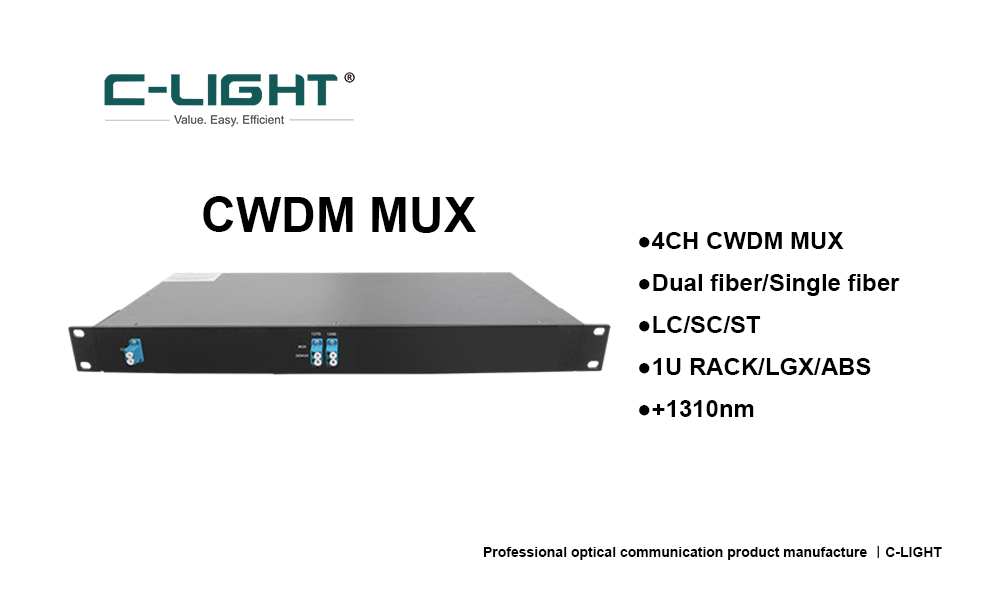
This 4-channel single-fiber bidirectional CWDM module boasts several prominent features, making it an ideal choice for environments with limited fiber resources.
It supports standard CWDM wavelength configurations with a channel spacing of 20nm, complying with the ITU-T G.694.2 standard. Each channel can provide transmission rates of up to 10Gbps, meeting the demands of most modern communication applications.
The module's low insertion loss (typically less than 3.0dB) ensures signal transmission quality, while its high channel isolation (greater than 30dB) effectively prevents inter-channel crosstalk. These performance metrics enable the device to support transmission distances of up to 80km, suitable for most metropolitan area network (MAN) and access network scenarios.
The module adopts a compact plug-in card or standalone box design for easy installation and maintenance. Its passive optical nature means it requires no power supply, offers high reliability, and incurs almost no maintenance costs. This "deploy-and-forget" characteristic makes it ideal for network edges and field environments.
Application Scenarios of 4-Channel Single-Fiber Bidirectional CWDM
In practical applications, the 4-channel single-fiber bidirectional CWDM module demonstrates broad applicability. In the field of 5G mobile communications, it can be used to address fiber resource constraints in fronthaul networks.
A single fiber can connect multiple 5G base stations, supporting shared access for different operators, significantly reducing the fiber cost and deployment time for 5G networks.
For enterprise private lines and data center interconnects, this module can quickly add service channels without altering existing fiber infrastructure, meeting ever-growing bandwidth demands. It is particularly suitable for critical business connections in finance, government, and large enterprises, providing secure and reliable high-bandwidth transmission pipelines.
In smart city and video surveillance networks, single-fiber bidirectional CWDM technology can aggregate and backhaul data from dispersed cameras and sensors, saving significant fiber resources and reducing overall deployment costs. Similarly, in dedicated communication networks for industries like power and transportation, it effectively resolves the conflict between limited fiber resources and growing service demands.
Why Choose the Single-Fiber Bidirectional Solution
Compared to traditional dual-fiber CWDM solutions, single-fiber bidirectional CWDM offers distinct competitive advantages. The most direct benefit is fiber resource savings—a 50% reduction in fiber usage for the same service capacity, which is particularly important in scenarios with scarce fiber resources or high leasing costs.
From an investment return perspective, although the unit price of a single-fiber bidirectional CWDM module might be slightly higher than that of a traditional dual-fiber module, the total cost of ownership is significantly lower when considering saved fiber costs and future expansion flexibility. This is especially true in scenarios requiring long-distance transmission, where the savings on fiber leasing can be substantial.
Network simplicity and maintainability are also key advantages. The single-fiber bidirectional solution reduces the number of fiber connections, lowering potential failure points and maintenance complexity. During network upgrades or expansions, no changes to the fiber infrastructure are needed; simply replacing or adding the corresponding modules at both ends is sufficient.
 >
>

 >
>
 >
>
 >
>
 >
>
 >
>
 >
>
 >
>