TEL:+86 132 6656 7067


1. Introduction
10G Ethernet can be deployed over either copper or optical fiber, and SFP+ technology supports both approaches through different transceiver types. A 10G Copper SFP+ typically provides an RJ45 interface for twisted-pair cabling, while a 10G Fiber SFP+ uses an optical interface such as LC for fiber connectivity. The two solutions provide the same nominal 10GbE data rate but differ significantly in transmission medium, reach, power consumption, latency, cabling, and deployment requirements.
2. What Is a 10G Copper SFP?
A 10G Copper SFP+ is a pluggable 10GbE transceiver designed for copper Ethernet connections. It is commonly based on 10GBASE-T technology and integrates a copper PHY inside the SFP+ module. The module is inserted into a compatible SFP+ port and exposes an RJ45 connector for a twisted-pair Ethernet cable.
3. What Is a 10G Fiber SFP+?
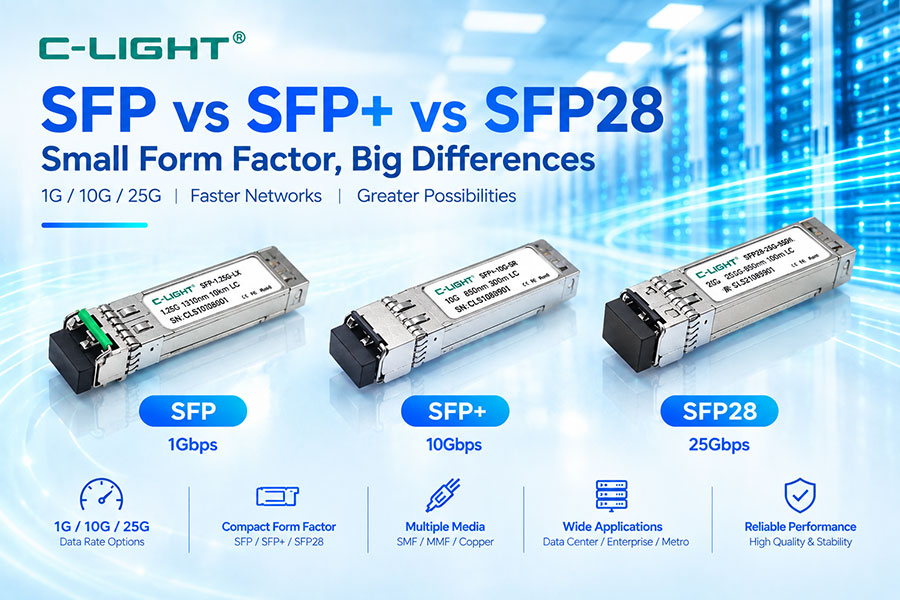
A 10G Fiber SFP+ is an optical transceiver designed to transmit 10GbE over fiber. Depending on the optical specification, it can support multimode fiber for short-reach applications or single-mode fiber for longer links. Common optical variants include 10GBASE-SR, LR, and ER families.
4. Why Are They Compared?
Both copper and optical SFP+ modules can be installed in compatible SFP+ equipment, but they are not interchangeable from a cabling or physical-interface perspective. Selecting the correct type affects network architecture, installation cost, transmission distance, power budget, and long-term scalability.
5. Basic Architecture
A typical copper connection follows:
SFP+ Port → 10G Copper SFP+ → RJ45 → Cat6A/Cat7 → Ethernet Device
A fiber connection follows:
SFP+ Port → 10G Fiber SFP+ → LC Fiber Connector → Optical Fiber → Fiber SFP+ → Remote Device
6. Core Technology Difference
The most important difference is the transmission technology. A copper SFP+ uses electrical signaling over balanced twisted-pair copper and relies on a copper PHY for signal processing. A fiber SFP+ converts electrical data into optical signals using a laser or other optical transmitter and converts received optical signals back into electrical data.
7. Transmission Medium
| Feature | 10G Copper SFP+ | 10G Fiber SFP+ |
|---|---|---|
| Medium | Twisted-pair copper | Optical fiber |
| Typical Cable | Cat6A/Cat7 | MMF or SMF |
| Front Connector | RJ45 | LC or other optical connector |
| Signal Type | Electrical | Optical |
| Typical Application | Short Ethernet links | Short to long fiber links |
8. Data Rate
Both solutions are designed for 10 Gigabit Ethernet applications. The nominal network speed is 10Gbps, but actual operation also depends on the host port, network standard, cable or fiber characteristics, and transceiver implementation.
9. Transmission Distance
Distance is one of the clearest differences. Many 10GBASE-T copper SFP+ modules are designed for short links, commonly up to around 30 meters in SFP+ implementations, although specific products can support longer distances under defined cabling conditions. Optical SFP+ modules can support much longer distances depending on the optical type and fiber.
10. Copper Reach
10GBASE-T commonly uses Cat6A or better structured copper cabling. Some copper implementations can reach up to approximately 100 meters under suitable cable and deployment conditions, but the actual supported distance must be checked against the specific transceiver specification. SFP+ RJ45 modules may have shorter limits than integrated 10GBASE-T switch ports.
11. Fiber Reach
Optical reach depends on the specific module. A 10GBASE-SR transceiver is intended for short-reach multimode fiber, while 10GBASE-LR is designed for substantially longer single-mode fiber links. Extended-reach optical modules can provide still longer connectivity.
12. 10GBASE-SR
10GBASE-SR is a common short-reach optical standard using multimode fiber and an approximately 850nm optical wavelength. It is widely used for data center links between nearby switches, servers, and network equipment.
13. 10GBASE-LR
10GBASE-LR is designed for longer optical links over single-mode fiber and commonly operates around 1310nm. It is used for connections where multimode fiber and short-reach optics are insufficient.
14. Copper Cabling Requirements
For 10GBASE-T applications, Cat6A is a common choice for structured cabling. Cat7 can also support 10GbE applications. Cable quality, installation conditions, connector performance, length, and electromagnetic environment all influence the practical link performance.
15. Fiber Cabling Requirements
Fiber SFP+ modules must be matched to the correct fiber type. Multimode transceivers normally use multimode fiber, while longer-reach single-mode modules require single-mode fiber. Connector type, polarity, optical wavelength, and transmission distance must also be compatible.
16. Connector Difference
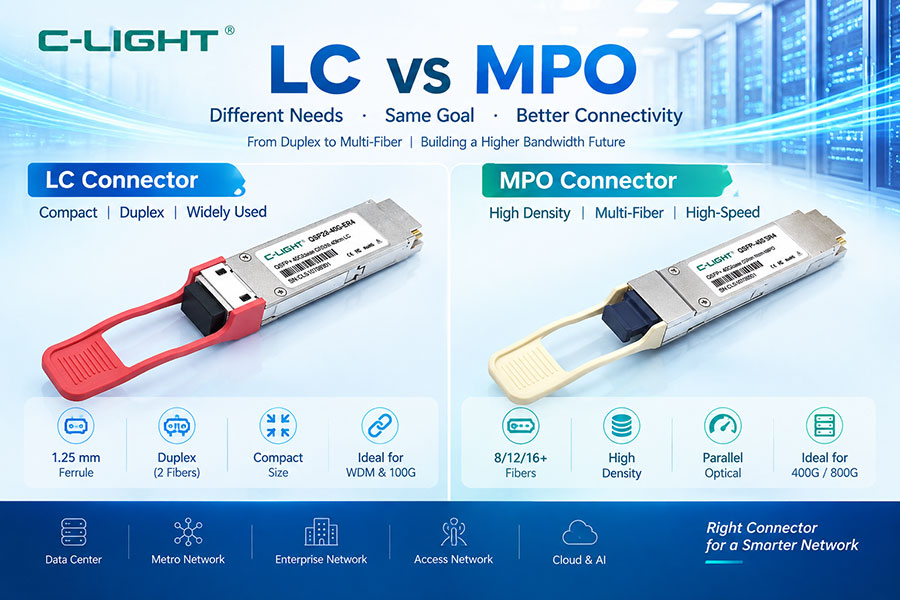
A copper SFP+ normally provides an RJ45 interface, allowing the use of standard Ethernet patch cables. Fiber SFP+ modules commonly use LC connectors, although other connector configurations can be used depending on the application.
17. Power Consumption
Power consumption is another important difference. 10GBASE-T copper SFP+ modules generally require additional PHY processing, equalization, and signal conditioning. As a result, they often consume more power than comparable 10G optical SFP+ modules.
18. Why Copper Uses More Power
High-speed copper transmission must compensate for insertion loss, frequency-dependent attenuation, crosstalk, and other electrical channel impairments. The integrated PHY performs substantial signal processing to maintain reliable 10GbE transmission across twisted-pair cabling.
19. Fiber Power Characteristics
Optical SFP+ modules also consume power for the transmitter, receiver, driver, monitoring, and control functions. However, many conventional 10G optical modules can operate at a lower module power level than 10GBASE-T copper SFP+ solutions.
20. Latency
Both technologies can support low-latency Ethernet connectivity, but their internal architectures differ. Copper 10GBASE-T modules perform additional PHY processing and can introduce more processing delay than simple optical transceiver paths. The actual latency depends on the module architecture and network equipment.
21. Electromagnetic Interference
Copper cabling can be affected by electromagnetic interference, particularly in environments with significant electrical equipment or poor cable management. Fiber is not electrically conductive and is inherently less sensitive to electromagnetic interference, making it useful in electrically noisy environments.
22. Security and Electrical Isolation
Fiber provides electrical isolation between network devices because the transmission medium is non-conductive. Copper creates an electrical connection between endpoints. This difference can matter in industrial, utility, and other environments where electrical isolation is an important design consideration.
23. Installation Complexity
Copper installation is familiar to most Ethernet technicians because RJ45 connectors and twisted-pair patch cables are widely used. Fiber installation requires appropriate optical patch cords, polarity management, connector cleaning, and attention to fiber handling and bend radius.
24. Maintenance
Copper connections are generally straightforward to inspect and replace. Fiber connections require additional attention to connector cleanliness because contamination on optical end faces can increase insertion loss and affect link performance.
25. Existing Infrastructure
Infrastructure is often the deciding factor. A facility with existing Cat6A or Cat7 cabling may use 10G Copper SFP+ modules to upgrade compatible equipment without replacing the horizontal cabling. A facility with established fiber infrastructure may prefer optical SFP+ modules for direct compatibility with the existing fiber plant.
26. Data Center Applications
10G Copper SFP+ modules can be useful for short server, storage, and rack-level Ethernet connections. Fiber SFP+ modules are commonly used for switch-to-switch, server-to-switch, aggregation, and longer structured fiber links.
27. Server Connectivity
A common copper deployment connects an SFP+ switch port to a server with an RJ45 interface. A copper SFP+ module provides the interface conversion needed to connect these two environments through standard Ethernet cabling.
28. Switch-to-Switch Connectivity
Optical SFP+ is often selected for switch-to-switch links where greater distance or lower cable density is required. Copper can still be practical when switches are located within the supported copper reach and compatible RJ45 infrastructure already exists.
29. Rack-Level Connectivity
Short connections within the same rack or between adjacent racks can be suitable for copper SFP+ when the distance remains within the module specification. Optical SFP+ provides more flexibility when the same environment may later require longer connections.
30. High-Density Deployments
Power and thermal density become important as the number of transceiver ports increases. A copper module with higher power consumption can contribute more heat to a densely populated switch. Optical modules can provide a lower-power alternative in many 10G deployments.
31. Fiber Types for 10G SFP+
Common fiber choices include OM3 and OM4 multimode fiber for short-reach 10G applications and OS2 single-mode fiber for longer-reach applications. The correct combination depends on the optical transceiver specification.
32. Copper vs Fiber Cost
Cost should be considered at the system level rather than by module price alone. Copper may be economical when suitable cabling is already installed. Fiber may have higher initial cabling and transceiver costs in some deployments but can provide longer reach and greater scalability.
33. Cabling Flexibility
Copper provides convenient compatibility with conventional Ethernet equipment because RJ45 remains common across enterprise networks. Fiber offers greater flexibility for longer distances and high-density optical infrastructure.
34. Network Upgrade Scenarios
For an existing copper network, 10G Copper SFP+ can provide a relatively simple migration path to 10GbE. For a fiber-based network, optical SFP+ can preserve the existing optical cabling and provide a more direct upgrade path.
35. Compatibility
Physical insertion into an SFP+ slot does not guarantee compatibility. The host switch, router, server NIC, or other device must support the specific transceiver type, data rate, coding, power requirements, and operating mode.
36. EEPROM and Vendor Coding
Many networking platforms verify transceiver identification information through EEPROM data. Vendor coding, supported operating parameters, digital diagnostics, and platform-specific requirements should therefore be confirmed before deployment.
37. Copper Module Compatibility
A host SFP+ port that supports optical 10G modules may not necessarily support every 10GBASE-T RJ45 module. Compatibility should be checked against the equipment documentation or qualified transceiver list.
38. Optical Module Compatibility
Optical compatibility requires matching the module wavelength, fiber type, connector, reach, optical budget, and host interface. For example, an 850nm SR module should not be treated as a replacement for a 1310nm LR module simply because both operate at 10GbE.
39. Optical Link Budget
For fiber connections, the total link loss includes fiber attenuation, connector loss, splice loss, and other passive components. The available optical power budget must be sufficient to maintain a reliable receiver signal throughout the intended link.
40. Copper Signal Integrity
Copper links are affected by insertion loss, return loss, near-end crosstalk, far-end crosstalk, impedance characteristics, and external electromagnetic noise. These factors become increasingly important as cable length and operating frequency increase.
41. Fiber Signal Integrity
Optical links are affected by insertion loss, connector quality, dispersion, reflections, fiber attenuation, and optical power levels. Multimode systems also depend on fiber modal characteristics and the compatibility between the transceiver and fiber grade.
42. Troubleshooting Copper Links
When a copper SFP+ link fails, check host compatibility, module recognition, RJ45 connections, cable category, cable length, port configuration, speed settings, and physical cable condition. Testing with a known-good cable and transceiver can help isolate the problem.
43. Troubleshooting Fiber Links
For optical SFP+ links, check module recognition, wavelength, fiber type, polarity, connector cleanliness, optical power, Tx/Rx levels, cable condition, link budget, and remote-end configuration. DOM or DDM information can provide additional diagnostic data when supported.
44. Copper vs Fiber for Short Reach
For short 10GbE links, both technologies can be technically viable. Copper may simplify deployment where RJ45 infrastructure is already installed, while fiber may provide lower power or greater future distance flexibility depending on the application.
45. Copper vs Fiber for Long Reach
Fiber is generally the practical choice when the required distance exceeds the supported copper reach. Optical transceiver families provide multiple reach options, allowing the same general SFP+ form factor to support different network distances.
46. Copper vs Fiber for AI and Data Center Networks
Although 10G is no longer the dominant bandwidth for many new AI fabrics, 10G connectivity remains relevant for management, legacy infrastructure, enterprise access, storage, and selected server links. In these environments, power density, cabling architecture, and migration strategy can influence the choice between copper and fiber.
47. Copper vs Fiber for Enterprise Networks
Enterprise environments often contain both RJ45 and fiber infrastructure. Copper SFP+ can bridge SFP+ equipment to existing copper-based Ethernet networks, while fiber SFP+ can serve backbone, inter-building, aggregation, and longer-distance connections.
48. Comparison Table
| Parameter | 10G Copper SFP+ | 10G Fiber SFP+ |
|---|---|---|
| Technology | 10GBASE-T | 10G optical Ethernet |
| Medium | Copper | Optical fiber |
| Connector | RJ45 | LC or other optical connector |
| Cabling | Cat6A/Cat7 | OM3/OM4/OM5 or OS2 |
| Typical Reach | Short reach; product dependent | Short to long; module dependent |
| Power | Generally higher | Generally lower for many modules |
| EMI Sensitivity | Higher | Very low |
| Electrical Isolation | No | Yes |
| Existing RJ45 Infrastructure | Excellent fit | Requires fiber |
| Long-Distance Networking | Limited | Well suited |
| Maintenance | Simple copper maintenance | Requires optical cleaning and handling |
| Scalability | Good for short Ethernet links | Strong for fiber-based network expansion |
49. How to Choose Between 10G Copper SFP and Fiber SFP+
Start with the required transmission distance and the existing cabling. Next, verify host-device compatibility and module power requirements. For short Ethernet connections with installed Cat6A or Cat7 infrastructure, copper can be practical. For longer links, fiber infrastructure, lower module power, or electrically isolated connections, optical SFP+ is often the more suitable architecture.
50. Selection Checklist
Before deployment, verify the host SFP+ port, supported transceiver type, transmission distance, cable category or fiber type, connector, wavelength, optical budget where applicable, module power, operating temperature, vendor coding, DOM/DDM support, and remote-end compatibility.
51. Frequently Asked Questions
Q1. Is a 10G Copper SFP the same as a 10G Fiber SFP+?
Q2. What cable does a 10G Copper SFP+ use?
Q3. How far can a 10G Copper SFP+ transmit?
Q4. How far can a 10G Fiber SFP+ transmit?
Q5. Does 10G Copper SFP+ use fiber?
Q6. Does 10G SFP+ always mean optical fiber?
Q7. Which consumes more power, copper or fiber SFP+?
Q8. Can a copper SFP+ and optical SFP+ use the same switch port?
Q9. Is 10G Copper SFP+ suitable for data centers?
Q10. When should fiber SFP+ be selected?
52. Summary
10G Copper SFP+ and 10G Fiber SFP+ both provide 10GbE connectivity, but they solve different networking requirements. Copper SFP+ uses 10GBASE-T and RJ45 copper cabling, making it useful for short-distance Ethernet connections and existing structured copper infrastructure. Fiber SFP+ uses optical transmission and supports a wider range of distances through different SR, LR, ER, and related optical solutions. The final selection should consider distance, cabling, power consumption, compatibility, optical requirements, thermal constraints, and the planned network architecture.
 >
>

 >
>
 >
>
 >
>
 >
>
 >
>
 >
>
 >
>