TEL:+86 132 6656 7067


Fiber optic networks use different cable assemblies to connect equipment, distribute optical signals, and organize high-density fiber infrastructure. Three commonly used categories are fiber patch cords, trunk cables, and breakout cables. Although all three carry optical signals, their structures and deployment purposes are different.
A fiber patch cord provides a direct connection between two optical interfaces. A trunk cable carries multiple fibers between network distribution points, while a breakout cable separates a multi-fiber connection into several individual optical connections.
Understanding these differences is important when planning data center racks, telecom networks, structured cabling systems, and high-speed 100G, 400G, and 800G optical deployments.
1. What Is a Fiber Patch Cord?
A fiber patch cord is a pre-terminated optical cable with connectors installed at both ends. It is commonly used to connect switches, optical transceivers, patch panels, fiber distribution frames, and other optical equipment.
Standard fiber patch cords usually contain one or two fibers, although multi-fiber patch cable assemblies are also available. Common connector types include LC, SC, FC, ST, and MPO/MTP, depending on the application.
Common Characteristics
Connectors are factory-installed at both ends.
Available in simplex and duplex configurations.
Commonly uses LC, SC, FC, or ST connectors.
Available in single-mode and multimode fiber.
Designed for equipment patching and short-distance optical connections.
Available with different cable diameters, jacket materials, and connector polish types.
Typical Applications
Fiber patch cords are used to connect optical transceivers to distribution panels, interconnect equipment ports, and complete connections between different sections of a fiber network.
LC duplex patch cords are especially common in data centers because their compact connectors support high-density equipment and patch-panel layouts.
LC Single-Mode Fiber Patch Cord
The C-LIGHT LC SM Patch Cord is designed for single-mode optical connections using compact LC connectors. Available configurations include 0.9mm, 2.0mm, and 3.0mm cable diameters, with UPC and APC connector options. The product page specifies insertion loss of ≤0.3 dB.
View C-LIGHT LC SM Patch Cord →3.0mm Multimode Fiber Patch Cord
The C-LIGHT 3.0mm MMF Patch Cord supports multimode fiber configurations using 50/125µm or 62.5/125µm fiber. Its product specifications cover 850nm and 1300nm wavelength applications and connector options such as LC and SC.
View C-LIGHT 3.0mm MMF Patch Cord →2. What Is a Fiber Trunk Cable?
A fiber trunk cable is a high-capacity cable assembly designed to carry multiple optical fibers between network distribution locations. It is commonly used as part of the backbone infrastructure in data centers, telecommunications facilities, enterprise campuses, and other large fiber networks.
Trunk cabling is available in different constructions. High-fiber-count backbone cables may contain dozens or hundreds of fibers, while pre-terminated MPO/MTP trunk assemblies provide compact multi-fiber connections between distribution panels or equipment areas.
Common Characteristics
Designed to carry multiple optical fibers in one organized cable structure.
Available in high fiber counts such as 12, 24, 48, 72, 144, and higher configurations.
Pre-terminated MPO/MTP versions can use multi-fiber connectors at both ends.
High-capacity backbone versions may use other termination methods depending on the installation.
Available in single-mode and multimode configurations.
Can be designed for indoor, outdoor, aerial, conduit, or other installation environments.
Typical Applications
Connecting main and horizontal distribution areas in data centers.
Backbone connections between equipment rooms and network racks.
Fiber distribution between telecom cabinets and optical distribution frames.
High-density interconnection between MPO/MTP patch panels.
Campus and metropolitan fiber infrastructure.
C-LIGHT Trunk Fiber Cable
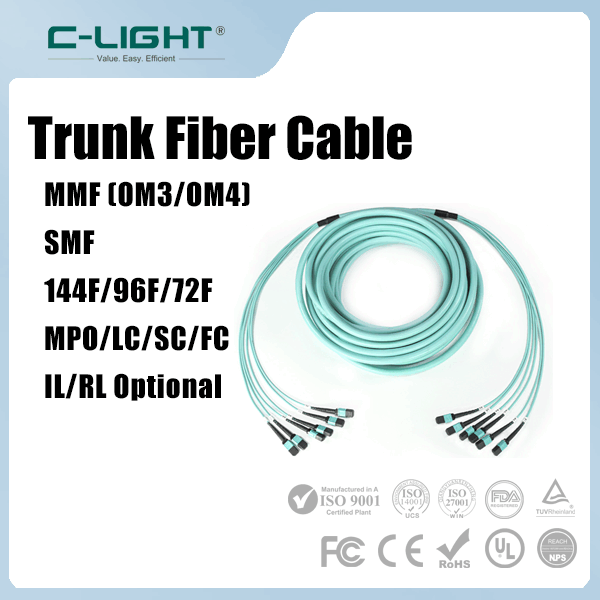
The C-LIGHT Trunk Fiber Cable is a high-capacity backbone cable designed for long-distance, high-bandwidth fiber transmission. Its product information includes high fiber-count constructions, such as 144-core and 288-core configurations, with options involving PE or LSZH jackets and armored designs.
It is intended for data center interconnects, telecom backbone networks, metropolitan networks, and enterprise campus installations.
View C-LIGHT Trunk Fiber Cable →MPO/MTP Pre-Terminated Trunk Assemblies
For high-density data center cabling, pre-terminated MPO/MTP trunk assemblies provide multi-fiber connections at both ends. They can connect patch panels, distribution modules, and compatible optical equipment without terminating every individual fiber during installation.
C-LIGHT MTP-MTP Cable
The C-LIGHT MTP-MTP Fiber Patch Cable uses high-density MTP connectors at both ends. The listed configurations include 8-, 12-, and 24-fiber options, with single-mode and multimode fiber choices.
The product page specifies insertion loss of ≤0.5 dB.
View MTP-MTP Product →C-LIGHT MPO-MPO Cable
The C-LIGHT MPO-MPO Fiber Patch Cable provides multi-fiber connectivity between compatible MPO interfaces. The product information lists 8-, 12-, and 24-core configurations for single-mode and multimode applications.
It is intended for high-density fiber interconnections and parallel optical network environments.
View MPO-MPO Product →3. What Is a Breakout Cable?
A breakout cable, also known as a fanout cable or harness cable, converts a multi-fiber connection into several smaller individual optical connections. A common example is an MPO connector at one end that branches into multiple LC duplex connectors at the other end.
Unlike a trunk cable, which keeps the fibers grouped together between two distribution points, a breakout cable separates the fibers into individual legs so they can connect to separate equipment ports or optical interfaces.
Common Characteristics
Uses one multi-fiber connector at the trunk side in common configurations.
Branches into multiple LC, SC, FC, or other individual connector legs.
Can provide simplex or duplex connections depending on the fiber mapping.
Available in different fiber counts, breakout lengths, and polarity arrangements.
Designed to connect multi-fiber distribution systems to individual equipment ports.
Typical Applications
Connecting MPO distribution panels to LC optical equipment ports.
Breaking out high-density fiber connections into individual duplex links.
Supporting compatible 100G-to-4 × 25G or 400G-to-4 × 100G breakout architectures.
Connecting structured fiber systems to switches, servers, and optical modules.
C-LIGHT MPO-SC/FC/LC/ST Hybrid Fiber Assemblies
The C-LIGHT MPO-SC/FC/LC/ST product family combines multi-fiber MPO interfaces with individual fiber connectors, including SC, FC, LC, and ST. The product page describes customizable MPO-to-LC breakout cable configurations for connecting high-density fiber systems to individual optical interfaces.
The published product information specifies insertion loss of ≤0.5 dB and single-mode or multimode options.
View C-LIGHT MPO Hybrid Assemblies →C-LIGHT MTP-to-SC/FC/LC/ST Hybrid Assemblies
The C-LIGHT MTP SC/FC/LC/ST product family provides hybrid connectivity between high-density MTP interfaces and individual fiber connector types. The product page identifies MTP-LC breakout cables as an application for high-speed interconnection and cross-device integration.
View C-LIGHT MTP Hybrid Assemblies →4. Fiber Patch Cord vs Trunk Cable vs Breakout Cable
These cable types serve different roles within the same fiber network. The following comparison highlights their main structural and functional differences.
| Feature | Fiber Patch Cord | Trunk Cable | Breakout Cable |
|---|---|---|---|
| Primary Function | Direct equipment-to-equipment or equipment-to-panel connection. | High-capacity backbone connectivity between distribution locations. | Converts multi-fiber connections into individual optical interfaces. |
| Fiber Count | Commonly 1 or 2 fibers; multi-fiber versions also exist. | From multiple fibers to hundreds of cores, depending on construction. | Depends on the source MPO/MTP interface and breakout configuration. |
| Connector Structure | LC, SC, FC, ST, or MPO/MTP. | Often MPO/MTP or high-count fiber termination configurations. | One MPO/MTP connector to multiple LC, SC, or other connectors in common designs. |
| Fiber Arrangement | Individual or duplex fibers. | Fibers remain grouped within a common cable structure. | Fibers separate into individual legs. |
| Typical Use | Equipment patching and local connections. | Rack-to-rack, panel-to-panel, and backbone links. | Connecting MPO distribution points to individual device ports. |
| Installation Role | Final equipment connection. | Permanent or semi-permanent backbone routing. | Equipment fanout and interface conversion. |
| Key Selection Factors | Connector type, fiber mode, polish, length, and jacket. | Fiber count, route length, cable construction, environment, and termination. | Fiber mapping, polarity, connector count, leg length, and breakout type. |
Patch cord: connects two individual optical interfaces.
Trunk cable: carries multiple fibers through a backbone route.
Breakout cable: separates a multi-fiber interface into multiple smaller connections.
5. How Are the Three Cable Types Used Together?
In a typical data center structured cabling design, trunk cables, breakout assemblies, and standard patch cords can work together to provide an organized end-to-end optical connection.
The trunk cable provides the main fiber route between distribution locations. The breakout assembly converts a multi-fiber connection into the required individual interfaces. Standard patch cords can then provide local equipment connections where additional patching is needed.
Not every installation requires all three components. A direct equipment connection may only need a patch cord, while a high-density structured cabling system may use a trunk and cassette instead of a separate harness.
6. Applications in 100G, 400G, and 800G Networks
100G Network Infrastructure
100G networks commonly use both duplex LC and parallel MPO interfaces. A duplex LC patch cord can connect LR4 or FR4 optical modules, while MPO assemblies may be used for SR4 and other parallel interfaces.
400G Data Center Networks
400G deployments use different optical architectures. DR4 and SR8 interfaces use parallel optical fibers, while FR4 commonly uses duplex LC connectivity. A suitable MPO trunk can support the required multi-fiber backbone, and a breakout assembly can provide compatible connections to multiple lower-speed ports when the equipment supports the intended breakout mode.
800G Data Center Networks
800G optical interfaces may use MPO-16, dual MPO-12, or duplex LC configurations depending on the specific transceiver design. The cable assembly must match the module's connector arrangement, lane mapping, fiber type, and polarity.
High-density trunk cabling is especially useful for connecting distribution areas, while breakout assemblies simplify the transition to individual device interfaces. Standard patch cords complete local connections and provide flexibility for equipment changes.
7. How to Select the Right Fiber Cable
Cable selection should begin with the network connection being built. The correct choice depends on whether the requirement is a direct equipment connection, a multi-fiber backbone, or a transition from one multi-fiber interface to several individual connections.
Key Selection Factors
Connection purpose: Equipment patching, backbone routing, or breakout conversion.
Fiber type: Single-mode OS2 or multimode OM3, OM4, or OM5.
Fiber count: Simplex, duplex, 8F, 12F, 16F, 24F, or higher-count configurations.
Connector type: LC, SC, FC, ST, MPO, or MTP.
Polarity: Confirm the required fiber mapping for the complete link.
Connector gender: Check pinned and unpinned MPO/MTP interfaces.
End-face polish: Match UPC or APC requirements where specified.
Cable length: Include backbone route length, patching distance, and fanout leg length.
Insertion loss: Confirm the complete channel meets the optical link budget.
Jacket and installation environment: Select suitable PVC, LSZH, OFNR, OFNP, armored, or other specified constructions.
8. Common Cable Selection Mistakes
Using a standard patch cord for a high-density backbone: Multiple individual cords can create unnecessary routing complexity when a trunk assembly is more appropriate.
Using a trunk cable when equipment fanout is required: An MPO-to-MPO cable does not automatically provide individual LC equipment connections.
Selecting a breakout cable without checking polarity: Incorrect fiber mapping can prevent transmit and receive lanes from connecting properly.
Matching only the connector shape: Fiber count, connector gender, key position, and polish must also match.
Ignoring the installation environment: Indoor and outdoor cable constructions can have different jacket and mechanical protection requirements.
Overlooking optical loss: Connector, adapter, splice, and cable losses must be included in the channel budget.
9. C-LIGHT Fiber Optic Cabling Solutions
C-LIGHT provides fiber optic cable assemblies for telecom networks, data centers, enterprise infrastructure, and high-density optical interconnection projects. Its cabling portfolio includes standard patch cords, high-fiber-count trunk cables, MPO/MTP multi-fiber assemblies, and hybrid connector configurations.
Fiber Patch Cords
C-LIGHT offers single-mode and multimode patch cord options with different connector types, fiber specifications, cable diameters, and jacket materials.
Product examples include LC SM Patch Cord and 3.0mm MMF Patch Cord.
Browse C-LIGHT Fiber Cabling Products →Trunk and MPO/MTP Cables
For backbone and high-density distribution, C-LIGHT offers Trunk Fiber Cable, MTP-MTP, and MPO-MPO cable configurations.
These product families support different fiber counts and single-mode or multimode applications, depending on the selected configuration.
Breakout and Hybrid Fiber Assemblies
C-LIGHT's MPO-SC/FC/LC/ST and MTP-SC/FC/LC/ST product families provide hybrid multi-fiber and individual-connector connectivity, including customizable MPO-to-LC breakout configurations.
These assemblies are suitable for applications that need to connect high-density MPO/MTP systems to individual optical equipment interfaces.
For customized projects, the required connector combination, fiber count, polarity, cable length, fiber mode, and installation environment should be provided during the quotation process. This helps ensure that the cable assembly matches the intended equipment and complete optical channel.
10. Conclusion
Fiber patch cords, trunk cables, and breakout cables serve different functions in an optical network. Patch cords provide direct connections between equipment and fiber distribution interfaces. Trunk cables carry multiple fibers through backbone routes, while breakout cables separate multi-fiber connections into individual optical interfaces.
In modern data centers, these cable assemblies often work together. Trunks establish the backbone infrastructure, breakout assemblies connect multi-fiber distribution points to equipment ports, and patch cords provide flexible local connections.
Choosing the correct cable requires checking fiber count, connector type, polarity, fiber mode, length, insertion loss, and installation conditions. Matching these requirements to the network topology helps simplify cabling and maintain reliable optical connectivity.
Looking for Fiber Patch Cords, Trunk Cables, or Breakout Assemblies?
Contact C-LIGHT for fiber optic cabling solutions, MPO/MTP assemblies, customized breakout cables, and high-density data center connectivity.
Contact C-LIGHT >

 >
 >
 >
 >
 >
 >
 >