TEL:+86 132 6656 7067


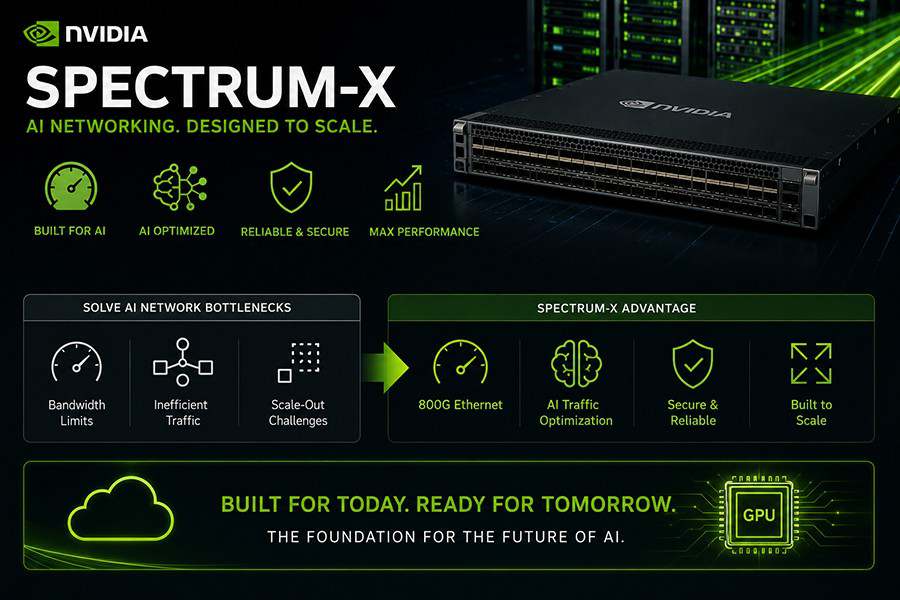
Artificial Intelligence is rapidly transforming industries, driving unprecedented demand for high-performance computing infrastructure. As AI models continue to grow in size and complexity, traditional network architectures are becoming a critical bottleneck. To address this challenge, NVIDIA introduced Spectrum-X, an Ethernet-based networking platform specifically designed for AI workloads.
Spectrum-X is not simply another data center switch solution—it represents a new approach to AI networking, combining high-bandwidth Ethernet, intelligent traffic management, and optimized GPU communication to maximize AI cluster performance.
This innovation is reshaping how enterprises, cloud providers, and AI research organizations build next-generation infrastructure.
The Growing Challenge of AI Networking
Modern AI training clusters often consist of thousands of GPUs working simultaneously. These GPUs continuously exchange massive amounts of data during model training and inference.
Traditional Ethernet networks frequently encounter challenges such as:
Network congestion
Packet loss
Uneven traffic distribution
Increased latency
Reduced GPU utilization
When GPUs wait for data instead of processing workloads, organizations lose valuable computing efficiency and increase operational costs.
As AI infrastructure scales, networking performance becomes just as important as computing power.
What Is NVIDIA Spectrum-X?
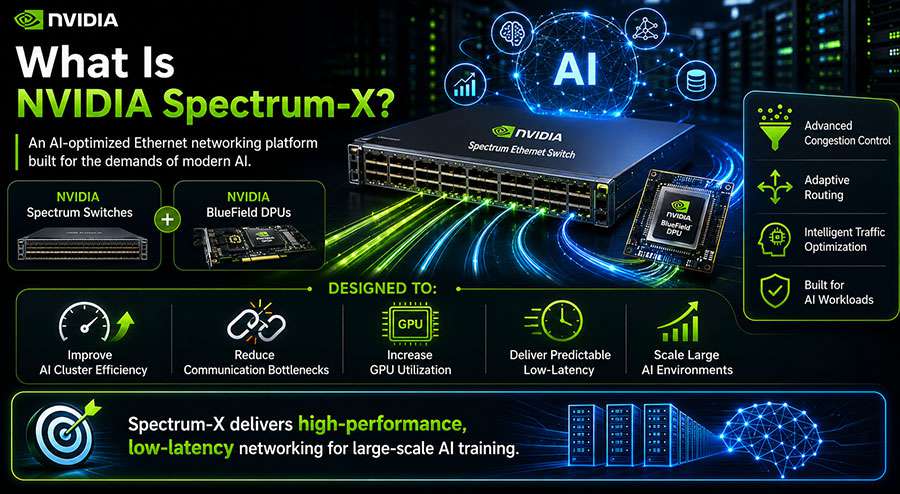
NVIDIA Spectrum-X is an AI-optimized Ethernet networking platform built around NVIDIA Spectrum Ethernet switches and NVIDIA BlueField DPUs.
The platform is designed to:
Improve AI cluster efficiency
Reduce communication bottlenecks
Increase GPU utilization
Deliver predictable low-latency performance
Scale large AI training environments
Unlike conventional Ethernet networks, Spectrum-X introduces advanced congestion control, adaptive routing, and intelligent traffic optimization specifically tailored for AI workloads.
The result is a networking environment capable of supporting large-scale distributed AI training with significantly improved performance.
Key Technologies Behind Spectrum-X
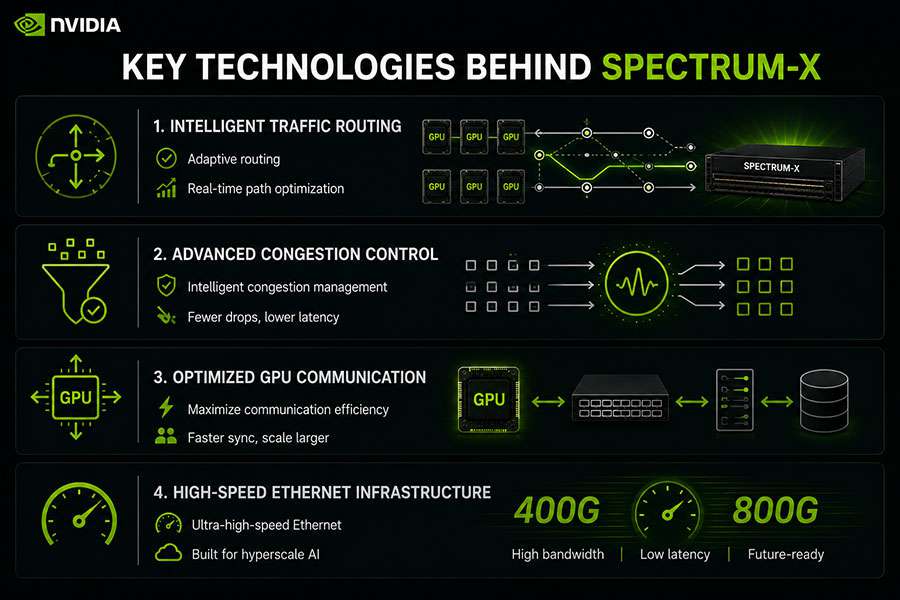
●Intelligent Traffic Routing
AI workloads generate highly dynamic east-west traffic across GPU clusters.
Spectrum-X uses adaptive routing mechanisms to identify the most efficient paths in real time, helping reduce congestion and improve overall network utilization.
●Advanced Congestion Control
Network congestion can severely impact distributed AI training.
Spectrum-X introduces intelligent congestion management technologies that balance traffic loads across the network, minimizing packet drops and reducing latency.
●Optimized GPU Communication
The platform is designed to maximize communication efficiency between GPUs, storage systems, and compute nodes.
This enables faster synchronization during AI model training and supports larger-scale deployments.
●High-Speed Ethernet Infrastructure
Spectrum-X supports ultra-high-speed Ethernet connectivity, including 400G and 800G networking environments, making it suitable for hyperscale AI data centers and cloud infrastructures.
Why Spectrum-X Matters for AI Infrastructure
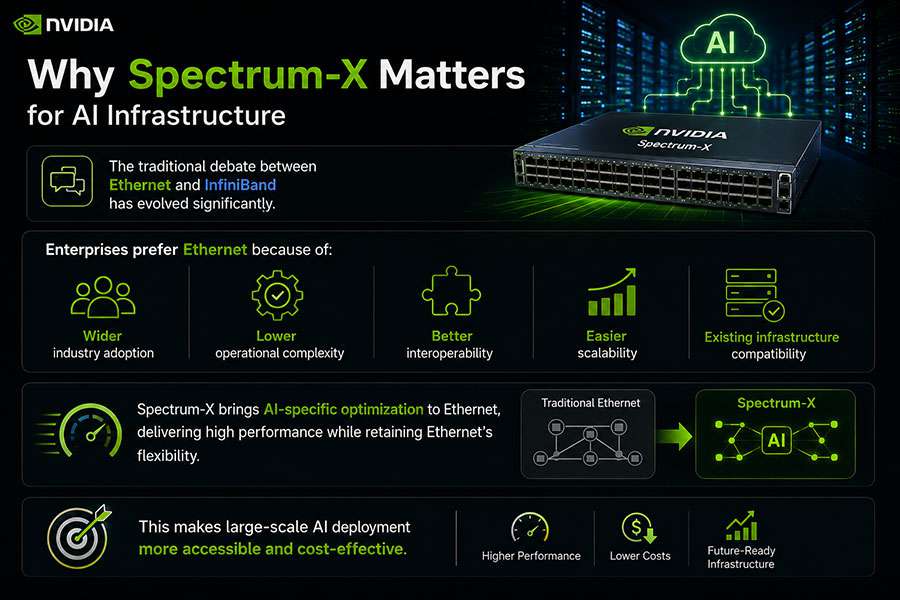
The traditional debate between Ethernet and InfiniBand has evolved significantly.
While InfiniBand remains popular in certain high-performance computing environments, many enterprises prefer Ethernet because of:
Wider industry adoption
Lower operational complexity
Better interoperability
Easier scalability
Existing infrastructure compatibility
Spectrum-X brings AI-specific optimization to Ethernet, allowing organizations to achieve many of the benefits previously associated with specialized networking technologies while maintaining Ethernet's flexibility.
This makes large-scale AI deployment more accessible and cost-effective.
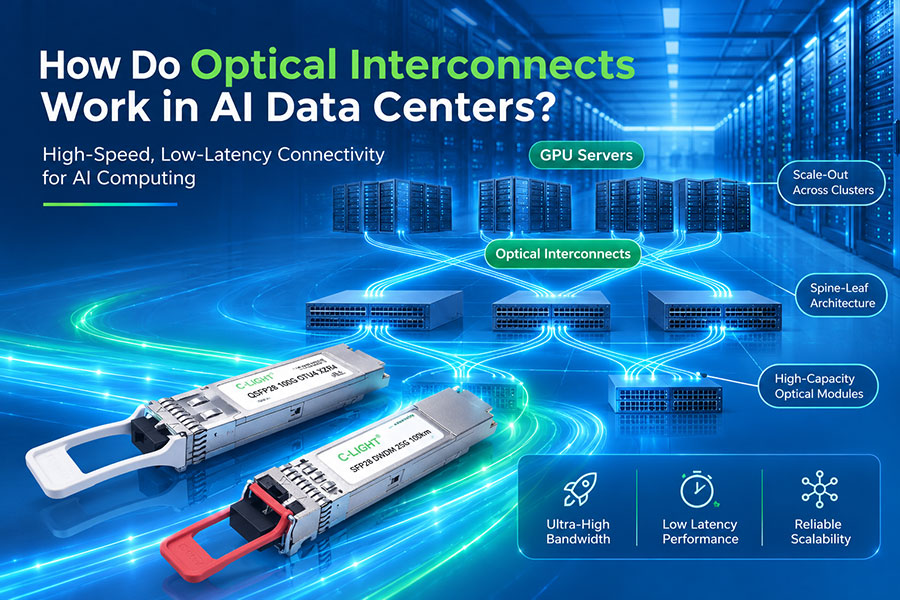
Optical Connectivity: The Foundation of AI Networking
As AI clusters continue expanding, high-performance optical connectivity becomes increasingly important.
Large-scale GPU clusters rely on high-density optical interconnects to support massive east-west traffic flows.
C-LIGHT provides a range of optical networking products that can support modern AI data center deployments, including:
High-Speed Optical Transceivers
C-LIGHT offers:
800G OSFP and 800G QSFP-DD Solutions
These products enable high-bandwidth connectivity between switches, servers, storage systems, and AI computing nodes.
Data Center WDM Solutions
For large-scale AI campuses and distributed computing environments, C-LIGHT CWDM and DWDM solutions help maximize fiber utilization while reducing infrastructure costs.
Typical products include:
These technologies support efficient optical transport for high-capacity AI traffic.
Fiber Connectivity Infrastructure
Reliable fiber connectivity remains critical for AI networking performance.
C-LIGHT provides:
Fiber Patch Panels
High-Density Optical Distribution Solutions
These products help simplify deployment and scaling of AI data center networks.
Spectrum-X and the Future of AI Networking
AI infrastructure is entering a new era where networking performance directly impacts business outcomes.
As AI clusters continue growing from hundreds to thousands of GPUs, network efficiency becomes a key factor in determining:
Training speed
Infrastructure utilization
Energy efficiency
Operational cost
Scalability
NVIDIA Spectrum-X addresses these challenges by transforming Ethernet into a high-performance AI networking platform capable of supporting next-generation AI workloads.
Combined with advanced optical connectivity solutions, high-speed transceivers, and scalable WDM infrastructure from providers such as C-LIGHT, organizations can build future-ready AI networks designed for the demands of large-scale artificial intelligence.
NVIDIA Spectrum-X is redefining AI networking by bringing intelligent traffic management, congestion control, and optimized GPU communication to Ethernet-based infrastructures.
As enterprises accelerate AI adoption, the combination of AI-optimized networking and high-performance optical connectivity will become essential for achieving maximum infrastructure efficiency.
Organizations planning future AI deployments should carefully evaluate both networking architecture and optical transport infrastructure to ensure their data centers are ready for the next generation of AI innovation.
NVIDIA Spectrum-X AI Networking FAQ
Q1: What is NVIDIA Spectrum-X Ethernet Platform?
Answer: NVIDIA Spectrum-X is an AI-focused Ethernet networking platform designed to improve the performance and efficiency of large-scale AI data center networks.
Unlike traditional Ethernet environments optimized for general data traffic, Spectrum-X is designed specifically for AI workloads such as:
Large Language Model (LLM) training
Distributed AI computing
GPU cluster communication
High-performance computing (HPC)
The platform combines AI-optimized Ethernet switches, SuperNIC networking adapters, and software technologies to provide high-bandwidth and predictable network performance for AI infrastructure.
Q2: Why is NVIDIA Spectrum-X important for AI data centers?
Answer: AI workloads create massive communication requirements between GPUs, servers, and storage systems.
During AI model training, GPUs frequently exchange large amounts of data through distributed computing processes. Traditional Ethernet networks may face challenges such as:
Network congestion
Unpredictable latency
Reduced GPU utilization
Limited scalability
Spectrum-X addresses these challenges by optimizing Ethernet networking for AI communication patterns, helping improve AI cluster efficiency and scalability.
Q3: How does NVIDIA Spectrum-X improve AI network performance?
Answer: NVIDIA Spectrum-X improves AI networking performance through hardware and software optimization across the entire network stack.
Key technologies include:
AI-optimized Ethernet switching
Advanced RoCE (RDMA over Converged Ethernet)
Network congestion management
Performance optimization for GPU communication
End-to-end network monitoring
These technologies help provide more consistent bandwidth and lower latency for large-scale AI workloads.
Q4: What is the difference between NVIDIA Spectrum-X and traditional Ethernet networking?
Answer: The main difference is that Spectrum-X is specifically optimized for AI workloads, while traditional Ethernet is designed for general-purpose networking.
| Feature | Traditional Ethernet | NVIDIA Spectrum-X |
| Main Purpose | General data communication | AI workload networking |
| Traffic Pattern | Mixed applications | GPU-intensive workloads |
| Optimization | Standard Ethernet | AI-optimized architecture |
| Latency Control | General networking | AI-focused performance control |
| Application | Enterprise/cloud | AI clusters and HPC |
Spectrum-X adds AI-specific networking optimization while maintaining Ethernet compatibility.
Q5: How does Spectrum-X support GPU clusters and AI fabrics?
Answer: Large AI clusters require high-speed communication between thousands of GPUs.
Spectrum-X supports AI fabric architectures by enabling:
High-bandwidth GPU-to-GPU communication
Efficient distributed training
Scalable Ethernet-based AI networks
Improved network utilization
In AI data centers, Spectrum-X works together with GPU servers, networking adapters, switches, and optical interconnect solutions to build large-scale AI infrastructure.
Q6: What role do optical modules and cables play in Spectrum-X AI networks?
Answer: High-performance AI networks require reliable high-speed physical connections between servers and switches.
Optical interconnect solutions such as:
400G optical transceivers
800G optical modules
DAC cables
AOC cables
provide the bandwidth required for AI cluster communication.
Depending on network distance and architecture:
DAC is commonly used for short server-to-switch connections.
AOC supports flexible rack-to-rack connections.
Optical transceivers support larger-scale network links.
These interconnect technologies are essential for building scalable AI Ethernet fabrics.
Q7: Why is Ethernet becoming important for AI networking?
Answer: Traditionally, AI clusters often relied on specialized networking technologies. However, Ethernet is becoming increasingly important because it provides:
Open ecosystem support
Broad industry adoption
Flexible scalability
Compatibility with cloud infrastructure
AI-specific Ethernet solutions such as Spectrum-X aim to combine Ethernet flexibility with the performance required for large AI workloads.
Q8: What is the future of NVIDIA Spectrum-X and AI networking?
Answer: As AI models continue growing, future data centers will require:
Higher bandwidth connectivity
Lower network latency
Better power efficiency
Larger GPU cluster scalability
The evolution toward:
400G AI networking
800G Ethernet infrastructure
Advanced optical interconnect
Future AI fabric architectures
will require optimized networking platforms like Spectrum-X.
AI networking is becoming a critical foundation for next-generation AI data centers, where computing performance depends not only on GPUs but also on high-speed communication infrastructure.
 >
>

 >
>
 >
>
 >
>
 >
>
 >
>
 >
>
 >
>