TEL:+86 132 6656 7067


1. The Breaking Point of Traditional AI Networking
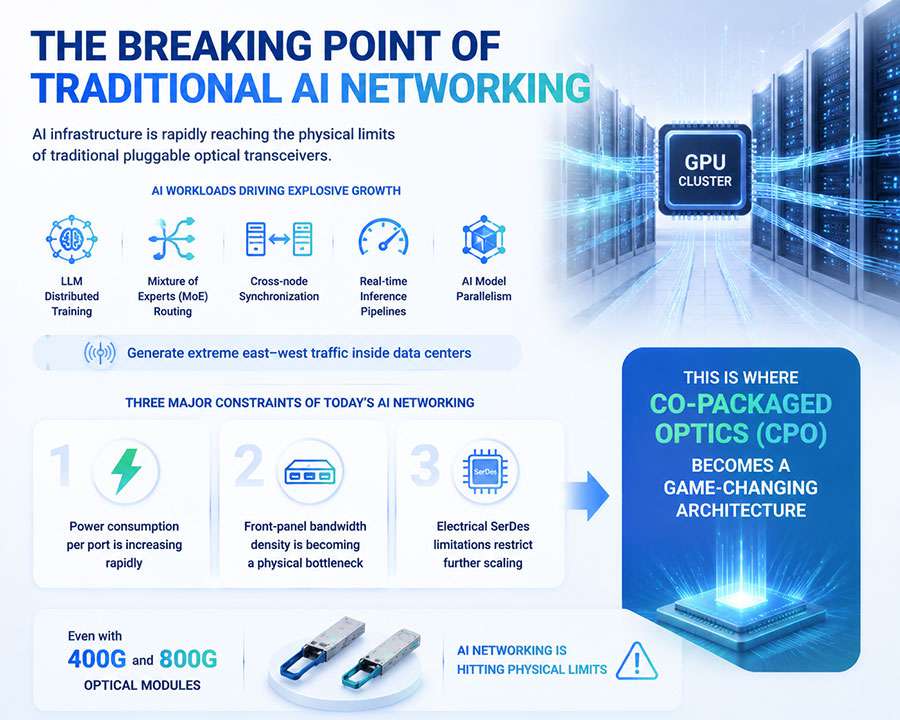
Artificial Intelligence infrastructure is rapidly reaching the physical limits of traditional pluggable optical transceivers.
As GPU clusters scale into tens of thousands of accelerators, modern AI workloads such as:
LLM distributed training
Mixture of Experts (MoE) routing
Cross-node synchronization
Real-time inference pipelines
AI model parallelism
generate extreme levels of east-west traffic inside data centers.
Even with 400G and 800G optical modules, AI networking is facing three major constraints:
Power consumption per port is increasing rapidly
Front-panel bandwidth density is becoming a physical bottleneck
Electrical SerDes limitations restrict further scaling
This is where Co-Packaged Optics (CPO) becomes a game-changing architecture.
2. What Is CPO and Why It Matters
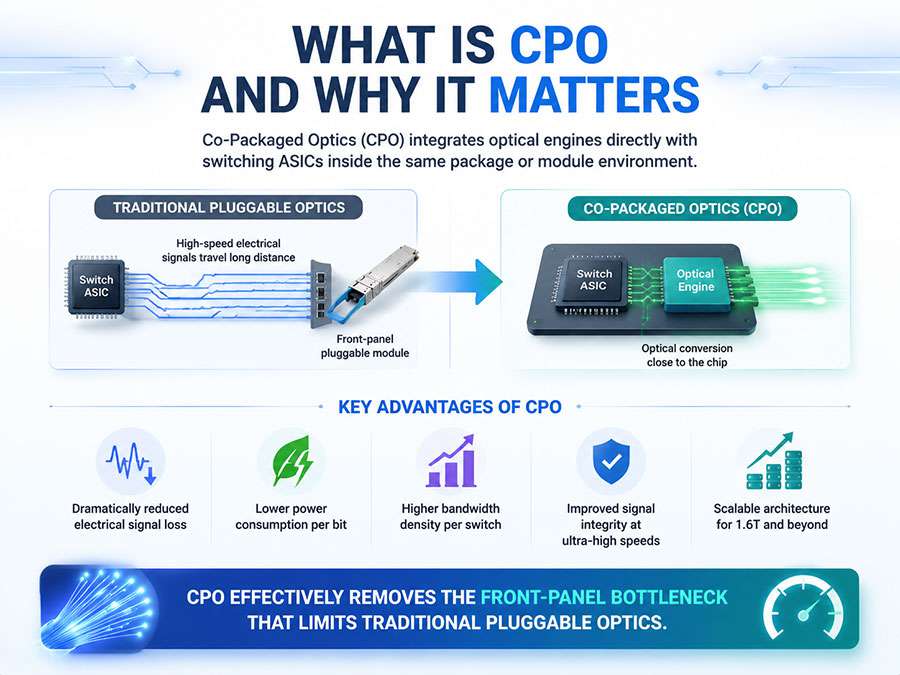
Co-Packaged Optics (CPO) integrates optical engines directly with switching ASICs inside the same package or module environment.
Instead of routing high-speed electrical signals to front-panel pluggable modules, CPO moves optical conversion closer to the chip.
Key Advantages of CPO:
Dramatically reduced electrical signal loss
Lower power consumption per bit
Higher bandwidth density per switch
Improved signal integrity at ultra-high speeds
Scalable architecture for 1.6T and beyond
CPO effectively removes the front-panel bottleneck that limits traditional pluggable optics.
3. Why AI Networking Needs CPO Now
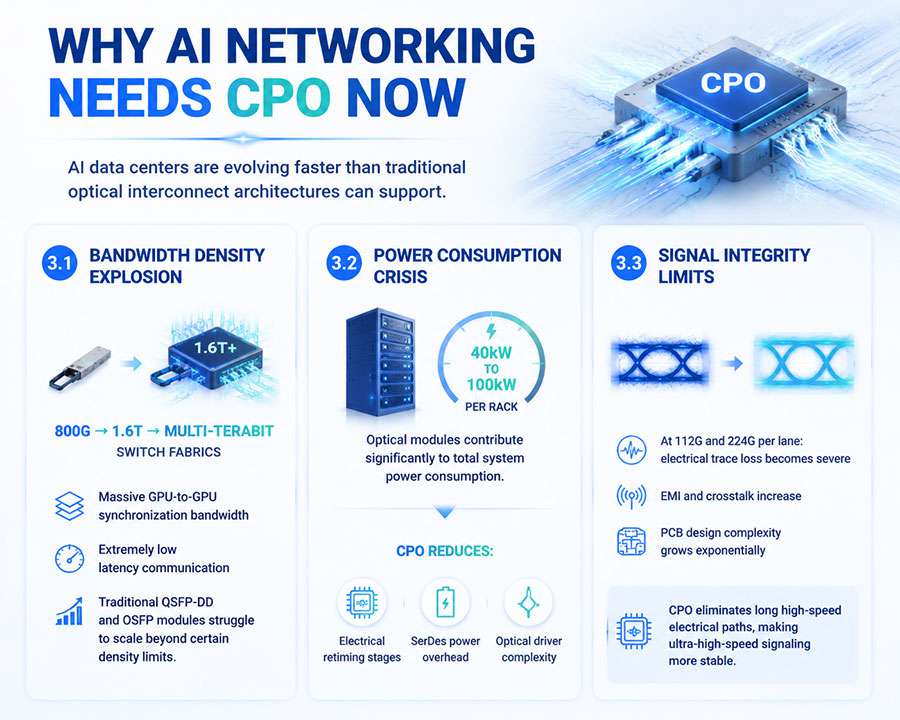
AI data centers are evolving faster than traditional optical interconnect architectures can support.
3.1 Bandwidth Density Explosion
Next-generation AI clusters require:
800G → 1.6T → multi-terabit switch fabrics
Massive GPU-to-GPU synchronization bandwidth
Extremely low latency communication
Traditional QSFP-DD and OSFP modules struggle to scale beyond certain density limits.
3.2 Power Consumption Crisis
Modern AI racks already exceed:
40kW to 100kW per rack
Optical modules contribute significantly to total system power consumption.
CPO reduces:
Electrical retiming stages
SerDes power overhead
Optical driver complexity
3.3 Signal Integrity Limits
At 112G and 224G per lane:
Electrical trace loss becomes severe
EMI and crosstalk increase
PCB design complexity grows exponentially
CPO eliminates long high-speed electrical paths, making ultra-high-speed signaling more stable.
4. CPO vs Traditional Pluggable Optics
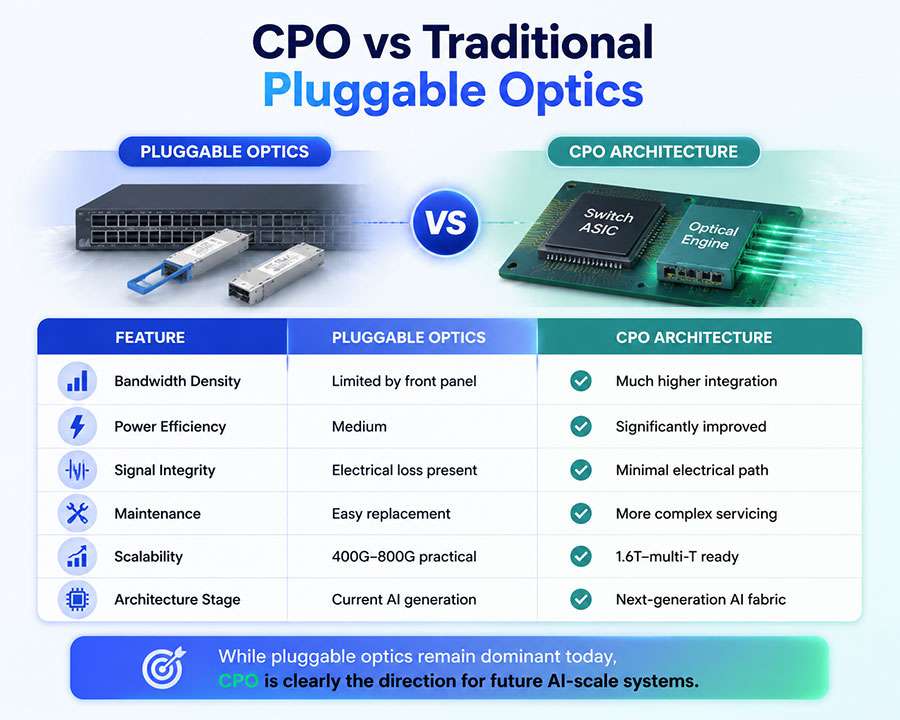
While pluggable optics remain dominant today, CPO is clearly the direction for future AI-scale systems.
5. Transition Path: From Pluggable Optics to CPO
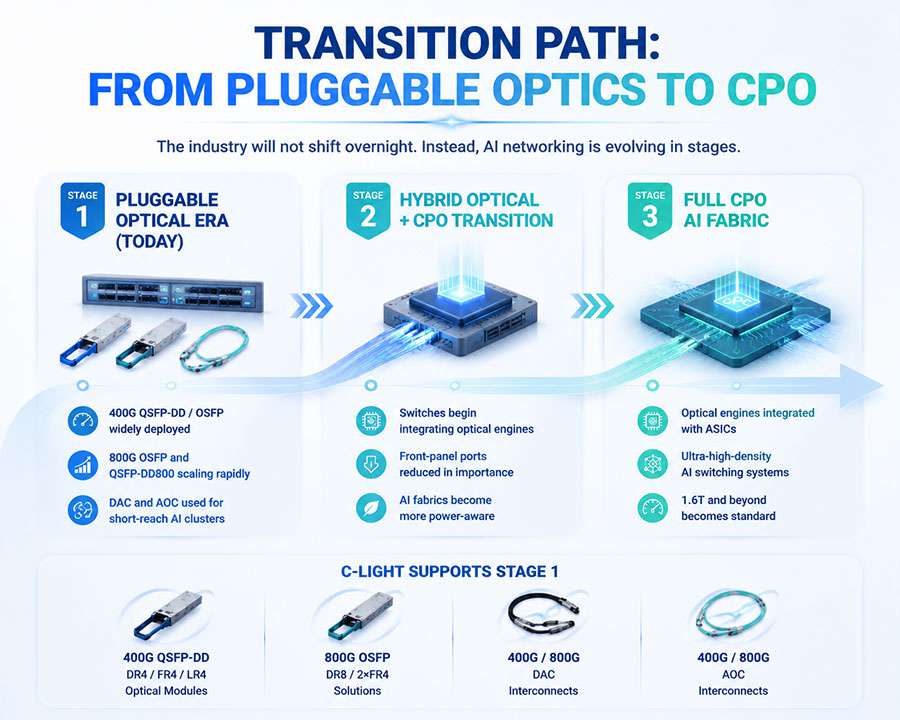
The industry will not shift overnight. Instead, AI networking is evolving in stages:
Stage 1: Pluggable Optical Era (Today)
400G QSFP-DD / OSFP widely deployed
800G OSFP and QSFP-DD800 scaling rapidly
DAC and AOC used for short-reach AI clusters
C-LIGHT supports this stage with:
400G QSFP-DD DR4 / FR4 / LR4 optical modules
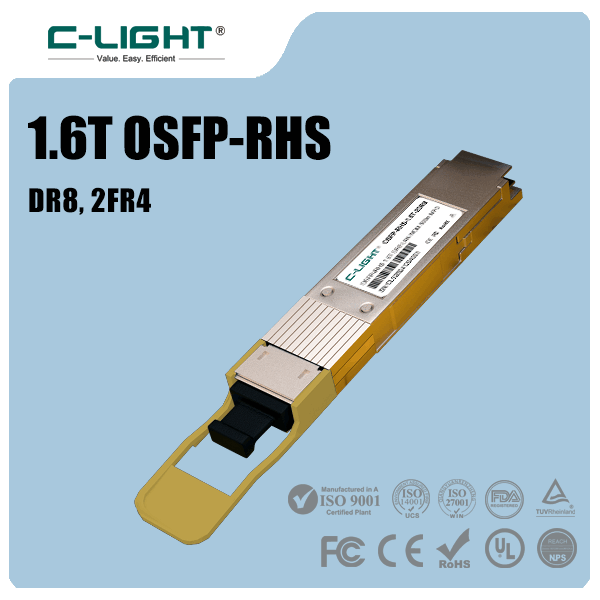
800G OSFP DR8 / 2×FR4 solutions
400G/800G DAC and AOC interconnects
Stage 2: Hybrid Optical + CPO Transition
Switches begin integrating optical engines
Front-panel ports reduced in importance
AI fabrics become more power-aware
Stage 3: Full CPO AI Fabric
Optical engines integrated with ASICs
Ultra-high-density AI switching systems
1.6T and beyond becomes standard
6. Where CPO Will Be Used in AI Data Centers
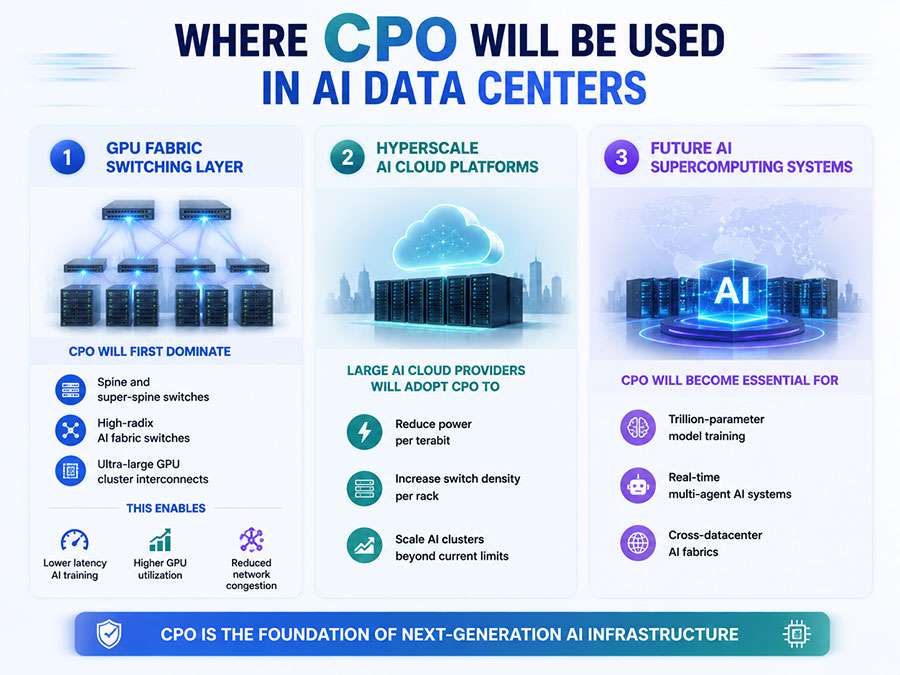
6.1 GPU Fabric Switching Layer
CPO will first dominate:
Spine and super-spine switches
High-radix AI fabric switches
Ultra-large GPU cluster interconnects
This enables:
Lower latency AI training
Higher GPU utilization
Reduced network congestion
6.2 Hyperscale AI Cloud Platforms
Large AI cloud providers will adopt CPO to:
Reduce power per terabit
Increase switch density per rack
Scale AI clusters beyond current limits
6.3 Future AI Supercomputing Systems
CPO will become essential for:
Trillion-parameter model training
Real-time multi-agent AI systems
Cross-datacenter AI fabrics
7. The Role of C-LIGHT in the CPO Era
While CPO defines the future architecture, pluggable optics will remain essential during the transition period.
C-LIGHT provides a full-stack optical interconnect ecosystem that bridges today’s infrastructure with future CPO systems:
7.1 Current Generation Solutions
400G DAC / AOC / optical modules
800G OSFP and 800G QSFP-DD interconnects
High-density AI cluster networking solutions
7.2 Advanced Optical Infrastructure
DWDM / CWDM transport systems
MUX/DEMUX platforms for AI data center interconnect
Long-reach optical networking solutions
7.3 AI Networking Enablement
Compatibility testing for NVIDIA / Broadcom / Intel platforms
BER / eye diagram / reliability validation
Custom coding for switch ecosystems
These capabilities ensure smooth evolution from pluggable optics toward CPO-based architectures.
8. Why CPO Will Define the Next Decade of AI Networking
CPO is not just an incremental improvement—it represents a structural shift in how AI infrastructure is built.
It enables:
Higher bandwidth per switch
Lower power per bit
More compact AI fabric design
Scalable trillion-parameter computing systems
As AI models continue to grow exponentially, the networking layer must evolve accordingly.
CPO provides the only scalable path beyond 800G and 1.6T pluggable optics.
9. Conclusion
AI infrastructure is approaching a fundamental limit in traditional pluggable optical architectures.
400G and 800G optics power today’s AI clusters
1.6T defines the next evolutionary step
CPO represents the long-term architectural breakthrough
Together, they form a continuous evolution of AI networking.
C-LIGHT supports this entire journey with:
400G and 800G optical interconnect portfolios
DAC and AOC solutions for short-reach AI clusters
DWDM systems for scalable data center interconnect
Future-ready optical architecture planning toward CPO-era AI systems
As AI computing scales toward unprecedented levels, CPO will become the foundation of next-generation AI networking architecture.
Why CPO Is the Future of AI Networking FAQ
Q1: What is CPO (Co-Packaged Optics) in AI networking?
Answer: CPO (Co-Packaged Optics) is an advanced optical interconnect architecture that integrates optical engines directly with switching ASICs or processing chips.
Unlike traditional pluggable optical modules where high-speed electrical signals travel across PCB traces before reaching optical components, CPO places optical conversion much closer to the chip.
The main benefits of CPO include:
Lower power consumption
Reduced electrical signal loss
Higher bandwidth density
Improved signal integrity
Better scalability for future AI networks
CPO is considered a key technology for next-generation AI data center networking.
Q2: Why does AI networking need CPO technology?
Answer: AI workloads generate extremely high communication traffic between GPUs, switches, and storage systems.
Large AI clusters supporting:
Large Language Model (LLM) training
Distributed AI computing
Mixture of Experts (MoE)
Real-time AI inference
require massive east-west data movement.
Traditional optical architectures face challenges such as:
Increasing power consumption
Limited switch front-panel density
Higher electrical signal loss
Thermal management pressure
CPO helps overcome these limitations by moving optical conversion closer to the switching silicon.
Q3: How does CPO improve AI data center network efficiency?
Answer: CPO improves network efficiency by reducing the distance that high-speed electrical signals travel inside networking equipment.
Traditional architecture:
Switch ASIC → PCB Trace → Pluggable Optical Module → Fiber
CPO architecture:
Switch ASIC → Optical Engine → Fiber
By shortening electrical paths, CPO can reduce:
Signal attenuation
Power consumption
Electrical interference
System complexity
This makes CPO suitable for ultra-high bandwidth AI networking environments.
Q4: What is the difference between CPO and traditional optical transceivers?
Answer: The main difference is where optical components are located.
| Feature | Traditional Optical Module | CPO |
| Optical Location | Front-panel pluggable module | Integrated near ASIC |
| Electrical Path | Longer | Shorter |
| Power Consumption | Higher | Lower |
| Bandwidth Density | Limited | Higher |
| Maintenance | Easier replacement | More complex |
Traditional optical transceivers remain widely used today because of flexibility and compatibility, while CPO targets future high-density AI networking requirements.
Q5: Why is CPO important for 800G and 1.6T AI networks?
Answer: AI networks are rapidly moving toward higher bandwidth requirements.
The evolution path includes:
400G optical networking
800G optical interconnect
1.6T networking
Multi-terabit AI fabrics
At higher speeds, electrical signal transmission becomes increasingly challenging due to:
Higher power consumption
Signal integrity issues
PCB design limitations
CPO provides a scalable architecture for supporting future high-speed AI networks beyond traditional pluggable optics.
Q6: What is the relationship between CPO and Silicon Photonics?
Answer: Silicon Photonics is one of the key technologies enabling CPO development.
The relationship is:
Silicon Photonics
→ Provides integrated optical components
CPO
→ Places optical engines closer to switching chips
Together, they enable:
Higher optical integration
Lower power consumption
Improved bandwidth scalability
Future AI networking architectures
Q7: What challenges does CPO face before large-scale adoption?
Answer: Although CPO provides significant advantages, several challenges remain.
Key challenges include:
Higher manufacturing complexity
More difficult testing processes
New system integration requirements
Maintenance challenges
Ecosystem development
Unlike pluggable optics that can be easily replaced, CPO requires closer integration between optical components, ASICs, packaging technology, and networking systems.
Q8: Will CPO replace optical transceivers in future AI data centers?
Answer: CPO is expected to become an important future technology, but it will not immediately replace all optical transceivers.
The industry is likely to evolve through several stages:
Current Stage
400G / 800G pluggable optical modules
DAC and AOC interconnect solutions
Transition Stage
Hybrid pluggable optics and CPO architectures
Future Stage
Large-scale CPO-based AI fabrics
1.6T and higher-speed optical systems
Pluggable optics will continue supporting current AI deployments, while CPO will provide the long-term path for ultra-scale AI networking.
 >
>

 >
>
 >
>
 >
>
 >
>
 >
>
 >
>
 >
>