TEL:+86 132 6656 7067


QSFP and QSFP28 are both transceivers used in data centers and networks, but they differ mainly in speed and intended application. QSFP (and its enhanced version QSFP+) supports 40G data rates, while QSFP28 is designed for 100G data rates.
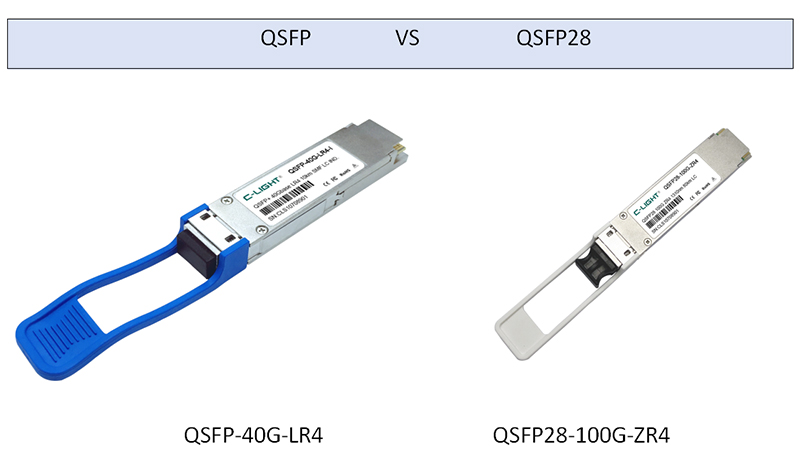
Here is a quick overview of their key differences:
| Feature | QSFP/QSFP+ | QSFP28 |
| Primary Application | 40 Gigabit Ethernet (40GbE) | 100 Gigabit Ethernet (100GbE) |
| Data Rate | 40 Gbps aggregate (4 x 10 Gbps lanes) | 100 Gbps aggregate (4 x 25 Gbps lanes) |
| Form Factor | Same physical size; hot-pluggable | Same physical size; hot-pluggable |
| Typical Connectors | LC Duplex or MPO/MTP | LC Duplex or MPO/MTP |
| Typical Standards | IEEE 802.3ba, 40GBASE-SR4, LR4 | IEEE 802.3bm, 100GBASE-SR4, LR4, CWDM4 |
| Power Consumption | Generally lower | Generally higher |
| Key Use Case | Data center aggregation, high-performance computing | Data center core, high-density 100G connections |
Technical and Application Differences
Beyond the specifications, their real-world use differs in several key ways:
Speed and Lane Configuration: Both are "Quad" modules, meaning they use four lanes. However, QSFP+ uses four 10 Gbps lanes to achieve 40 Gbps, whereas QSFP28 uses four 25 Gbps lanes to achieve 100 Gbps.
Flexibility and Breakout Modes: QSFP28 is more flexible. Beyond the standard 4x25G mode, some variants can operate in 2x50G or 1x100G modes. Both can also be "broken out" to connect to lower-speed devices. For example, a QSFP+ port can be split to connect four 10G devices, and a QSFP28 port can be split to connect four 25G devices.
Physical Compatibility: Their same physical size allows for important backward compatibility: a QSFP28 port on a modern switch can typically accept a QSFP+ module, but it will run at the lower 40G speed. The reverse (plugging QSFP28 into a QSFP+ port) is not supported
How to Choose Between Them
Your choice depends almost entirely on your network's speed requirements and existing infrastructure:
Choose QSFP/QSFP+ if you are building or maintaining a 40G network backbone, connecting switches that require 40G uplinks, or looking for a cost-effective solution where 40G performance is sufficient.
Choose QSFP28 if you are deploying a new 100G data center core or spine, require future-proof high-density connectivity, or need the flexibility for breakout configurations to multiple 25G servers.
QSFP vs QSFP28 Optical Transceiver FAQ
Q1: What is the difference between QSFP and QSFP28?
Answer: The main difference between QSFP and QSFP28 is the supported data rate.
QSFP/QSFP+ is designed for 40G Ethernet, using four 10Gbps electrical lanes to provide 40Gbps aggregate bandwidth.
QSFP28 is designed for 100G Ethernet, using four 25Gbps electrical lanes to deliver 100Gbps aggregate bandwidth.
Although both modules share the same physical form factor, QSFP28 provides higher bandwidth and is widely used in modern data center networks.
Q2: What is a QSFP optical transceiver?
Answer: A QSFP (Quad Small Form-factor Pluggable) optical transceiver is a high-density optical module designed to provide multiple data channels in a compact package.
QSFP+ typically supports:
40Gbps total bandwidth
4×10Gbps lanes
40G Ethernet applications
Data center aggregation and network backbone connections
QSFP+ modules are commonly available in SR4, LR4, and ER4 versions for different transmission distances.
Q3: What is a QSFP28 optical transceiver?
Answer: A QSFP28 optical transceiver is a 100G optical module designed for high-speed data center and telecom networking applications.
QSFP28 uses:
Four 25Gbps electrical lanes
100Gbps aggregate bandwidth
Compact QSFP form factor
Support for 100G Ethernet applications
Common QSFP28 solutions include 100G SR4, LR4, ER4, CWDM4, and PSM4 optical modules.
Q4: What is the difference between QSFP and QSFP28 in data rate and lane configuration?
Answer: The key difference between QSFP and QSFP28 is the lane speed.
| Feature | QSFP+ | QSFP28 |
| Total Data Rate | 40Gbps | 100Gbps |
| Electrical Lanes | 4 lanes | 4 lanes |
| Per Lane Speed | 10Gbps | 25Gbps |
| Main Application | 40G Ethernet | 100G Ethernet |
Both use a four-channel architecture, but QSFP28 significantly increases bandwidth by improving the speed of each lane.
Q5: Are QSFP and QSFP28 modules physically compatible?
Answer: QSFP and QSFP28 modules share the same physical dimensions and hot-pluggable design, allowing network equipment manufacturers to maintain similar switch and router port designs.
In many cases, QSFP28 ports can support QSFP+ modules and operate at 40G speeds. However, QSFP+ ports cannot support QSFP28 modules running at 100G because the hardware does not provide the required bandwidth capability.
Q6: What is the difference between QSFP and QSFP28 applications?
Answer: QSFP+ and QSFP28 target different network environments.
QSFP+ Applications:
40G data center aggregation
Enterprise backbone networks
High-performance computing systems
Storage networks
QSFP28 Applications:
100G data center spine-leaf networks
Cloud computing infrastructure
AI and HPC clusters
Data center interconnect (DCI)
QSFP28 is becoming the preferred choice for new high-bandwidth data center deployments.
Q7: Should I upgrade from QSFP+ to QSFP28?
Answer: The decision depends on network bandwidth requirements and future expansion plans.
Choose QSFP+ when:
Existing infrastructure operates at 40G
Current bandwidth requirements are limited
Cost optimization is the priority
Choose QSFP28 when:
Deploying new 100G networks
Higher bandwidth density is required
Future network scalability is important
Supporting AI, cloud, or high-performance computing workloads
QSFP28 provides a smoother migration path toward higher-speed networking technologies.
Q8: How do I choose between QSFP and QSFP28 optical modules?
Answer: Selecting between QSFP and QSFP28 depends on:
Required network speed
Switch and router compatibility
Transmission distance
Fiber infrastructure
Power and thermal requirements
Future upgrade plans
For existing 40G networks, QSFP+ remains a reliable solution. For modern data centers requiring higher bandwidth and scalability, QSFP28 is generally the better choice.
 >
>

 >
>
 >
>
 >
>
 >
>
 >
>
 >
>
 >
>