TEL:+86 132 6656 7067


The explosive growth of Artificial Intelligence (AI), machine learning, cloud computing, and high-performance computing (HPC) is placing unprecedented demands on data center networks. As network speeds evolve from 400G to 800G and move toward 1.6T and beyond, traditional pluggable optical transceivers are approaching their physical and power-efficiency limits.
To overcome these challenges, the industry is increasingly turning its attention to Co-Packaged Optics (CPO)—a revolutionary optical interconnect architecture designed to support the next generation of AI and hyperscale networking infrastructure.
CPO is widely regarded as one of the most promising technologies for enabling future high-bandwidth, low-power, and highly scalable network architectures.
What Is Co-Packaged Optics (CPO)?
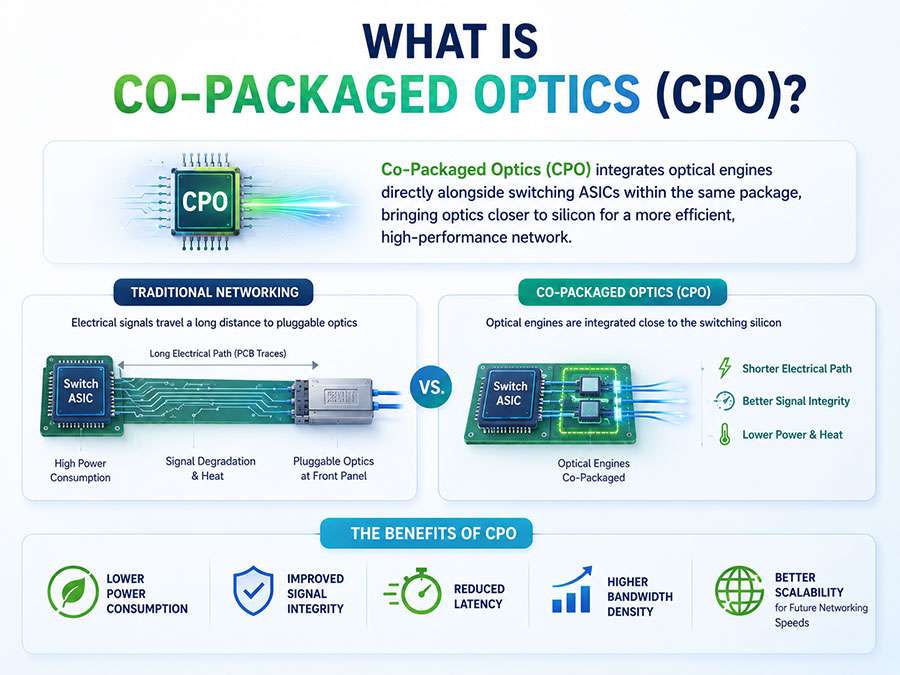
Co-Packaged Optics (CPO) is an advanced networking technology that integrates optical engines directly alongside switching ASICs or processing chips within the same package.
In traditional networking systems, electrical signals travel from the switch chip through PCB traces to pluggable optical transceivers located at the front panel of a switch. As bandwidth increases, these electrical pathways become a significant source of power consumption, signal degradation, and thermal challenges.
CPO eliminates much of this electrical distance by positioning optical components closer to the switching silicon.
The result is:
Lower power consumption
Improved signal integrity
Reduced latency
Higher bandwidth density
Better scalability for future networking speeds
Why Traditional Optics Are Reaching Their Limits
The growth of AI infrastructure is driving massive increases in network bandwidth requirements.
Large AI training clusters often contain thousands of GPUs exchanging enormous volumes of data in real time.
As switch capacities evolve toward:
51.2T Ethernet switches
102.4T Ethernet switches
Future 204.8T platforms
Traditional pluggable optics face several challenges:
●Increased Power Consumption
High-speed SerDes interfaces require more power as electrical transmission distances increase.
●Signal Integrity Challenges
Maintaining clean electrical signals across long PCB traces becomes increasingly difficult at 800G and 1.6T speeds.
●Front Panel Density Constraints
Modern switches require hundreds of optical connections, creating mechanical and thermal limitations.
●Cooling Complexity
Higher optical density generates more heat, increasing cooling requirements and operational costs.
These limitations are accelerating the industry's interest in CPO architectures.
How CPO Works
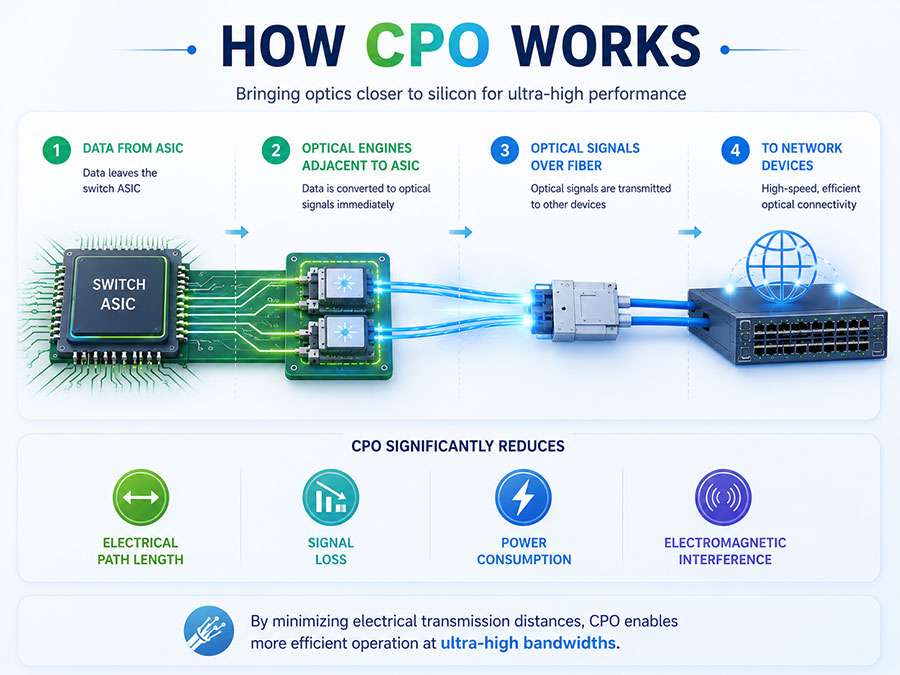
In a CPO design, optical engines are positioned directly adjacent to the switch ASIC.
Instead of transmitting high-speed electrical signals across the entire switch board, data is converted into optical signals almost immediately after leaving the chip.
This architecture significantly reduces:
Electrical path length
Signal loss
Power consumption
Electromagnetic interference
The optical signals are then transmitted through external fiber connections to other network devices.
By minimizing electrical transmission distances, CPO enables more efficient operation at ultra-high bandwidths.
Why CPO Matters for AI Data Centers
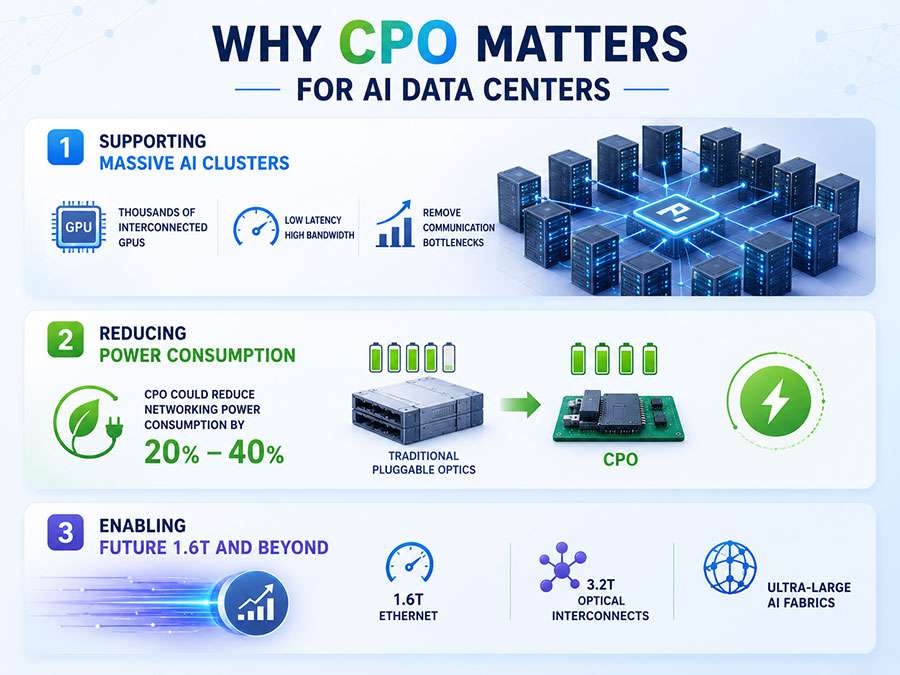
Supporting Massive AI Clusters
Modern AI models require thousands of interconnected GPUs.
Network performance directly impacts training efficiency, making low-latency and high-bandwidth communication essential.
CPO helps remove communication bottlenecks and supports larger AI deployments.
Reducing Power Consumption
Power efficiency has become one of the most critical concerns for hyperscale data centers.
Industry analysts estimate that CPO could reduce networking power consumption by 20% to 40% compared with traditional pluggable optics in certain deployment scenarios.
Enabling Future 1.6T and Beyond
While 800G optics are becoming mainstream today, future AI infrastructures will require even higher speeds.
CPO is viewed as a key enabling technology for:
1.6T Ethernet
3.2T Optical Interconnects
Ultra-large AI Fabrics
CPO vs Traditional Pluggable Optics
While CPO represents the future direction of ultra-high-speed networking, pluggable optical transceivers remain the dominant technology today.
For current AI and cloud data center deployments, solutions such as:
continue to provide excellent flexibility, interoperability, and deployment simplicity.
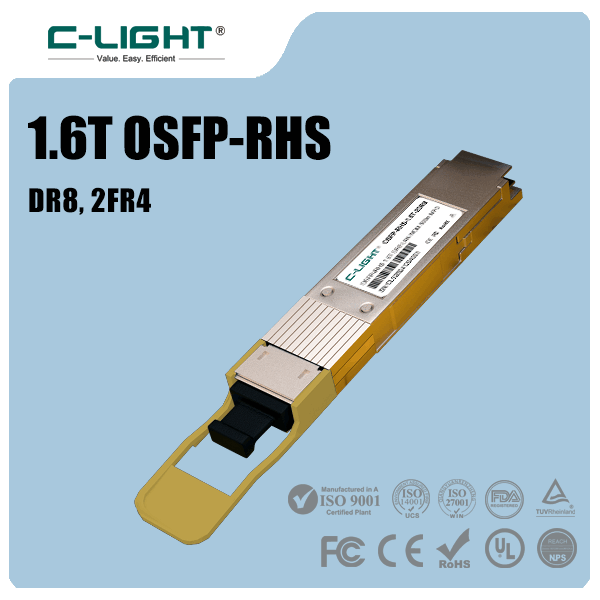
For example, C-LIGHT offers a comprehensive portfolio of 400G and 800G optical transceivers designed for AI clusters, cloud infrastructure, and high-performance data center networks. These solutions enable customers to build scalable networks today while preparing for future CPO-based architectures.
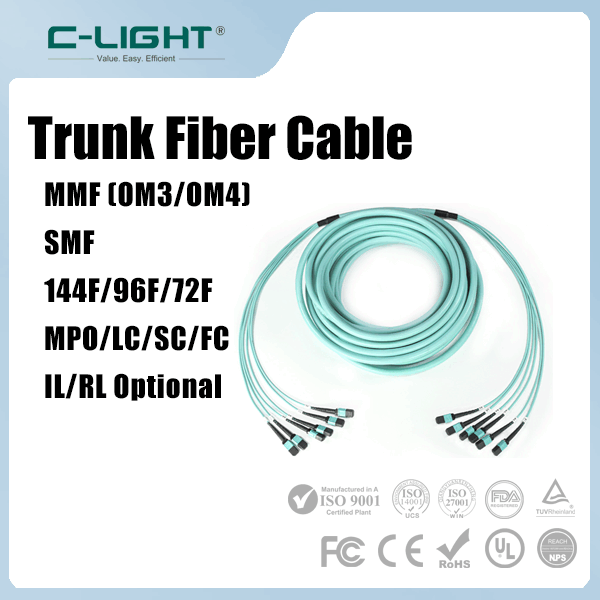
In addition, C-LIGHT's MPO/MTP fiber cabling systems and high-density optical connectivity solutions provide the physical infrastructure required to support next-generation AI networking environments.
Challenges Facing CPO Adoption
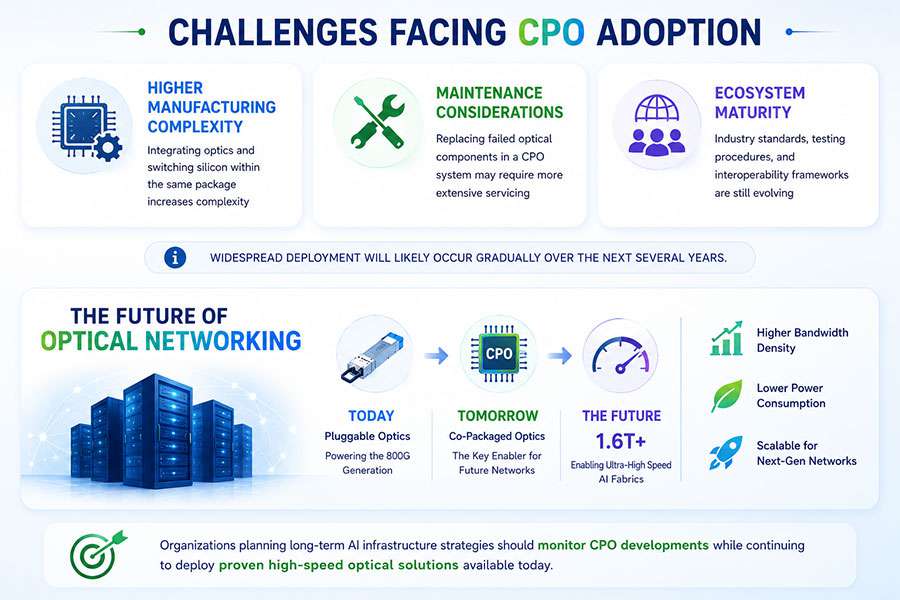
Although CPO offers significant advantages, several challenges remain:
Higher Manufacturing Complexity
Integrating optics and switching silicon within the same package increases design and production complexity.
Maintenance Considerations
Unlike pluggable optics, replacing failed optical components in a CPO system may require more extensive servicing.
Ecosystem Maturity
Industry standards, testing procedures, and interoperability frameworks are still evolving.
As a result, widespread deployment will likely occur gradually over the next several years.
The Future of Optical Networking
The networking industry is entering a period of rapid transformation driven by AI.
As bandwidth requirements continue to increase, optical interconnect technologies will play an increasingly critical role in data center architecture.
While pluggable optics will remain the primary solution throughout the current 800G generation, Co-Packaged Optics is expected to become a key technology for future 1.6T and higher-speed networks.
Organizations planning long-term AI infrastructure strategies should closely monitor CPO developments while continuing to deploy proven high-speed optical solutions available today.
Co-Packaged Optics (CPO) represents a major evolution in optical networking technology.
By bringing optical engines closer to switching silicon, CPO can reduce power consumption, improve signal integrity, and support the massive bandwidth requirements of future AI and hyperscale data centers.
Although traditional 400G and 800G optical transceivers remain essential today, CPO is poised to become a foundational technology for the next generation of AI networking infrastructure.
As the industry moves toward 1.6T and beyond, companies that understand and prepare for CPO adoption will be better positioned to build scalable, efficient, and future-ready networks.
Co-Packaged Optics (CPO) FAQ
Q1: What is CPO (Co-Packaged Optics)?
Answer: CPO (Co-Packaged Optics) is an advanced optical interconnect technology that integrates optical engines directly with switching ASICs or processing chips within the same package.
Unlike traditional optical transceivers that are connected through long electrical PCB traces, CPO places optical components much closer to the chip, reducing electrical signal transmission distance.
The main benefits of CPO include:
Lower power consumption
Improved signal integrity
Higher bandwidth density
Reduced latency
Better scalability for future networks
CPO is considered a key technology for next-generation AI data centers and hyperscale networking systems.
Q2: Why is CPO important for AI data centers?
Answer: AI data centers require extremely high bandwidth communication between GPUs, switches, and storage systems.
As AI clusters scale to thousands of GPUs, traditional optical architectures face challenges such as:
Higher power consumption
Increased thermal pressure
Electrical signal loss
Limited front-panel density
CPO addresses these challenges by moving optical conversion closer to the switching silicon, enabling more efficient data transmission for large-scale AI workloads.
CPO is especially important for future AI networks requiring higher bandwidth and lower energy consumption.
Q3: How does CPO technology work?
Answer: In traditional networking systems, electrical signals travel from the switch ASIC through PCB traces to pluggable optical modules before being converted into optical signals.
CPO changes this architecture by placing optical engines directly beside the ASIC.
The process is:
Data is processed by the switching ASIC.
Electrical signals travel only a very short distance.
Optical engines convert electrical signals into optical signals.
Optical signals are transmitted through fiber connections.
By shortening electrical paths, CPO reduces signal loss, power consumption, and transmission complexity.
Q4: What is the difference between CPO and traditional optical transceivers?
Answer: The main difference is the location of optical components and the system architecture.
| Feature | Traditional Optical Transceiver | CPO |
| Optical Location | Front-panel pluggable module | Integrated near ASIC |
| Electrical Distance | Longer PCB path | Very short path |
| Power Consumption | Higher | Lower |
| Bandwidth Density | Limited | Higher |
| Maintenance | Easier replacement | More complex |
Traditional pluggable optics remain widely used today because of flexibility and interoperability, while CPO targets future ultra-high bandwidth networking requirements.
Q5: What are the advantages of CPO for AI networking?
Answer: CPO provides several advantages for AI data center networks:
1. Lower Power Consumption
By reducing electrical transmission distance, CPO decreases energy requirements for high-speed data movement.
2. Higher Bandwidth Density
CPO allows more optical connectivity within limited switch space.
3. Improved Signal Quality
Shorter electrical paths reduce signal degradation at high speeds.
4. Better Scalability
CPO supports future AI networks requiring higher bandwidth and larger GPU clusters.
Q6: What is the difference between CPO, LPO, and Silicon Photonics?
Answer: CPO, LPO, and Silicon Photonics are related technologies but focus on different aspects of optical networking.
| Technology | Main Focus |
| LPO | Reduce optical module power by simplifying DSP processing |
| Silicon Photonics | Integrate optical components using semiconductor processes |
| CPO | Integrate optical engines directly with ASIC chips |
Silicon Photonics can enable advanced optical integration.
LPO improves current pluggable optical module efficiency.
CPO represents a deeper architectural change by moving optics closer to computing chips.
Q7: What challenges does CPO face before large-scale adoption?
Answer: Although CPO provides significant performance advantages, several challenges remain:
Higher manufacturing complexity
More difficult system integration
New testing requirements
Maintenance and replacement considerations
Ecosystem maturity
Unlike pluggable optical modules that can be easily replaced, CPO requires closer integration between optical components, ASICs, packaging technologies, and network systems.
Q8: Will CPO become important for future 800G and 1.6T AI networks?
Answer: Yes. CPO is expected to become increasingly important as AI networks move toward higher speeds.
Future AI infrastructure trends include:
800G Ethernet deployment
1.6T optical interconnect
Larger GPU clusters
Advanced AI fabric architectures
While 400G and 800G pluggable optical modules remain practical solutions today, CPO is expected to become a key technology for future ultra-scale AI data centers requiring maximum bandwidth density and energy efficiency.
 >
>

 >
>
 >
>
 >
>
 >
>
 >
>
 >
>
 >
>