TEL:+86 132 6656 7067


1. Choosing the Right AI Data Center Interconnect Solution
With the rapid growth of Artificial Intelligence (AI), Large Language Models (LLMs), and high-performance computing (HPC), modern data centers are experiencing unprecedented bandwidth requirements.
AI clusters consisting of thousands of GPUs require extremely high-speed communication between:
GPU servers
Network switches
Storage systems
Computing nodes
Traditional electrical connections are becoming increasingly challenging due to signal loss, power consumption, and bandwidth limitations.
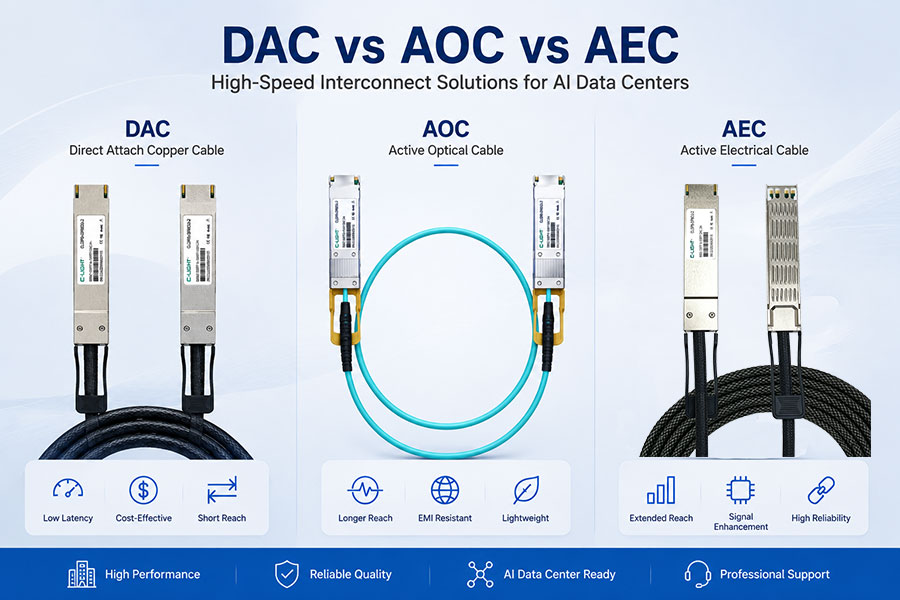
To address these challenges, high-speed interconnect technologies such as DAC (Direct Attach Copper), AEC (Active Electrical Cable), and AOC (Active Optical Cable) have become essential solutions for AI data center networks.
Each technology has different advantages in terms of:
Transmission distance
Power consumption
Signal integrity
Cost
Deployment scenarios
Understanding the differences between DAC, AEC, and AOC helps network engineers select the optimal connectivity solution for AI infrastructure.
C-LIGHT provides advanced high-speed interconnect solutions, including:
400G DAC
800G DAC
800G AEC
High-speed AOC solutions
supporting next-generation AI data center architectures.
2. What Are DAC, AEC, and AOC?
2.1 DAC (Direct Attach Copper)
DAC, or Direct Attach Copper Cable, is a passive copper-based interconnect solution that transmits electrical signals directly through copper conductors.
Because DAC does not contain active electronic components, it provides:
Zero additional power consumption
Lowest latency
Cost-effective deployment
DAC is mainly used for short-distance connections inside data centers.
Typical applications:
Server-to-switch connections
Top-of-Rack (ToR) networking
In-rack GPU connections
Advantages:
Low cost
Simple architecture
Excellent latency performance
Limitations:
Limited transmission distance
Cable thickness increases at higher speeds
C-LIGHT provides high-speed DAC solutions supporting:
400G QSFP-DD DAC
400G QSFP112 DAC
800G OSFP DAC
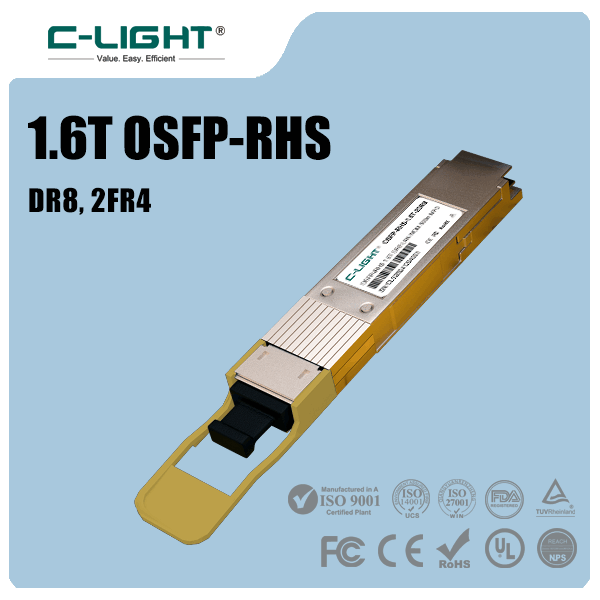
1.6T OSFP DAC
for AI cluster and high-performance computing applications.
2.2 AEC (Active Electrical Cable)
AEC, or Active Electrical Cable, is an advanced copper interconnect solution integrating active signal processing components inside the cable ends.
Compared with passive DAC, AEC improves signal quality through:
Retimer technology
Signal regeneration
Clock and Data Recovery (CDR)
AEC provides longer reach and better signal integrity while maintaining copper-based cost advantages.
Main applications:
AI GPU cluster connections
Rack-to-rack interconnection
High-density switch environments
Advantages:
Longer reach than DAC
Improved signal integrity
Better cable management
Suitable for high-speed 800G networks
C-LIGHT provides:
400G AEC solutions
800G OSFP AEC
designed for future AI data center deployments.
2.3 AOC (Active Optical Cable)
AOC, or Active Optical Cable, integrates optical transceivers and fiber cable into a complete interconnect assembly.
Unlike DAC and AEC, AOC transmits data through optical fiber.
Advantages:
Longer transmission distance
Lightweight cable structure
Excellent electromagnetic interference resistance
Better airflow management
Typical applications:
Switch-to-switch connections
AI cluster inter-rack links
Data center backbone networks
Limitations:
Higher cost than DAC
Requires optical conversion components
C-LIGHT provides high-speed AOC solutions for:
400G networking
800G AI data centers
High-performance computing systems
3. DAC vs AEC vs AOC: Technical Comparison
| Feature | DAC | AEC | AOC |
|---|---|---|---|
| Transmission Medium | Copper | Copper + Active Electronics | Optical Fiber |
| Signal Processing | Passive | Retimer / DSP | Optical Conversion |
| Power Consumption | Lowest | Medium | Higher |
| Latency | Lowest | Low | Slightly Higher |
| Reach | Short Distance | Medium Distance | Long Distance |
| Cost | Lowest | Medium | Higher |
| EMI Resistance | Normal | Normal | Excellent |
| Cable Weight | Heavy | Medium | Lightweight |
4. Application Scenarios in AI Data Centers
4.1 DAC Applications
DAC is ideal for short-distance AI rack connections.
Typical scenarios:
GPU server to Top-of-Rack switch
Same rack connections
Short high-bandwidth links
For example:
AI training clusters often use DAC connections where:
Distance is less than several meters
Lowest latency is required
Cost efficiency is important
4.2 AEC Applications
AEC fills the gap between DAC and optical solutions.
It is suitable for:
Multi-rack AI systems
GPU cluster expansion
High-density networking environments
AEC provides:
Better signal quality
Longer copper transmission capability
Improved installation flexibility
4.3 AOC Applications
AOC is preferred when longer distance and flexible routing are required.
Typical applications:
AI pod interconnection
Data center rows
High-density switch networks
Benefits:
Thin cable design
Better airflow
Longer transmission capability
5. DAC, AEC, and AOC in 400G / 800G / 1.6T Networks
5.1 400G Interconnect
400G has become widely deployed in modern data centers.
Common solutions:
400G QSFP-DD DAC
400G QSFP112 DAC
400G AEC
400G AOC
Applications:
Cloud computing
AI infrastructure
Enterprise data centers
5.2 800G Interconnect
800G is becoming the mainstream solution for next-generation AI networks.
AI workloads require:
Higher bandwidth density
Lower power consumption
Faster GPU communication
C-LIGHT 800G solutions include:
800G OSFP DAC
800G OSFP AEC
800G AOC
Supporting:
AI clusters
HPC systems
Large-scale data centers
6. How to Choose Between DAC, AEC, and AOC?
The selection depends on:
Distance
Short distance → DAC
Medium distance → AEC
Longer distance → AOC
Power Budget
Lowest power → DAC
Balanced performance → AEC
Flexible long-distance → AOC
Network Architecture
Rack-level connection → DAC
AI cluster interconnection → AEC
Data center fabric → AOC
7. Why Choose C-LIGHT High-Speed Interconnect Solutions?
C-LIGHT focuses on advanced optical and electrical interconnect solutions for AI data centers and high-performance computing.
Product portfolio includes:
DAC Solutions
400G DAC
800G OSFP DAC
AEC Solutions
400G AEC
800G AEC
AOC Solutions
400G AOC
800G AOC
Key advantages:
High-speed product development capability
Advanced signal integrity testing
Reliable manufacturing quality
Customized solutions for AI networks
C-LIGHT helps global customers build scalable, efficient, and future-ready AI data center networks.
8.Conclusion
DAC, AEC, and AOC each play an important role in modern AI data center infrastructure.
DAC delivers the lowest cost and lowest latency for short connections.
AEC provides improved signal integrity for high-speed AI clusters.
AOC enables flexible and scalable optical connectivity.
With advanced 400G, 800G, and 1.6T interconnect solutions, C-LIGHT continues to support the evolution of next-generation AI data center networks.
9.DAC vs AOC vs AEC Q&A
Q1: What is the difference between DAC, AEC, and AOC?
Answer: DAC uses passive copper transmission, AEC uses copper with active signal processing, while AOC uses optical fiber with integrated optical conversion technology.
Q2: Which is better for AI data centers, DAC or AOC?
Answer: It depends on the application. DAC is suitable for short-distance, low-cost connections, while AOC is better for longer-distance and high-density AI network deployments.
Q3: Why choose AEC instead of DAC?
Answer: AEC provides improved signal integrity and longer transmission distance compared with DAC, making it suitable for high-speed AI cluster connections.
Q4: What DAC, AEC, and AOC products does C-LIGHT provide?
Answer: C-LIGHT provides:
400G DAC and AOC solutions
800G OSFP DAC and AEC products
Q5: Are DAC cables suitable for 800G networks?
Answer: Yes. 800G DAC solutions are suitable for short-distance AI data center connections where low latency and low power consumption are required.
Q6: What applications use AEC cables?
Answer: AEC cables are widely used in AI GPU clusters, high-density switches, and rack-to-rack data center connections requiring improved signal performance.
Q7: What are the advantages of AOC compared with copper cables?
Answer: AOC provides longer reach, lighter cable design, and better resistance to electromagnetic interference compared with copper-based solutions.
Q8: What is the future trend of high-speed interconnect technology?
Answer: Future AI networks will continue moving toward 800G, 1.6T, and higher-speed interconnect solutions, combining DAC, AEC, AOC, and optical transceiver technologies.
 >
>

 >
>
 >
>
 >
>
 >
>
 >
>
 >
>
 >
>