TEL:+86 132 6656 7067


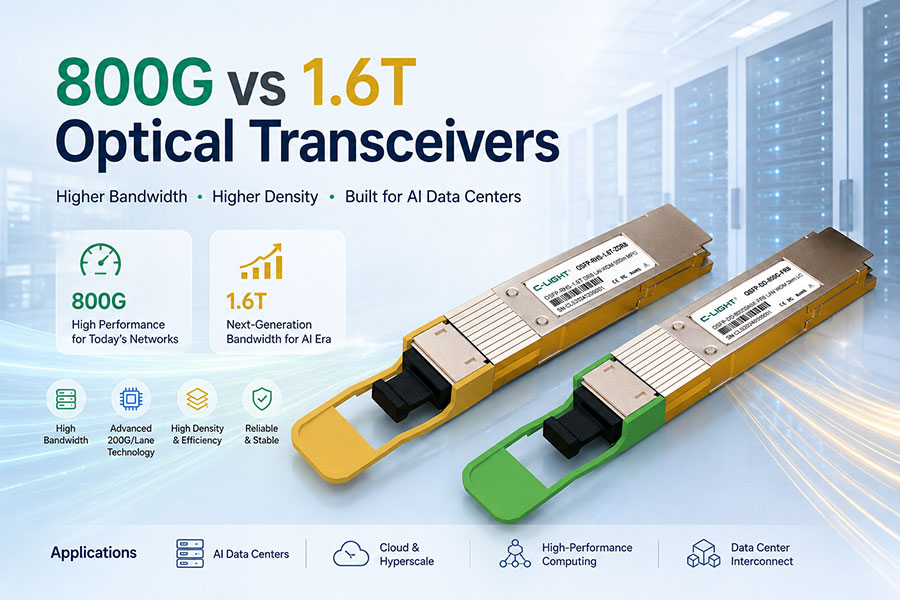
As AI workloads continue to scale, data center networks are moving rapidly toward higher-speed optical connectivity. 800G optical transceivers have become an important solution for high-bandwidth AI and hyperscale networks, while 1.6T optical transceivers are emerging as the next major step in optical interconnect technology.
The transition from 800G to 1.6T is not simply a matter of doubling bandwidth. It also involves higher electrical and optical lane rates, new switch architectures, increased port density, thermal considerations, and changes in optical module design.
This article compares 800G vs 1.6T optical transceivers and explains their key differences, technologies, applications, advantages, and deployment considerations for next-generation data centers.
1. What Is an 800G Optical Transceiver?
An 800G optical transceiver is a high-speed optical module designed to provide an aggregate data rate of up to 800Gbps. It is widely used in high-performance data center networks, AI clusters, cloud computing infrastructure, and hyperscale networks.
800G optical transceivers commonly use PAM4 signaling and multi-lane architectures. Depending on the module design, they may be available in form factors such as OSFP and QSFP-DD.
Typical 800G optical solutions include different reach and fiber configurations, allowing network designers to select modules according to the distance and architecture of the deployment.
Key Point: 800G provides a major bandwidth increase over 400G and has become an important building block for modern AI and high-performance data center networks.
2. What Is a 1.6T Optical Transceiver?
A 1.6T optical transceiver provides an aggregate data rate of approximately 1.6Tbps, which is twice the nominal bandwidth of an 800G module.
The development of 1.6T optical transceivers is closely related to the transition toward higher-speed SerDes and 200G-per-lane architectures. This allows network equipment to achieve significantly higher bandwidth without simply doubling the physical number of lanes.
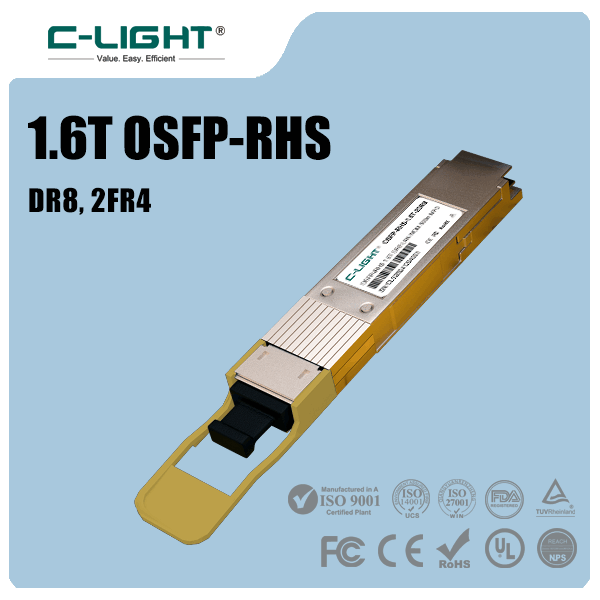
OSFP is an important form factor for 1.6T optical modules because its mechanical and thermal characteristics are suitable for high-speed, high-power data center applications.
1.6T optical transceivers are particularly relevant to next-generation AI clusters, hyperscale data centers, high-performance computing, and high-density Ethernet or InfiniBand networks.
3. 800G vs 1.6T Optical Transceivers: Key Differences
| Feature | 800G Optical Transceiver | 1.6T Optical Transceiver |
|---|---|---|
| Aggregate Bandwidth | 800Gbps | 1.6Tbps |
| Bandwidth Compared with 800G | Baseline | 2× 800G |
| Typical Lane Architecture | 100G/lane or advanced 200G/lane designs | Increasingly based on 200G/lane architectures |
| Signaling | PAM4 | Advanced PAM4 / high-speed electrical and optical interfaces |
| Common Form Factors | OSFP, QSFP-DD | OSFP and emerging next-generation form factors |
| Main Applications | AI data centers, cloud, hyperscale, HPC | Next-generation AI clusters, hyperscale, HPC, high-density networks |
| Port Density | High | Very high |
| Network Position | Current high-speed deployment | Next-generation high-bandwidth deployment |
| Deployment Maturity | More mature ecosystem | Newer ecosystem with rapidly increasing adoption |
4. 800G vs 1.6T: Why 200G per Lane Matters
One of the most important differences between current 800G systems and next-generation 1.6T systems is the evolution of data rate per lane.
A simplified example is:
800G: 8 × 100G lanes = 800G
1.6T: 8 × 200G lanes = 1.6T
The transition toward 200G per lane allows network equipment to increase aggregate bandwidth while maintaining a practical number of physical lanes.
This is especially important in AI data centers, where switch ports, PCB routing, connectors, optical engines, and cabling must all support increasingly high bandwidth.
It is also important to understand that not every 800G or 1.6T module uses exactly the same optical architecture. Electrical lane configuration, optical lane configuration, modulation, DSP implementation, and reach can vary between products.
5. 800G vs 1.6T: Bandwidth and Port Density
The most obvious advantage of 1.6T is its higher aggregate bandwidth. A single 1.6T optical transceiver can provide approximately twice the bandwidth of an 800G module.
For large AI clusters, this higher bandwidth can help increase network capacity while reducing the number of optical interfaces required for a given aggregate bandwidth target.
For example, a network requiring approximately 16Tbps of optical capacity could theoretically achieve that bandwidth with:
20 × 800G connections
10 × 1.6T connections
The actual network architecture will depend on switch design, topology, breakout requirements, redundancy, and other system-level considerations.
6. Power Consumption and Thermal Management
Power consumption is an increasingly important consideration for AI data centers.
As optical module speeds increase, the electrical interface, DSP, laser drivers, receivers, and thermal design become more demanding. Therefore, simply comparing bandwidth is not enough when evaluating 800G and 1.6T optical transceivers.
For large-scale AI switches populated with many optical modules, even a small difference in power consumption per module can have a significant impact on total rack power and cooling requirements.
This makes thermal management an important part of 1.6T deployment planning. High-density switches may require improved airflow, heat dissipation structures, and careful module selection.
Important: Higher bandwidth does not automatically mean lower power per module. The correct comparison should consider power per Gb/s, total switch power, thermal requirements, and network capacity.
7. 800G vs 1.6T Optical Transceivers for AI Data Centers
AI data centers are one of the major drivers behind the transition from 800G to 1.6T optical connectivity.
Large GPU clusters generate extremely high east-west traffic between GPUs, servers, switches, and accelerator nodes. As cluster sizes increase, the optical network must provide higher bandwidth and lower communication bottlenecks.
800G optical transceivers are already well positioned for high-speed AI networking, while 1.6T optical transceivers are designed to address the bandwidth requirements of next-generation high-density AI fabrics.
AI Training Clusters
High-speed optical connectivity between GPU servers and network switches.
Hyperscale Data Centers
High-density connectivity for large-scale cloud and computing infrastructure.
High-Performance Computing
High-bandwidth interconnects for compute-intensive workloads.
Data Center Interconnect
High-capacity optical links for data center and network infrastructure.
8. 800G Optical Transceivers: Advantages and Applications
800G remains an important choice for many data center deployments because of its combination of bandwidth, ecosystem maturity, availability, compatibility, and deployment experience.
8.1 Advantages of 800G
High bandwidth for AI and cloud networks
Mature optical transceiver ecosystem
Wide range of reach and optical configurations
Broad compatibility with high-speed data center platforms
More deployment experience compared with newer 1.6T solutions
8.2 Typical Applications
AI data centers
Cloud computing
Hyperscale data centers
High-performance computing
Switch-to-switch connectivity
Data center network upgrades
9. 1.6T Optical Transceivers: Advantages and Applications
1.6T optical transceivers are designed for the next stage of data center bandwidth scaling.
Their primary value is not simply higher speed. 1.6T can increase bandwidth density and help network architects scale large AI fabrics while keeping the number of high-speed physical connections manageable.
9.1 Advantages of 1.6T
Twice the aggregate bandwidth of 800G
Higher bandwidth density
Designed for next-generation 200G-per-lane architectures
Suitable for high-density AI networking
Potential to reduce the number of physical optical connections for a given bandwidth target
Supports future-oriented network architectures
9.2 Typical Applications
Next-generation AI data centers
Large GPU clusters
Hyperscale cloud infrastructure
High-performance computing
High-density Ethernet networks
Next-generation data center interconnects
10. 800G vs 1.6T: Optical Module Form Factors
Form factor is an important consideration when selecting an optical transceiver.
800G modules are available in multiple form factor families, including OSFP and QSFP-DD, depending on the host platform and system architecture.
For 1.6T applications, OSFP is an important form factor because it provides a practical mechanical and thermal platform for very high-speed optical connectivity.
However, the form factor alone does not determine compatibility. The switch port, electrical interface, optical architecture, firmware, management interface, power class, and module specifications must all be considered.
11. 800G vs 1.6T: Which One Should You Choose?
The choice between 800G and 1.6T should be based on the complete network architecture rather than the headline bandwidth alone.
| Requirement | Recommended Direction |
|---|---|
| Existing 800G switch infrastructure | 800G |
| Current AI cluster requiring high bandwidth | 800G or 1.6T |
| New high-density AI deployment | Consider 1.6T |
| Maximum bandwidth density | 1.6T |
| Mature ecosystem and broad compatibility | 800G |
| Next-generation 200G/lane infrastructure | 1.6T |
| Cost-sensitive high-speed deployment | Evaluate 800G |
12. 800G to 1.6T Migration Considerations
Moving from 800G to 1.6T is not simply a module replacement.
Before upgrading, network operators should evaluate the entire platform.
Switch Compatibility: Confirm that the switch ASIC and optical ports support the required 1.6T architecture.
Electrical Lane Rate: Verify whether the platform supports the required high-speed electrical interface.
Optical Architecture: Check optical lane configuration, wavelengths, fiber type, connector, and transmission distance.
Power Budget: Evaluate module power and total switch power.
Thermal Design: Confirm that the switch and rack cooling system can support high-density optical modules.
Breakout Architecture: Determine whether the network requires 1.6T-to-800G or other breakout configurations.
Network Roadmap: Consider future bandwidth requirements before selecting the optical platform.
13. C-LIGHT High-Speed Optical Connectivity Solutions
C-LIGHT provides high-speed optical and data center interconnect solutions designed for the evolving requirements of modern data center networks.
The C-LIGHT portfolio covers high-speed connectivity technologies including 400G, 800G and 1.6T solutions, supporting the industry's transition toward higher bandwidth and higher-density AI networking.
For AI data centers and hyperscale environments, C-LIGHT can provide optical transceivers and high-speed interconnect solutions for different network architectures and deployment requirements.
800G Optical Connectivity
800G solutions are suitable for high-bandwidth AI data center, cloud, hyperscale, and switch-to-switch applications.
1.6T Optical Connectivity
1.6T solutions target next-generation high-density AI networks and high-bandwidth data center architectures.
When selecting an optical solution, C-LIGHT recommends evaluating the complete system requirements, including switch compatibility, form factor, lane architecture, optical reach, fiber infrastructure, power consumption, and thermal conditions.
14. 800G vs 1.6T: Future Development
The optical networking industry is moving through a rapid bandwidth evolution:
As AI clusters continue to grow, the industry will continue to increase bandwidth per optical and electrical lane. Higher-speed SerDes, advanced DSPs, silicon photonics, improved laser technology, and new optical architectures will all play an important role in this evolution.
However, the emergence of 1.6T does not mean that 800G will immediately become obsolete. 800G and 1.6T are expected to coexist as data center operators upgrade infrastructure according to bandwidth requirements, cost, power, compatibility, and deployment timelines.
15. FAQ: 800G vs 1.6T Optical Transceivers
Q1: Is 1.6T twice as fast as 800G?
Answer: Yes. 1.6T provides approximately twice the aggregate bandwidth of 800G. However, the more important technical change is the transition toward higher lane rates and next-generation network architectures.
Q2: Will 1.6T replace 800G?
Answer: Not immediately. 800G remains an important solution for current AI, cloud, and hyperscale networks, while 1.6T is increasingly targeted at next-generation high-density deployments.
Q3: Why is 200G per lane important for 1.6T?
Answer: Higher lane rates allow the network to increase aggregate bandwidth without simply increasing the number of physical lanes. This is particularly important for high-density AI switches.
Q4: Is 1.6T only used in AI data centers?
Answer: No. AI data centers are a major application, but 1.6T optical connectivity can also be relevant to hyperscale cloud networks, high-performance computing, data center interconnects, and other high-bandwidth environments.
Q5: What form factor is commonly used for 1.6T optical transceivers?
Answer: OSFP is an important form factor for 1.6T optical transceivers. Actual compatibility depends on the target switch platform and the complete module specification.
Q6: Should a data center upgrade from 800G to 1.6T immediately?
Answer: Not necessarily. The decision should consider switch compatibility, network bandwidth requirements, power consumption, thermal management, optical infrastructure, cost, and the expected lifecycle of the network.
Q7: What should I check before purchasing an 800G or 1.6T optical transceiver?
Answer: Check the host switch, form factor, electrical lane rate, optical lane configuration, fiber type, connector, transmission distance, power consumption, FEC requirements, breakout architecture, management interface, and interoperability requirements.
16. Summary
The evolution from 800G to 1.6T optical transceivers represents one of the most important bandwidth upgrades in modern data center networking.
800G offers a mature and widely applicable solution for today's high-speed AI, cloud, and hyperscale networks. 1.6T provides approximately twice the aggregate bandwidth and is increasingly positioned for next-generation high-density AI infrastructure.
The key difference is not simply 800G vs 1.6T. The transition also involves 200G-per-lane technologies, higher-speed electrical interfaces, advanced optical components, thermal management, and new network architectures.
For organizations planning future AI data center infrastructure, the best approach is to evaluate both technologies according to current bandwidth requirements and long-term network expansion plans.
C-LIGHT continues to develop high-speed optical connectivity solutions for the evolving data center market, supporting the industry's transition from 400G and 800G toward 1.6T and future higher-speed optical networks.
 >
>

 >
>
 >
>
 >
>
 >
>
 >
>
 >
>
 >
>