C-LIGHT telephone TEL:+86 158 1857 3751    
Language
C-LIGHT search

800G DCO Coherent Optical Module | Host Interface, Line Protocol & 400G vs 800G

By C-LIGHT Marketing 丨 Jul 2, 2026

800G-DCO-OPTICAL-MODULE.jpg

1. What Is an 800G DCO Optical Module?

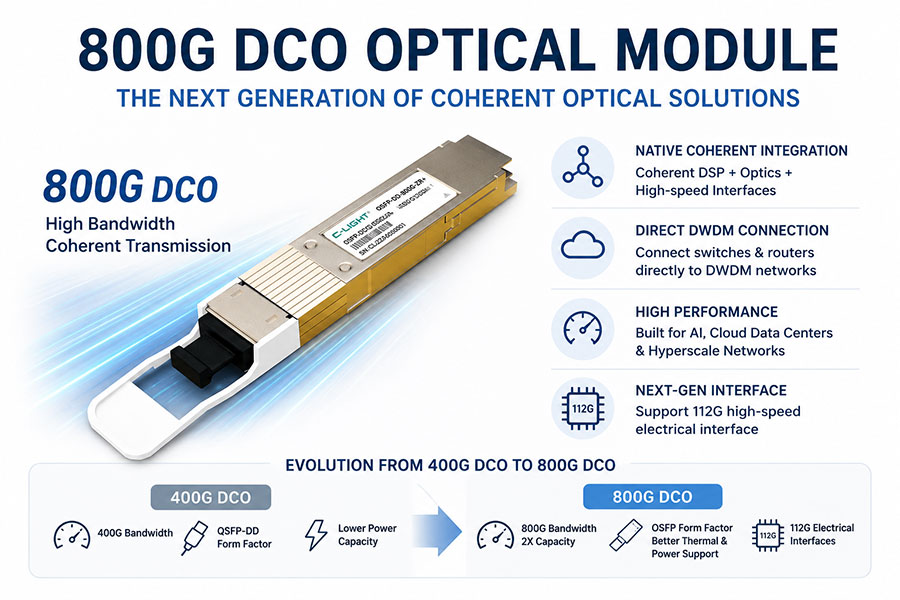
With the rapid development of AI computing, cloud data centers, and hyperscale networks, optical transmission is gradually evolving from the 400G era to the 800G era. The 800G DCO (Digital Coherent Optics) is a new generation of pluggable coherent optical module based on 400G DCO technology. It highly integrates a coherent DSP, coherent optical components, and high-speed electrical interfaces, enabling switches and routers to connect directly to DWDM optical networks without requiring traditional standalone coherent transmission equipment.

Compared with 400G DCO, the most significant change is not only the doubling of bandwidth, but also the adoption of the OSFP form factor to support higher power consumption, improved thermal performance, and next-generation 112G high-speed electrical interfaces.

2. Host Interface (Host Protocol) of 800G DCO

Host-Interface-of-800G-DCO.jpg

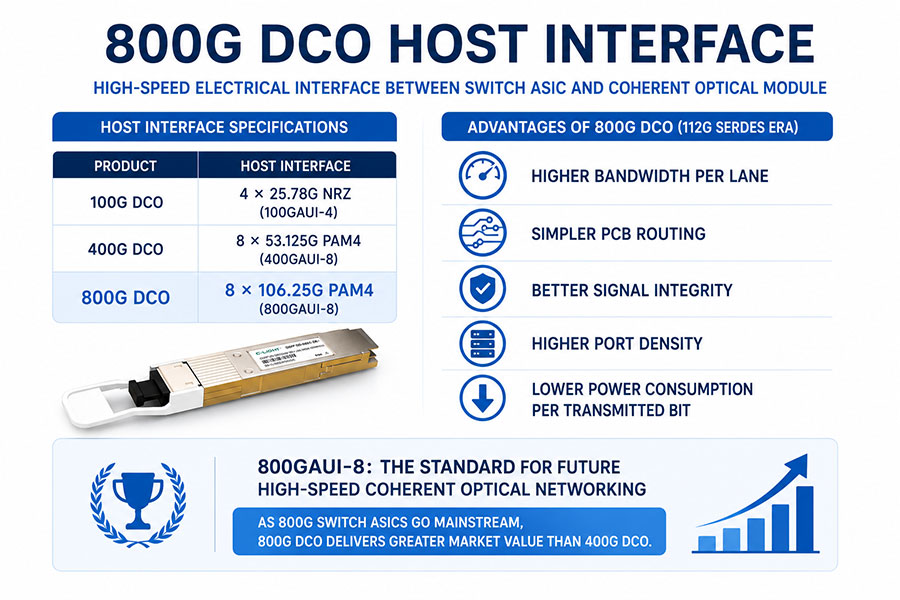
The Host Interface is the high-speed electrical interface between the switch ASIC and the coherent optical module.

The current Host Interface specifications are as follows:

DCO 800G/400G/200G/100G DWDM Coherent TransceiverC-LIGHT

ProductHost Interface
100G DCO4 × 25.78G NRZ (100GAUI-4)
400G DCO8 × 53.125G PAM4 (400GAUI-8)
800G DCO8 × 106.25G PAM4 (800GAUI-8)

The 800G DCO platform has fully entered the 112G SerDes era, providing several advantages over the 400G platform:

  • Higher bandwidth per lane

  • Simpler PCB routing

  • Better signal integrity

  • Higher port density

  • Lower power consumption per transmitted bit

As 800G switch ASICs become increasingly mainstream, 800GAUI-8 has become the standard Host Interface for future high-speed coherent optical networking. Consequently, 800G DCO offers greater market value than 400G DCO.

3. Line Protocol of 800G DCO

Line-Protocol-of-800G-DCO.jpg

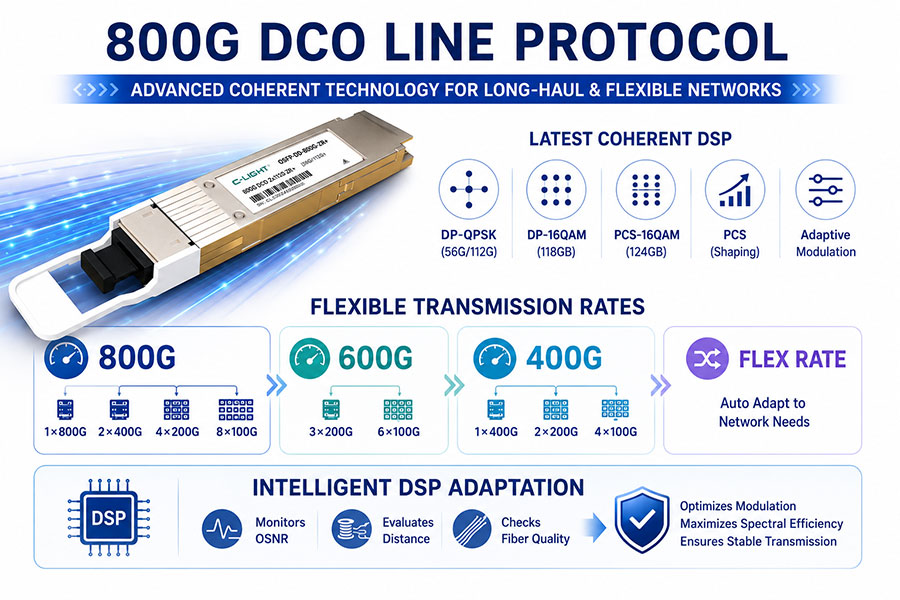
The Line Protocol determines how the module transmits optical signals over fiber.

800G DCO typically adopts the latest generation coherent DSP and supports the following modulation formats in ZR+ mode:

  • DP-QPSK (56G/112G SerDes)

  • DP-16QAM (118GB)

  • PCS-16QAM (124GB)

  • Probabilistic Constellation Shaping (PCS)

  • Adaptive Modulation

According to different transmission distances, the module can flexibly operate at:

  • 800G (1×800G / 2×400G / 4×200G / 8×100G)

  • 600G (3×200G / 6×100G)

  • 400G (1×400G / 2×200G / 4×100G)

  • Flex Rate

The DSP automatically adjusts the modulation format based on OSNR, transmission distance, and fiber quality, improving spectral efficiency while maintaining stable transmission performance.

4. 800G DCO vs. 400G DCO

800G-DCO-vs-400G-DCO.jpg

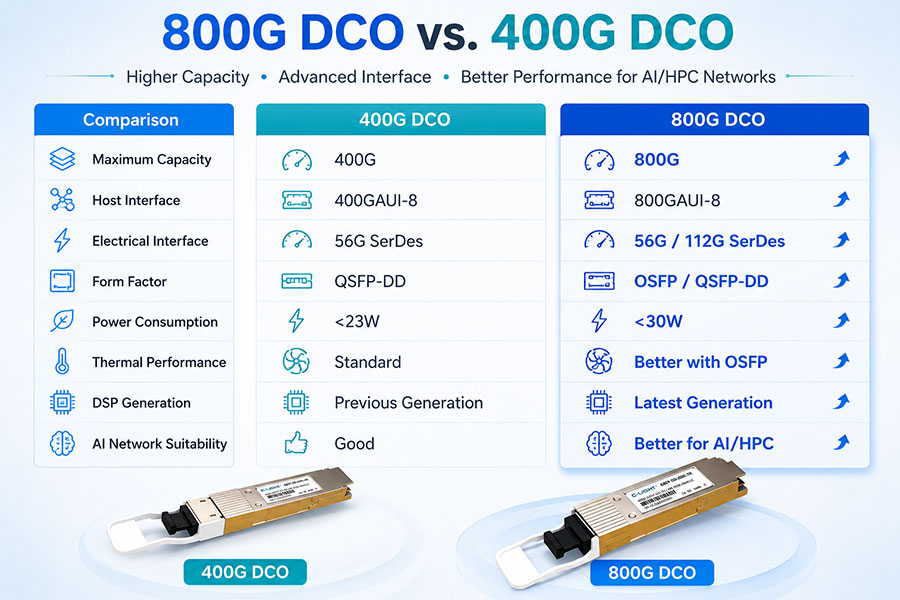
As shown above, 800G DCO not only doubles the transmission capacity, but also achieves comprehensive improvements in interface speed, thermal performance, DSP capability, and future scalability. The introduction of the OSFP form factor is an important milestone in the evolution toward higher-performance coherent optical modules, making 800G DCO more suitable for modern AI and HPC interconnect applications.

5. Advantages of OSFP over QSFP-DD for 800G DCO

Advantages-of-OSFP-over-QSFP-DD-for-800G-DCO.jpg

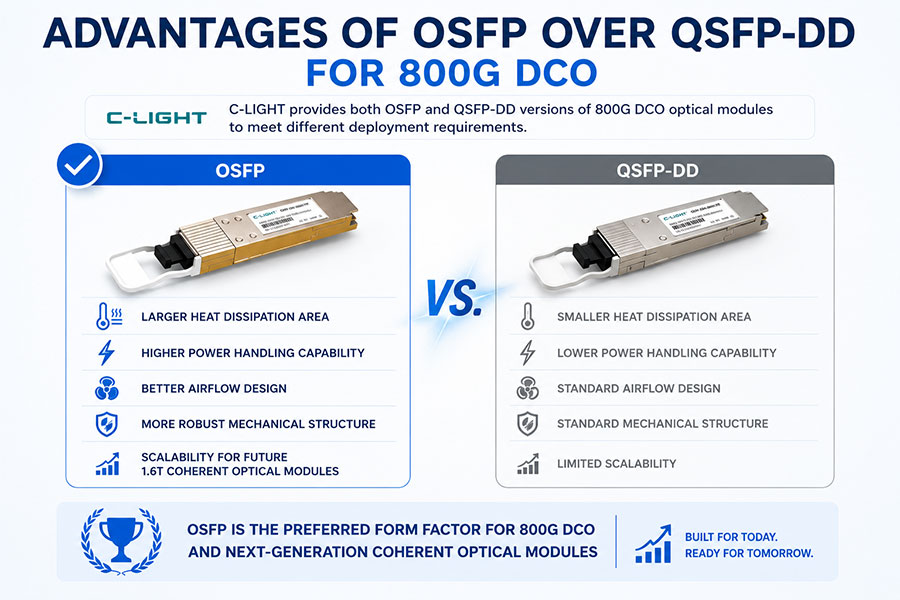
C-LIGHT provides both OSFP and QSFP-DD versions of 800G DCO optical modules to meet different deployment requirements.

Compared with QSFP-DD, the OSFP form factor offers the following advantages:

  • Larger heat dissipation area

  • Higher power handling capability

  • Better airflow design

  • More robust mechanical structure

  • Scalability for future 1.6T coherent optical modules

Therefore, OSFP has become one of the primary development directions for 800G DCO and next-generation high-speed coherent optical modules.

6. Typical Applications of 800G DCO

Typical-Applications-of-800G-DCO.jpg

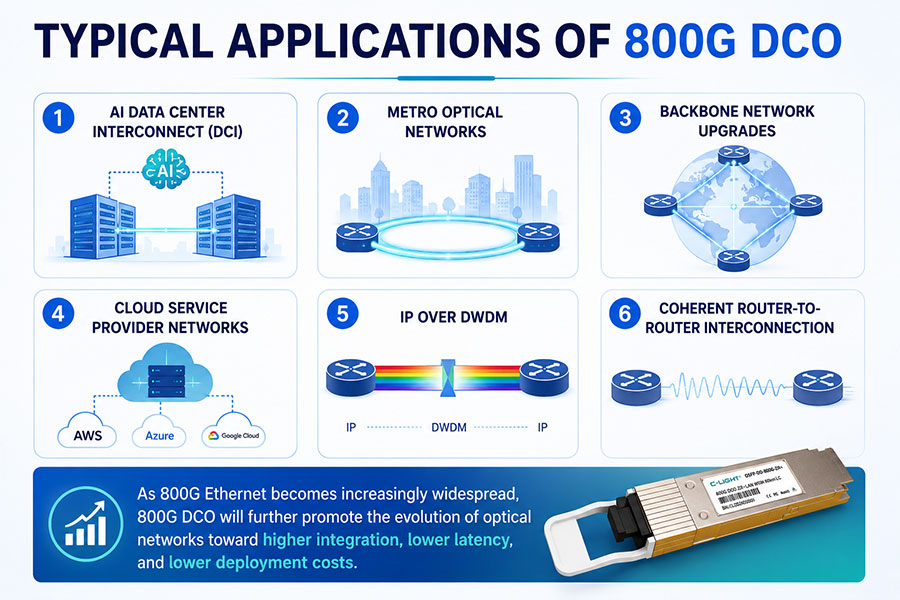
800G DCO is mainly designed for high-bandwidth and high-reliability optical transmission applications, including:

  • AI Data Center Interconnect (DCI)

  • Metro Optical Networks

  • Backbone Network Upgrades

  • Cloud Service Provider Networks

  • IP over DWDM

  • Coherent Router-to-Router Interconnection

As 800G Ethernet becomes increasingly widespread, 800G DCO will further promote the evolution of optical networks toward higher integration, lower latency, and lower deployment costs.

7. Future Development Trends

Future-Development-Trends.jpg

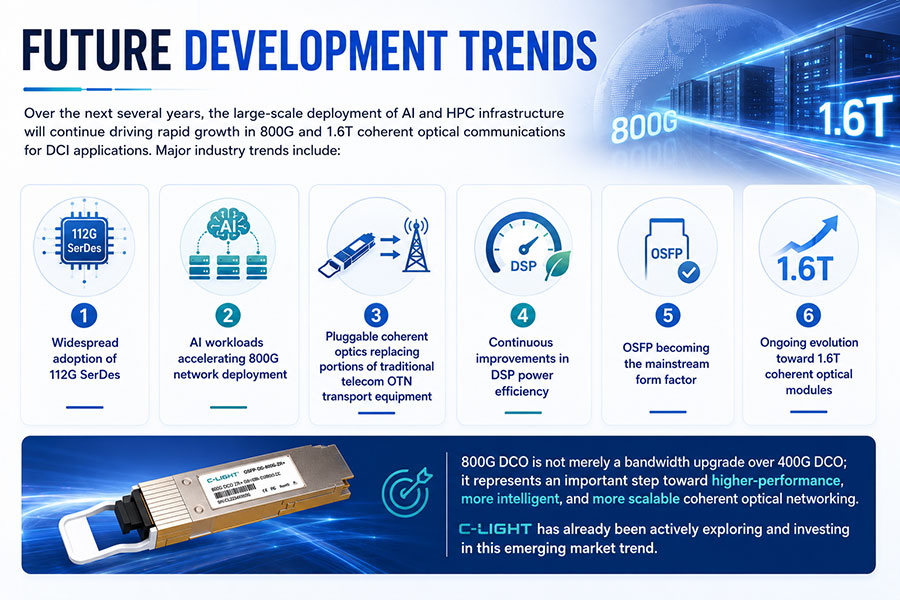
Over the next several years, the large-scale deployment of AI and HPC infrastructure will continue driving rapid growth in 800G and 1.6T coherent optical communications for DCI applications. Major industry trends include:

  • Widespread adoption of 112G SerDes

  • AI workloads accelerating 800G network deployment

  • Pluggable coherent optics replacing portions of traditional telecom OTN transport equipment

  • Continuous improvements in DSP power efficiency

  • OSFP becoming the mainstream form factor

  • Ongoing evolution toward 1.6T coherent optical modules

800G DCO is not merely a bandwidth upgrade over 400G DCO; it represents an important step toward higher-performance, more intelligent, and more scalable coherent optical networking. C-LIGHT has already been actively exploring and investing in this emerging market trend.

8、800G DCO Coherent Optical Module FAQ

Q1. What is an 800G DCO coherent optical module?

Answer: An 800G DCO (Digital Coherent Optics) coherent optical module is a pluggable optical transceiver that integrates a coherent DSP, tunable laser, coherent receiver, and advanced signal processing technology into compact QSFP-DD or OSFP form factors. It enables high-capacity optical transmission for AI data center interconnects, DWDM networks, metro networks, and backbone applications.

Q2. What is the difference between 800G DCO and traditional 800G optical transceivers?

Answer: The main difference is the transmission technology. Traditional 800G optical transceivers typically use direct-detection PAM4 technology for shorter data center links, while 800G DCO uses coherent modulation and DSP-based signal processing to support longer distances, higher spectral efficiency, and better tolerance against optical impairments such as chromatic dispersion and polarization effects.

Q3. Why are 800G DCO modules important for AI data center interconnects?

Answer: 800G DCO modules are important for AI data center interconnects because large-scale AI clusters require massive bandwidth between geographically distributed computing resources. By providing single-wavelength 800G transmission, DCO technology improves fiber utilization, reduces network complexity, and enables efficient scaling of AI infrastructure across multiple data centers.

Q4. What is the difference between 800ZR and OpenZR+ coherent optical solutions?

Answer: 800ZR and OpenZR+ are two important implementations of 800G coherent technology. 800ZR is optimized for data center interconnect applications with transmission distances around 120km. OpenZR+ provides greater flexibility with multiple modulation formats, adjustable reach, and enhanced FEC capabilities, making it suitable for metro networks, regional networks, and longer-distance optical transport applications.

Q5. What are the advantages of using 800G DCO optical modules for DWDM networks?

Answer: 800G DCO optical modules provide higher spectral efficiency, longer transmission distance, and improved optical performance compared with conventional pluggable solutions. They support IP over DWDM architectures by allowing routers and switches to connect directly to optical transport networks without requiring additional transponder equipment.

Q6. Which form factors are available for 800G DCO coherent transceivers?

Answer: 800G DCO coherent transceivers are commonly available in QSFP-DD and OSFP form factors. QSFP-DD provides compatibility with existing high-density networking platforms, while OSFP offers enhanced thermal capability and is widely adopted for next-generation high-performance data center and AI networking applications.

Q7. What are the typical applications of 800G DCO coherent optical modules?

Answer: 800G DCO coherent optical modules are mainly used in AI data center interconnect (DCI), IP over DWDM networks, metro optical networks, cloud infrastructure, and regional backbone networks. They are designed for scenarios requiring high bandwidth, long-distance transmission, and efficient fiber utilization.

Q8. How do I choose between 800G DCO and 800G Ethernet optical modules?

Answer: The choice depends on transmission distance and network architecture. 800G Ethernet optical modules are typically used for short-reach data center networks such as AI clusters and leaf-spine connections. 800G DCO modules are better suited for long-distance connectivity, DCI, and DWDM-based networks where coherent transmission performance and scalability are required.
For any questions, please contact us by email or WhatsApp.

Email: sales@c-light.com

WhatsApp: +86 158 1857 3751

Other articles

Call
Top