TEL:+86 132 6656 7067


1. What Is a 25G BiDi Optical Transceiver?
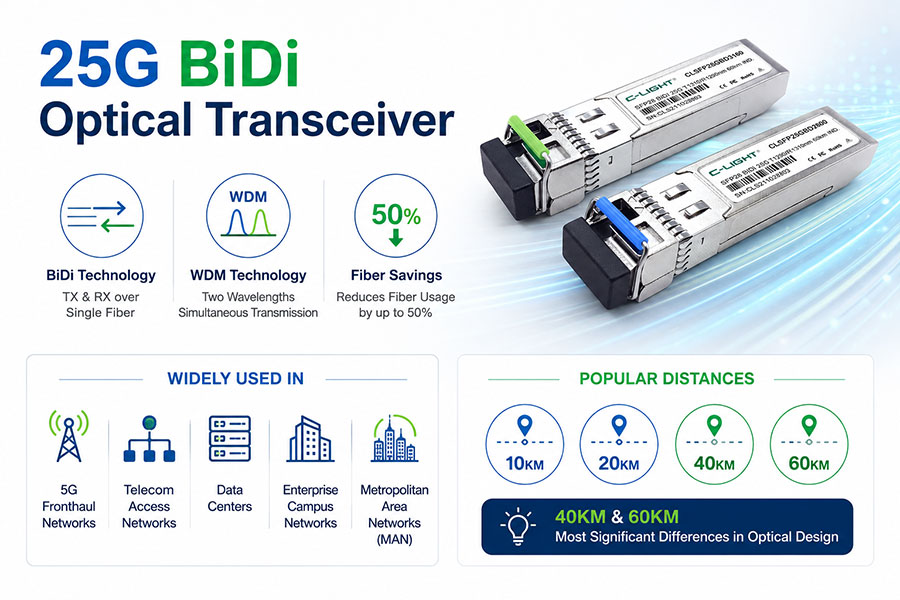
The C-LIGHT 25G BiDi (Bidirectional) optical transceiver utilizes Single Fiber Bidirectional (BiDi) transmission technology, enabling both transmit (TX) and receive (RX) signals to be carried over a single strand of single-mode fiber (SMF).
Its core technology is Wavelength Division Multiplexing (WDM), which uses two different wavelengths for simultaneous bidirectional communication. This design reduces fiber usage by up to 50%, making it an ideal solution for fiber-constrained network deployments.
C-LIGHT 25G BiDi SFP28 optical transceivers are widely deployed in:
5G Fronthaul Networks
Telecom Access Networks
Data Centers
Enterprise Campus Networks
Metropolitan Area Networks (MAN)
The most popular transmission distances on today's market include 10 km, 20 km, 40 km, and 60 km. Among them, the 40KM and 60KM models exhibit the most significant differences in optical design.
2. 25G BiDi 40KM vs. 60KM Specifications
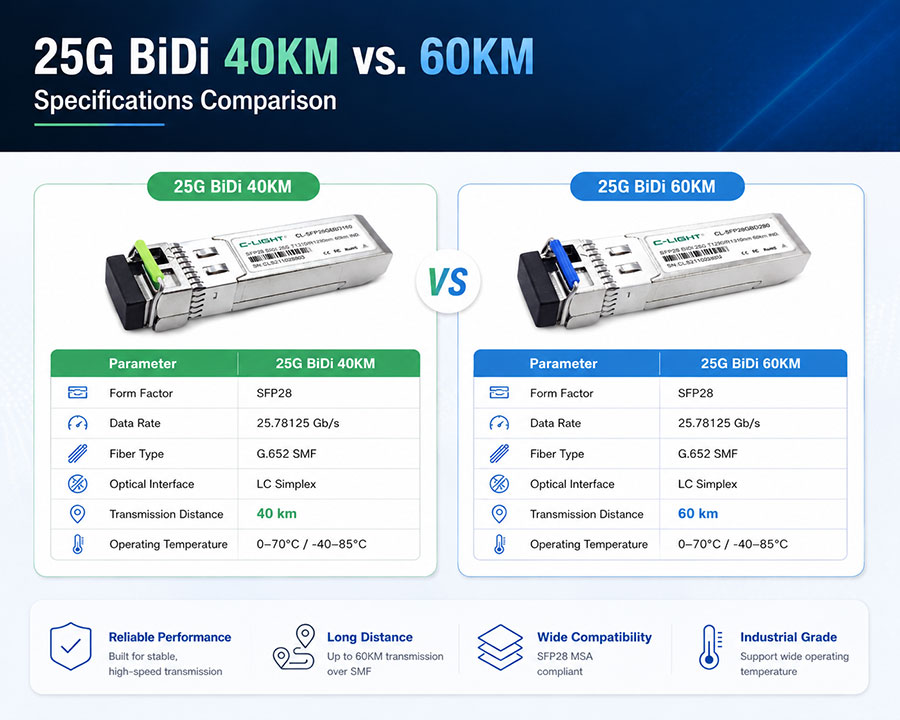
Although the two modules share nearly identical specifications, the real performance differences lie in their laser design, wavelength selection, and receiver architecture.
3. Laser Technology Comparison – The Biggest Difference
The laser design is the most significant technical distinction between the two products.
| Item | 40KM | 60KM |
|---|---|---|
| Laser Type | DFB Laser | DFB Laser |
| Optical Output Power | 0 to +5 dBm | +2 to +7 dBm |
| TX/RX Wavelength | 1270 nm / 1330 nm | 1290 nm / 1310 nm |
| Fiber Attenuation | 1270 nm: 3.5–4.5 dB/10 km 1330 nm: 2.5–3.5 dB/10 km | 1290 nm: 2.5–3.5 dB/10 km 1310 nm: 2.5–3.5 dB/10 km |
| Chirp | Standard | Lower |
| Chromatic Dispersion Tolerance | Standard | Higher |
| Recommended Reach | Up to 40 km | 60 km and beyond |
4. Wavelength Design Differences
C-LIGHT 25G BiDi 40KM
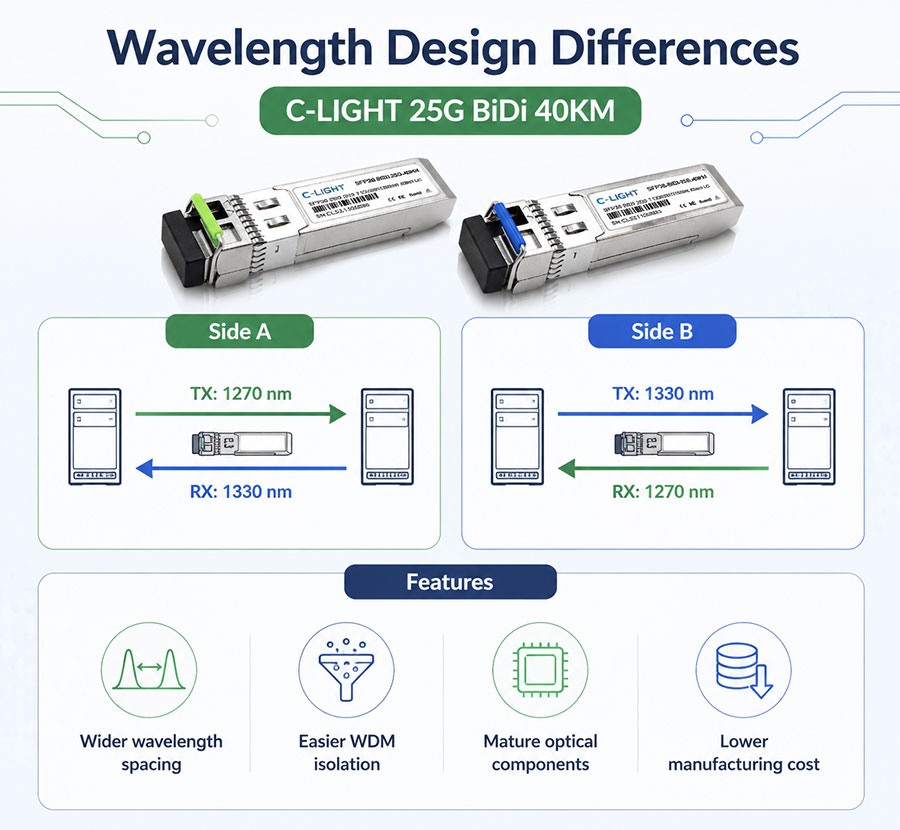
Side A
TX: 1270 nm
RX: 1330 nm
Side B
TX: 1330 nm
RX: 1270 nm
Features
Wider wavelength spacing
Easier WDM isolation
Mature optical components
Lower manufacturing cost
C-LIGHT 25G BiDi 60KM
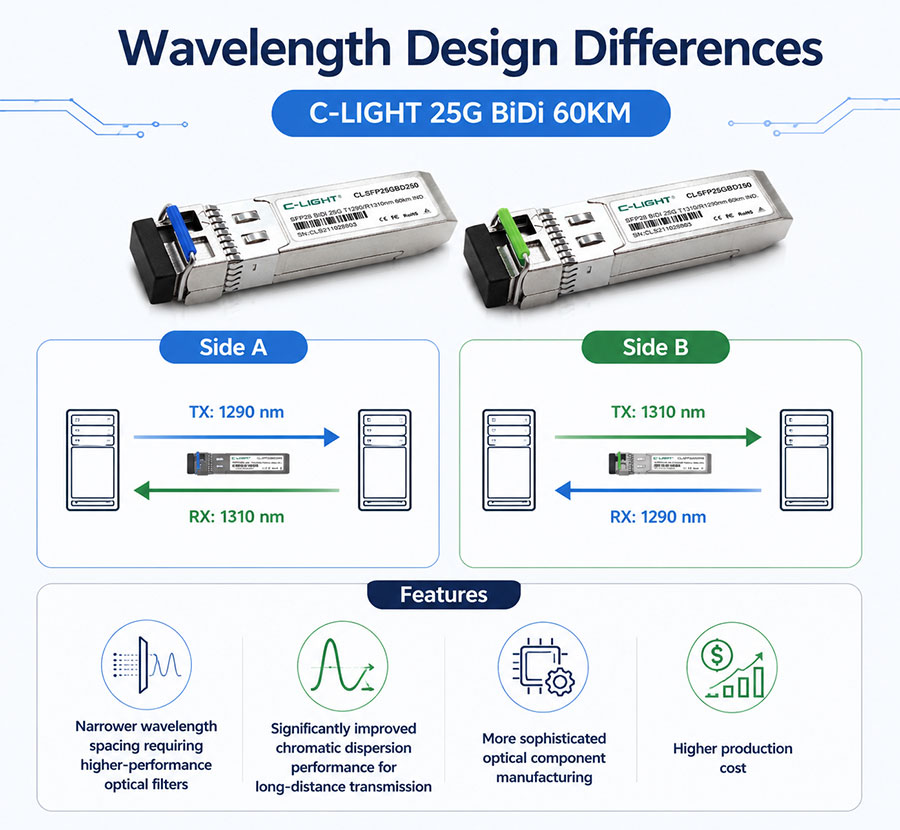
Side A
TX: 1290 nm
RX: 1310 nm
Side B
TX: 1310 nm
RX: 1290 nm
Features
Narrower wavelength spacing requiring higher-performance optical filters
Significantly improved chromatic dispersion performance for long-distance transmission
More sophisticated optical component manufacturing
Higher production cost
5. Receiver Comparison
| Specification | 40KM | 60KM |
|---|---|---|
| Receiver Type | APD Receiver | APD Receiver |
| Receiver Sensitivity | < -18 dBm @ BER 5E-5 | < -20 dBm @ BER 5E-5 |
The 60KM module employs a higher-sensitivity APD receiver, enabling improved optical power margin and enhanced long-distance transmission performance.
6. Why Does the C-LIGHT 25G BiDi 60KM Module Use Higher-Performance Components?
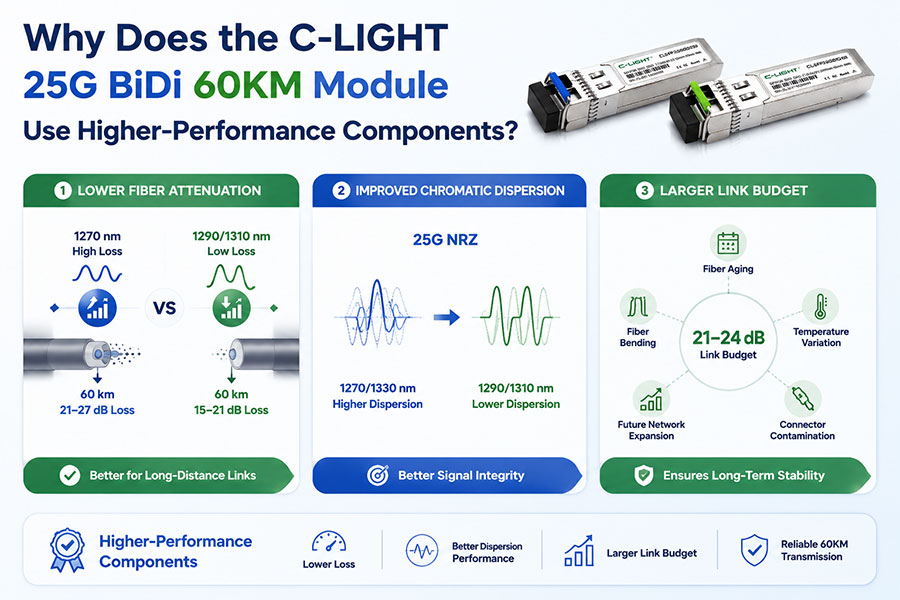
Several engineering considerations require the 60KM version to utilize higher-specification optical components.
(1) Higher Fiber Attenuation
Typical attenuation in G.652 single-mode fiber is approximately:
1270 nm: 3.5–4.5 dB per 10 km
1290/1310 nm: 2.5–3.5 dB per 10 km
Therefore:
40 km at 1270 nm: approximately 12–18 dB loss
60 km at 1270 nm: approximately 21–27 dB loss
A conventional 1270 nm DFB laser generally cannot provide sufficient optical budget for stable 60 km transmission.
By contrast, the 1290 nm/1310 nm wavelength pair experiences significantly lower attenuation, reducing total fiber loss to approximately 15–21 dB over 60 km, making it much better suited for long-distance links.
(2) Increased Chromatic Dispersion
At 25G NRZ, chromatic dispersion becomes a critical limiting factor.
Compared with the 1270 nm/1330 nm wavelength combination, the 1290 nm/1310 nm pair offers superior dispersion performance, allowing signals to maintain better integrity over longer distances.
(3) Larger Link Budget
Carrier-class optical networks typically reserve an additional 3–5 dB optical margin to compensate for:
Fiber aging
Temperature variation
Fiber bending
Connector contamination
Future network expansion
As a result, most 60KM BiDi optical transceivers are designed with an optical link budget of approximately 21–24 dB, ensuring long-term transmission stability.
7. How to Choose Between 40KM and 60KM
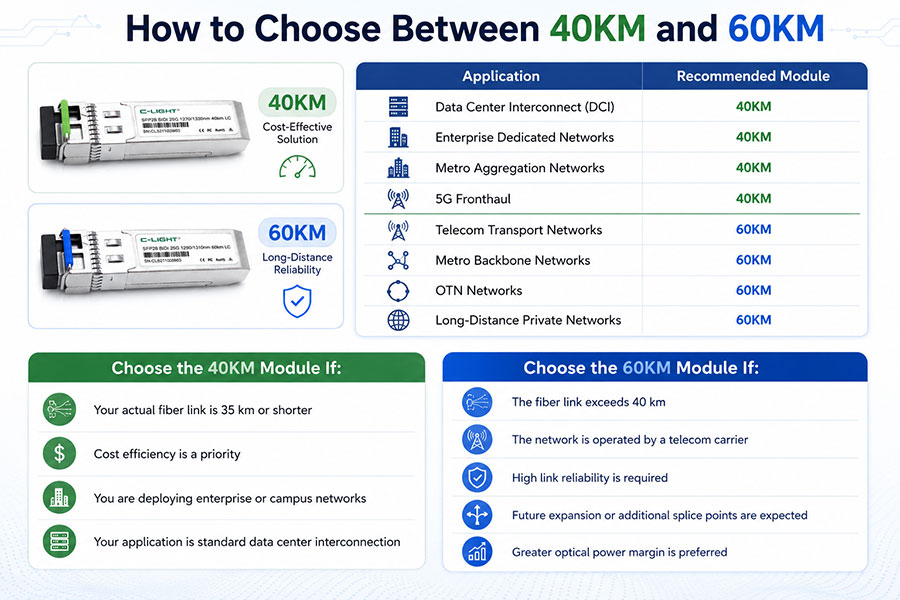
| Application | Recommended Module |
|---|---|
| Data Center Interconnect (DCI) | 40KM |
| Enterprise Dedicated Networks | 40KM |
| Metro Aggregation Networks | 40KM |
| 5G Fronthaul | 40KM |
| Telecom Transport Networks | 60KM |
| Metro Backbone Networks | 60KM |
| OTN Networks | 60KM |
| Long-Distance Private Networks | 60KM |
Choose the 40KM Module If:
Your actual fiber link is 35 km or shorter
Cost efficiency is a priority
You are deploying enterprise or campus networks
Your application is standard data center interconnection
Choose the 60KM Module If:
The fiber link exceeds 40 km
The network is operated by a telecom carrier
High link reliability is required
Future expansion or additional splice points are expected
Greater optical power margin is preferred
8. C-LIGHT 25G BiDi Optical Transceiver Solutions
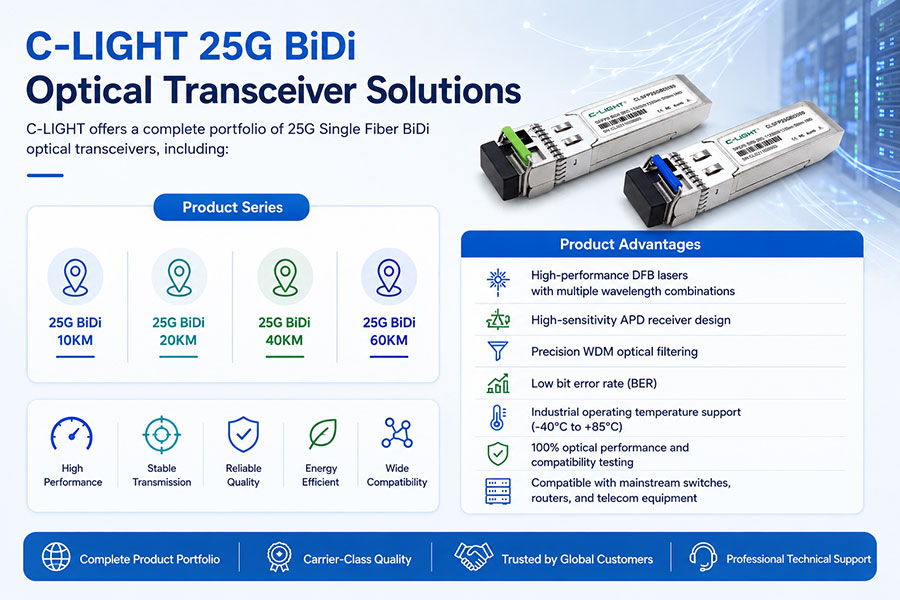
C-LIGHT offers a complete portfolio of 25G Single Fiber BiDi optical transceivers, including:
Product Series
25G BiDi 10KM
25G BiDi 20KM
25G BiDi 40KM
25G BiDi 60KM
Product Advantages
High-performance DFB lasers with multiple wavelength combinations
High-sensitivity APD receiver design
Precision WDM optical filtering
Low bit error rate (BER)
Industrial operating temperature support (-40°C to +85°C)
100% optical performance and compatibility testing
Compatible with mainstream switches, routers, and telecom equipment
9. Conclusion
Although the C-LIGHT 25G BiDi 40KM and 60KM optical transceivers share the same form factor, interface, and overall appearance, they differ substantially in laser performance, wavelength design, receiver sensitivity, optical link budget, and long-distance transmission capability.
When selecting an optical transceiver, network designers should evaluate not only transmission distance but also factors such as fiber attenuation, splice count, future network expansion, and required system reliability. Maintaining adequate optical power margin is essential for ensuring long-term stable network operation.
10、25G BiDi 40KM vs 60KM Optical Transceiver FAQ
Q1. What is the difference between 25G BiDi 40KM and 60KM optical transceivers?
Answer: The main difference between 25G BiDi 40KM and 60KM optical transceivers is the transmission distance capability, optical power budget, wavelength design, and receiver performance. Both modules use single-fiber bidirectional transmission technology, but the 60KM version uses optimized wavelength selection, higher-performance optical components, and improved sensitivity to achieve longer transmission distances.
Q2. What is a 25G BiDi SFP28 optical transceiver used for?
Answer: A 25G BiDi SFP28 optical transceiver is designed for high-speed single-fiber bidirectional communication over single-mode fiber. It is commonly used in 5G fronthaul networks, telecom access networks, metropolitan area networks, enterprise networks, and data center interconnect applications where fiber resources are limited.
Q3. How does a 25G BiDi optical transceiver transmit data over a single fiber?
Answer: A 25G BiDi optical transceiver uses wavelength division multiplexing (WDM) technology to transmit and receive signals through the same optical fiber. Different wavelengths are assigned for the TX and RX directions, allowing two-way communication while reducing fiber usage compared with traditional duplex fiber solutions.
Q4. Why does the 25G BiDi 60KM module support longer distances than the 40KM version?
Answer: The 25G BiDi 60KM module achieves longer transmission distances through improved optical design, including optimized wavelength selection, higher optical output power, better receiver sensitivity, and stronger chromatic dispersion tolerance. These improvements provide a larger optical link budget for long-distance telecom and transport networks.
Q5. Can a 25G BiDi 40KM optical module replace a 60KM module?
Answer: No. A 40KM BiDi optical module cannot reliably replace a 60KM module for longer-distance links because it has a lower optical budget and reduced transmission margin. For links approaching or exceeding 40km, the 60KM version provides better reliability against fiber loss, connector attenuation, and environmental changes.
Q6. Should I choose a 25G BiDi 40KM or 60KM optical transceiver for my network?
Answer: The choice depends on transmission distance and network requirements. A 25G BiDi 40KM module is suitable for data center interconnects, enterprise networks, metro aggregation, and standard long-distance connections. A 60KM module is recommended for telecom transport networks, metro backbone links, OTN networks, and applications requiring higher optical margin and long-term reliability.
Q7. What are the advantages of 25G BiDi optical transceivers compared with traditional dual-fiber modules?
Answer: The main advantage of 25G BiDi optical transceivers is reduced fiber usage. By transmitting and receiving signals over a single fiber, BiDi modules help save fiber resources, simplify network deployment, and improve fiber utilization in scenarios such as 5G fronthaul and access networks.
Q8. What factors should be considered when selecting a 25G BiDi optical module?
Answer: When selecting a 25G BiDi optical module, network designers should consider transmission distance, fiber attenuation, optical link budget, wavelength compatibility, receiver sensitivity, and future network expansion requirements. Choosing the appropriate reach version ensures stable transmission performance and long-term network reliability.
 >
>

 >
>
 >
>
 >
>
 >
>
 >
>
 >
>
 >
>