TEL:+86 132 6656 7067


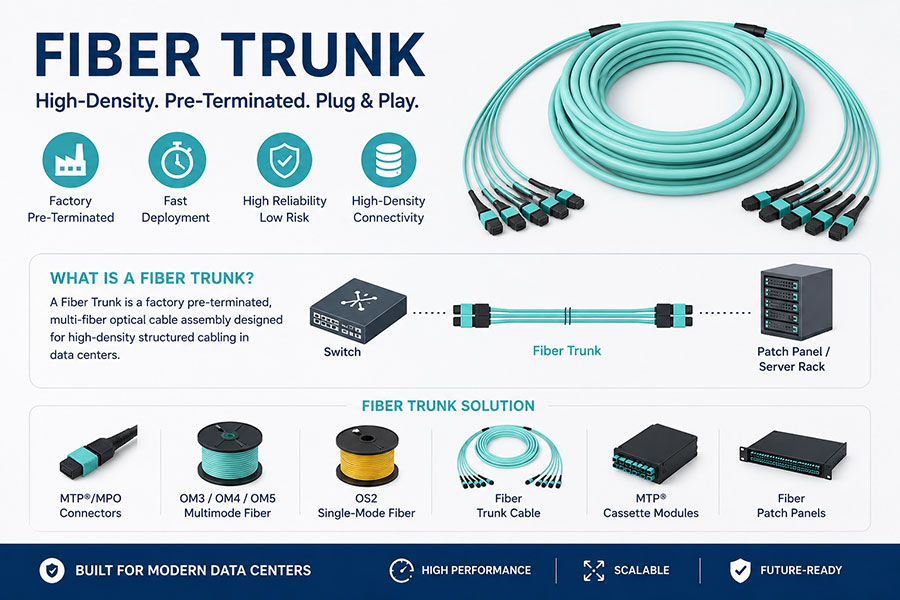
1、What Is a Fiber Trunk?
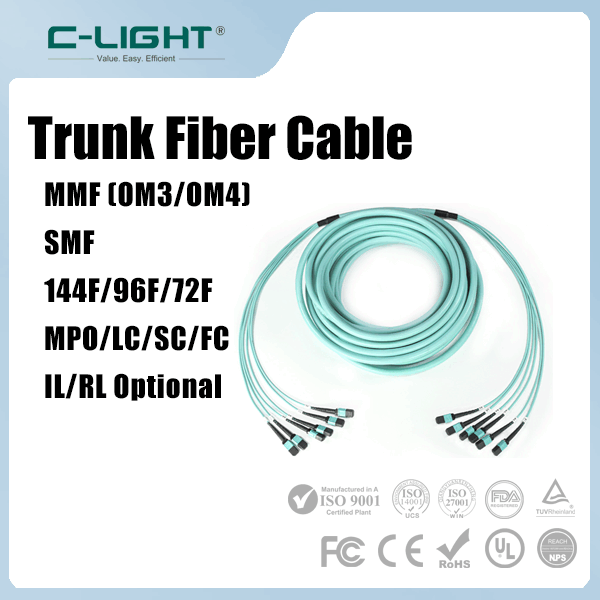
A Fiber Trunk is a factory pre-terminated, multi-fiber optical cable assembly designed for high-density structured cabling in data centers. Equipped with MTP®/MPO high-density connectors, Fiber Trunks provide fast and reliable backbone connectivity between patch panels, network switches, storage systems, and server racks.
Trunk Fiber Cable high-capacity backbone optical cable丨C-LIGHT
Unlike traditional field-terminated fiber cabling, Fiber Trunks are factory-assembled, polished, inspected, and fully tested before shipment. Installation simply requires plug-and-play connections, significantly reducing deployment time while minimizing installation risks and human error.
A typical Fiber Trunk solution includes:
MTP®/MPO Connectors
OM3, OM4, or OM5 Multimode Fiber
OS2 Single-Mode Fiber
Fiber Trunk Cable
MTP Cassette Modules
Fiber Patch Panels
Today, Fiber Trunks have become one of the core infrastructures of modern data center structured cabling.
2. Why Do Data Centers Need Fiber Trunks?
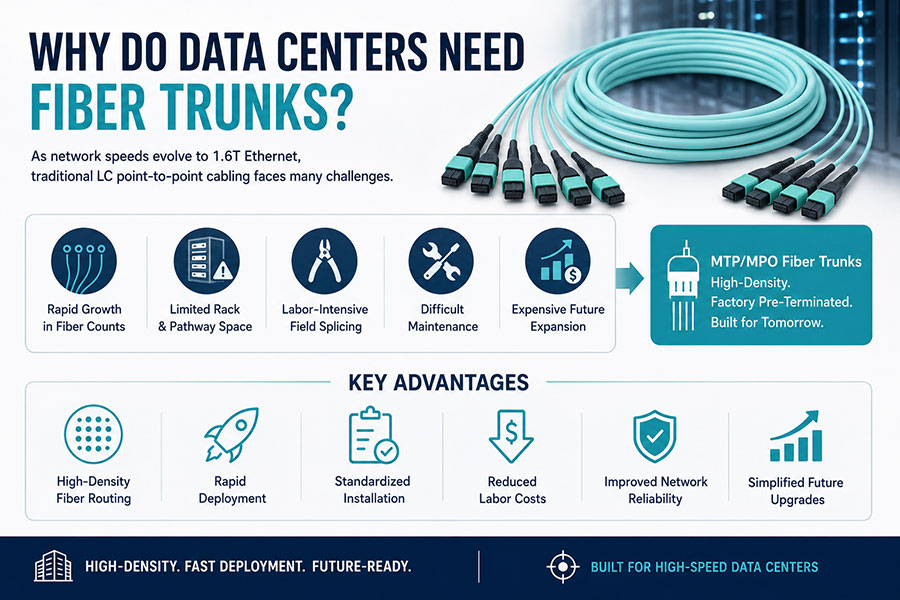
As network speeds evolve from 100G to 400G, 800G, and even 1.6T Ethernet, conventional LC point-to-point cabling presents several challenges:
Rapid growth in fiber counts
Limited rack and pathway space
Labor-intensive field splicing
Difficult maintenance
Expensive future expansion
MTP/MPO Fiber Trunks address these challenges through high-density, factory pre-terminated multi-fiber designs.
Key advantages include:
High-density fiber routing
Rapid deployment
Standardized installation
Reduced labor costs
Improved network reliability
Simplified future upgrades
3. Typical Fiber Trunk Applications in Data Centers
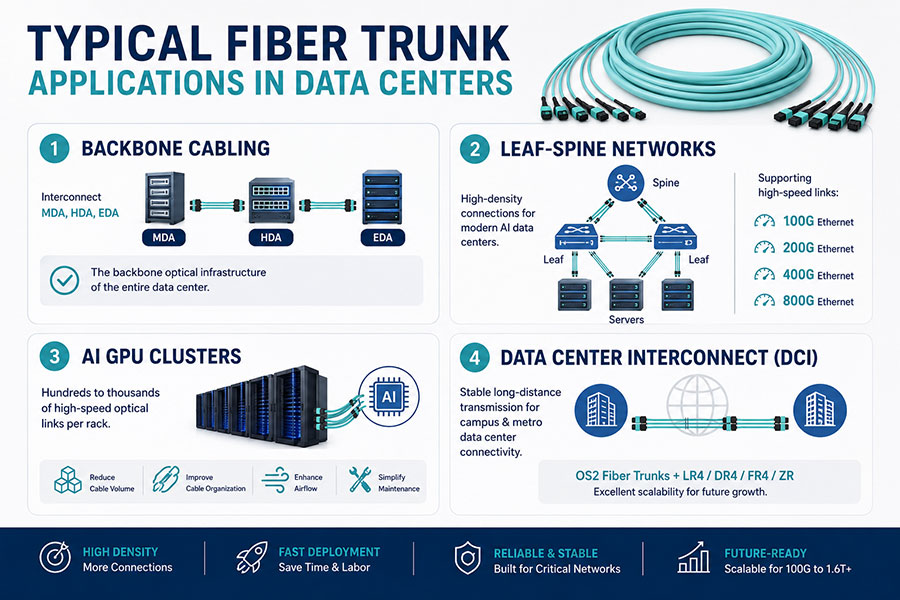
3.1 Backbone Cabling
Fiber Trunks are widely deployed to interconnect:
Main Distribution Area (MDA)
Horizontal Distribution Area (HDA)
Equipment Distribution Area (EDA)
Together they form the backbone optical infrastructure of the entire data center.
3.2 Leaf-Spine Networks
Modern AI data centers commonly adopt Leaf-Spine architectures.
Fiber Trunks provide high-density connections between:
Spine ↔ Leaf
Leaf ↔ Servers
Spine ↔ Core
Supporting high-speed links including:
100G Ethernet
200G Ethernet
400G Ethernet
800G Ethernet
3.3 AI GPU Clusters
Large AI GPU clusters may require hundreds or even thousands of high-speed optical links per rack.
Fiber Trunks help by:
Reducing cable volume
Improving cable organization
Enhancing airflow
Simplifying maintenance
3.4 Data Center Interconnect (DCI)
For campus and metro data center connectivity, OS2 Fiber Trunks combined with LR4, DR4, FR4, or ZR optical transceivers provide stable long-distance transmission with excellent scalability.
4. Common Fiber Trunk Components
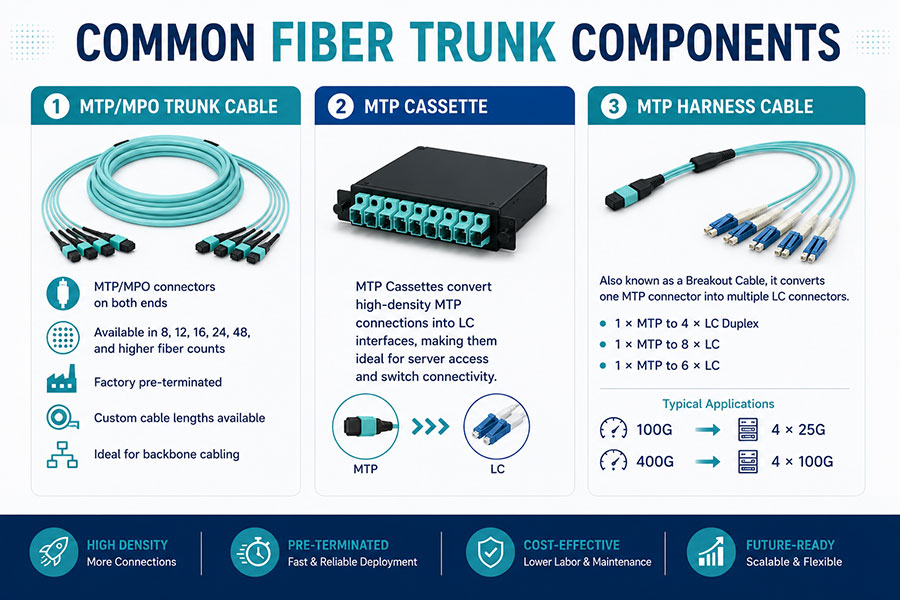
MTP/MPO Trunk Cable
Features include:
MTP/MPO connectors on both ends
Available in 8, 12, 16, 24, 48, and higher fiber counts
Factory pre-terminated
Custom cable lengths available
Ideal for backbone cabling.
MTP Cassette
MTP Cassettes convert high-density MTP connections into LC interfaces, making them ideal for server access and switch connectivity.
MTP Harness Cable
Also known as a Breakout Cable, it converts one MTP connector into multiple LC connectors, such as:
1 × MTP to 4 × LC Duplex
1 × MTP to 8 × LC
1 × MTP to 6 × LC
Typical applications include:
100G → 4 × 25G
400G → 4 × 100G
5. Fiber Trunk Deployment Process
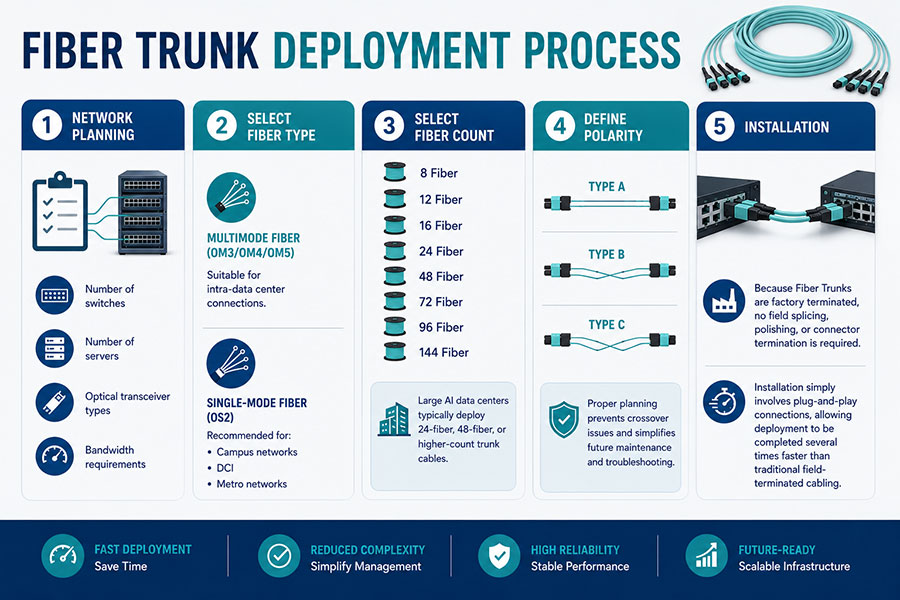
Step 1 – Network Planning
Determine the required number of Fiber Trunks based on:
Number of switches
Number of servers
Optical transceiver types
Bandwidth requirements
Step 2 – Select Fiber Type
Choose the appropriate fiber based on the application.
Multimode Fiber (OM3/OM4/OM5)
Suitable for intra-data center connections.
Single-Mode Fiber (OS2)
Recommended for:
Campus networks
DCI
Metro networks
Step 3 – Select Fiber Count
Common options include:
8 Fiber
12 Fiber
16 Fiber
24 Fiber
48 Fiber
72 Fiber
96 Fiber
144 Fiber
Large AI data centers typically deploy 24-fiber, 48-fiber, or higher-count trunk cables.
Step 4 – Define Polarity
Polarity planning is one of the most critical aspects of structured cabling.
Common polarity methods include:
Type A
Type B
Type C
Proper planning prevents crossover issues and simplifies future maintenance and troubleshooting.
Step 5 – Installation
Because Fiber Trunks are factory terminated, no field splicing, polishing, or connector termination is required.
Installation simply involves plug-and-play connections, allowing deployment to be completed several times faster than traditional field-terminated cabling.
6. Fiber Trunk vs. Traditional Field-Spliced Cabling
| Feature | Fiber Trunk | Field-Spliced Cabling |
|---|---|---|
| Installation Speed | Very Fast | Slow |
| Labor Cost | Low | High |
| Optical Performance | Highly Consistent | Depends on Installation Quality |
| Insertion Loss | Factory Controlled | Variable |
| Scalability | Excellent | Moderate |
| Maintenance | Easy | More Complex |
| Network Reliability | High | Installation Dependent |
7. Why AI Data Centers Prefer Fiber Trunks
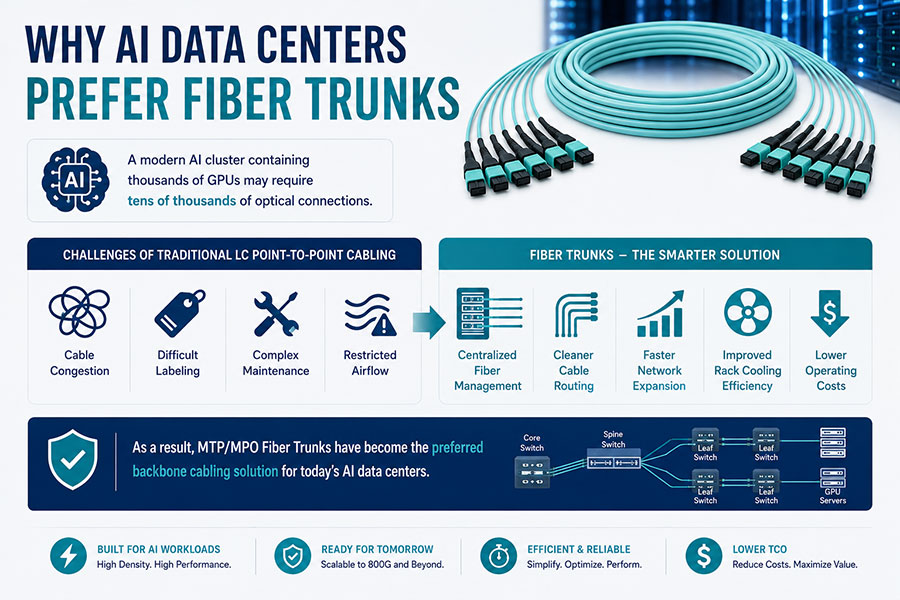
A modern AI cluster containing thousands of GPUs may require tens of thousands of optical connections.
Traditional LC point-to-point cabling often results in:
Cable congestion
Difficult labeling
Complex maintenance
Restricted airflow
Fiber Trunks solve these challenges by providing:
Centralized fiber management
Cleaner cable routing
Faster network expansion
Improved rack cooling efficiency
Lower operating costs
As a result, MTP/MPO Fiber Trunks have become the preferred backbone cabling solution for today's AI data centers.
8. Fiber Trunks for High-Speed Optical Transceivers
| Optical Transceiver | Recommended Fiber Trunk |
| 40G SR4 | 8-Fiber MTP |
| 100G SR4 | 8-Fiber MTP |
| 200G SR4 | 8-Fiber MTP |
| 400G SR4 | 16-Fiber MTP |
| 400G DR4 | 8-Fiber Single-Mode MTP |
| 800G SR8 | 16-Fiber MTP |
| 800G DR8 | 16-Fiber Single-Mode MTP |
| 1.6T SR16 | 32-Fiber MTP (Future Trend) |
When planning a structured cabling system, fiber counts should match transceiver interfaces such as MTP-8, MTP-12, and MTP-16, while also allowing room for future network upgrades.
9. C-LIGHT Fiber Trunk Structured Cabling Solutions
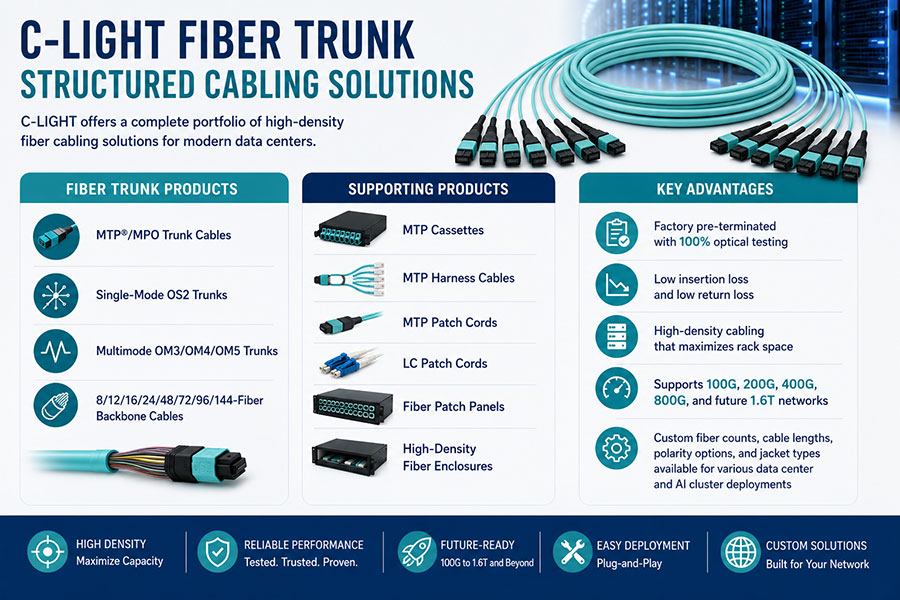
C-LIGHT offers a complete portfolio of high-density fiber cabling solutions for modern data centers.
Fiber Trunk Products
MTP®/MPO Trunk Cables
Single-Mode OS2 Trunks
Multimode OM3/OM4/OM5 Trunks
8/12/16/24/48/72/96/144-Fiber Backbone Cables
Supporting Products
MTP Cassettes
MTP Harness Cables
MTP Patch Cords
LC Patch Cords
Fiber Patch Panels
High-Density Fiber Enclosures
Key Advantages
Factory pre-terminated with 100% optical testing
Low insertion loss and low return loss
High-density cabling that maximizes rack space
Supports 100G, 200G, 400G, 800G, and future 1.6T networks
Custom fiber counts, cable lengths, polarity options, and jacket types available for various data center and AI cluster deployments
10. Conclusion
As AI, large language model (LLM) training, high-performance computing (HPC), and hyperscale cloud data centers continue to drive unprecedented bandwidth growth, standardized high-density fiber infrastructure has become essential for next-generation networks.
Compared with traditional field-spliced cabling, MTP/MPO Fiber Trunks provide significantly faster deployment, lower installation costs, more consistent optical performance, and superior scalability through factory pre-terminated designs.
For modern data centers, deploying Fiber Trunks as the backbone infrastructure—together with MTP Cassettes, Harness Cables, and high-speed optical transceivers—creates a unified structured cabling platform capable of supporting today's 100G, 400G, and 800G networks, while providing a smooth migration path toward 1.6T Ethernet and beyond.
11. Frequently Asked Questions (FAQ)
div class="faq-card">
Q1. What is the difference between a Fiber Trunk and a standard fiber patch cord?
Answer: A Fiber Trunk is a factory pre-terminated multi-fiber backbone cable primarily used for interconnecting patch panels, cabinets, or distribution areas. Standard fiber patch cords typically contain two fibers with LC connectors and are mainly used for equipment connections over short distances.
Q2. Why do AI data centers prefer MTP/MPO Fiber Trunks?
Answer: AI clusters require an enormous number of optical connections. Fiber Trunks significantly reduce cable congestion, increase cabling density, improve airflow, simplify cable management, and enable faster future expansion.
Q3. How do I choose the right fiber count for a Fiber Trunk?
Answer: The fiber count should be selected based on current port density, transceiver interface type (such as 8-fiber or 16-fiber MTP), and future expansion plans. For medium and large-scale data centers, 24-fiber, 48-fiber, and higher-count trunks generally provide better long-term investment value.
Q4. Are Fiber Trunks ready for future 1.6T networks?
Answer: Yes. With proper planning of fiber count, polarity, and cable routing during the design stage, Fiber Trunks provide a scalable infrastructure that supports next-generation 1.6T optical transceivers and future ultra-high-speed Ethernet networks.
 >
>

 >
>
 >
>
 >
>
 >
>
 >
>
 >
>
 >
>