TEL:+86 132 6656 7067


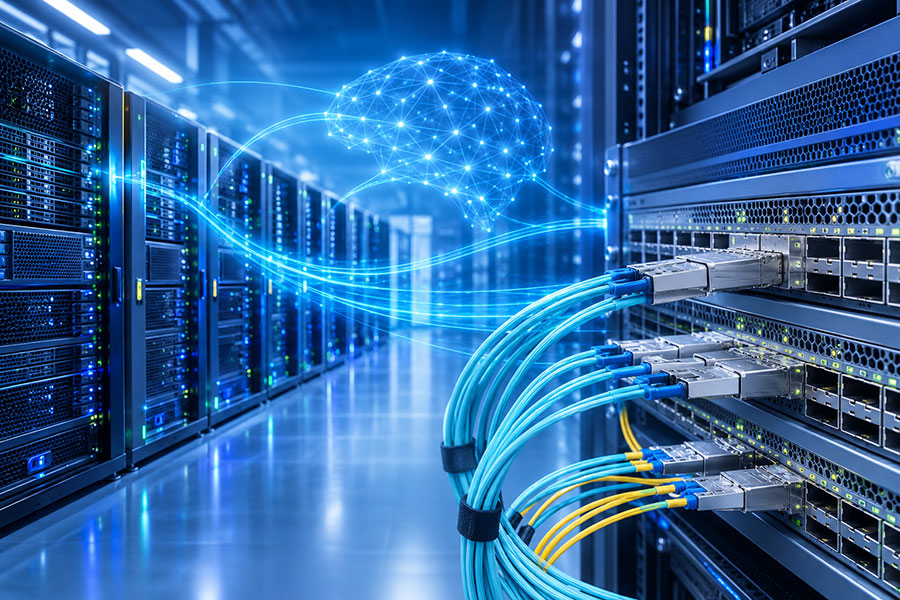
With the rapid development of artificial intelligence (AI), large-scale model training, high-performance computing (HPC), and cloud data centers, data center networks are accelerating their evolution from the traditional 100G/200G era toward 400G, 800G, and even 1.6T high-speed interconnect architectures.
In this trend, high-speed interconnect products such as optical transceivers, DAC, AOC, and AEC have become critical infrastructure that determines data center performance, power consumption, and scalability.
As a provider of high-speed interconnect solutions, C-LIGHT continues to expand its 400G, 800G, and 1.6T product portfolio, and delivers highly reliable interconnect solutions for AI data centers, GPU clusters, and cloud computing networks through a professional testing system.
1. Background of High-Speed Interconnect Evolution in Data Centers
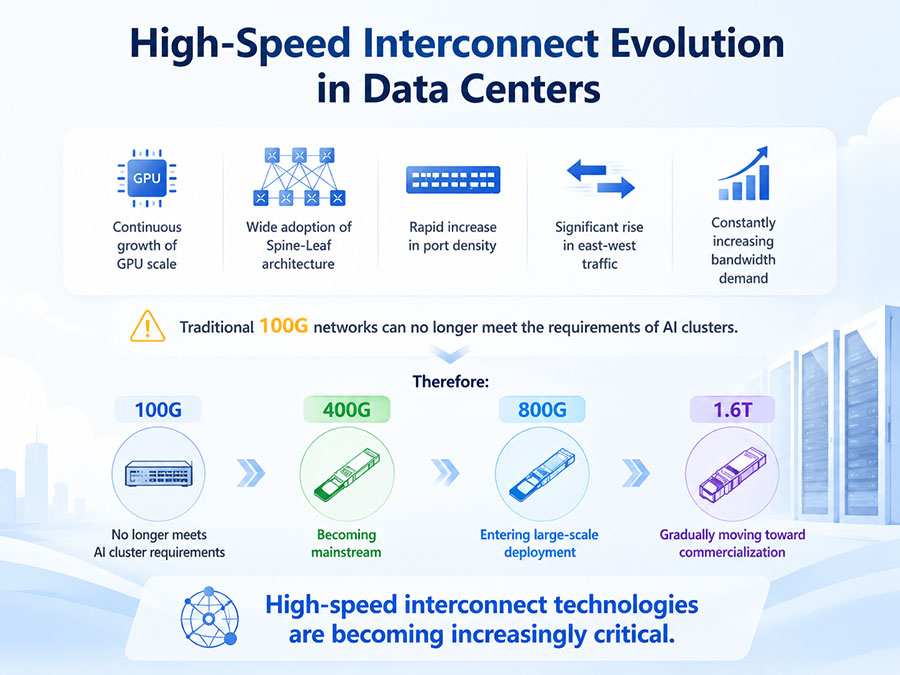
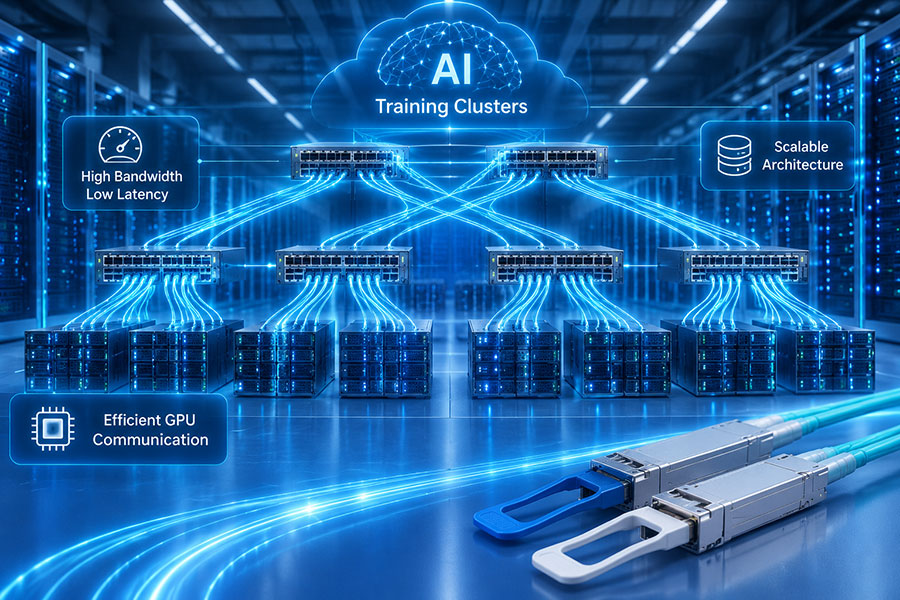
The rapid expansion of AI training clusters is driving fundamental changes in data center networks:
Continuous growth of GPU scale
Wide adoption of Spine-Leaf architecture
Rapid increase in port density
Significant rise in east-west traffic
Constantly increasing bandwidth demand
Traditional 100G networks can no longer meet the requirements of AI clusters.
Therefore:
400G is becoming mainstream
800G is entering large-scale deployment
1.6T is gradually moving toward commercialization
High-speed interconnect technologies are becoming increasingly critical.
2. Classification of Data Center High-Speed Interconnect Solutions
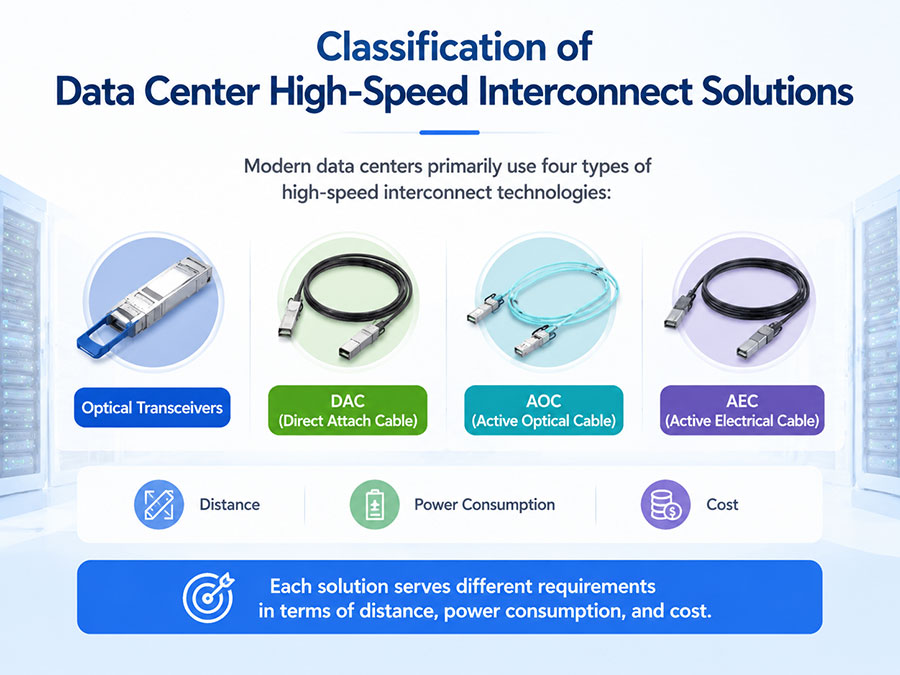
Modern data centers primarily use four types of high-speed interconnect technologies:
Optical Transceivers
DAC (Direct Attach Cable)
AOC (Active Optical Cable)
AEC (Active Electrical Cable)
Each solution serves different requirements in terms of distance, power consumption, and cost.
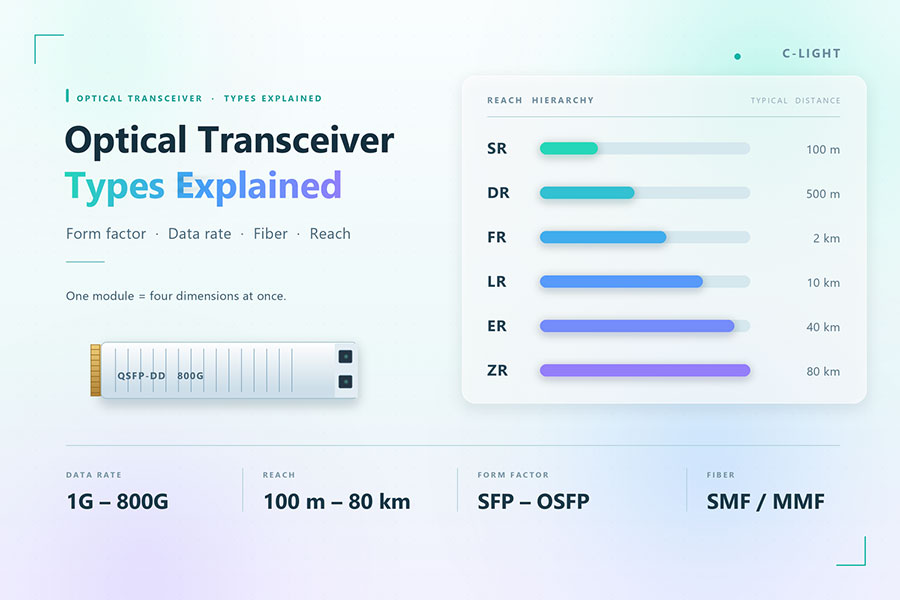
3. Optical Transceiver Technology Classification
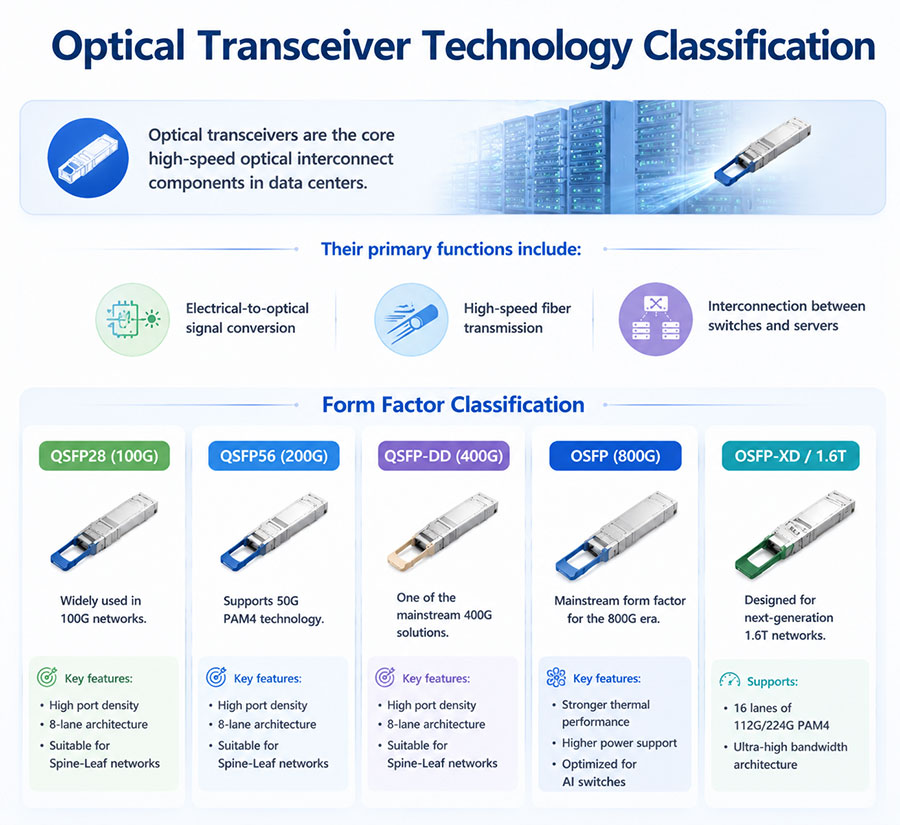
Optical transceivers are the core high-speed optical interconnect components in data centers.
Their primary functions include:
Electrical-to-optical signal conversion
High-speed fiber transmission
Interconnection between switches and servers
Form Factor Classification
QSFP28 (100G)
Widely used in 100G networks.
QSFP56 (200G)
Supports 50G PAM4 technology.
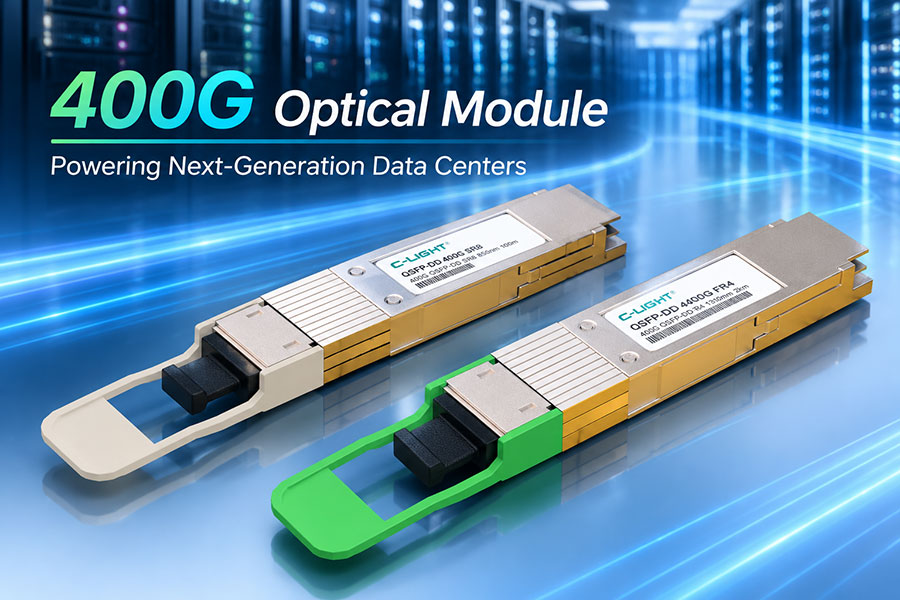
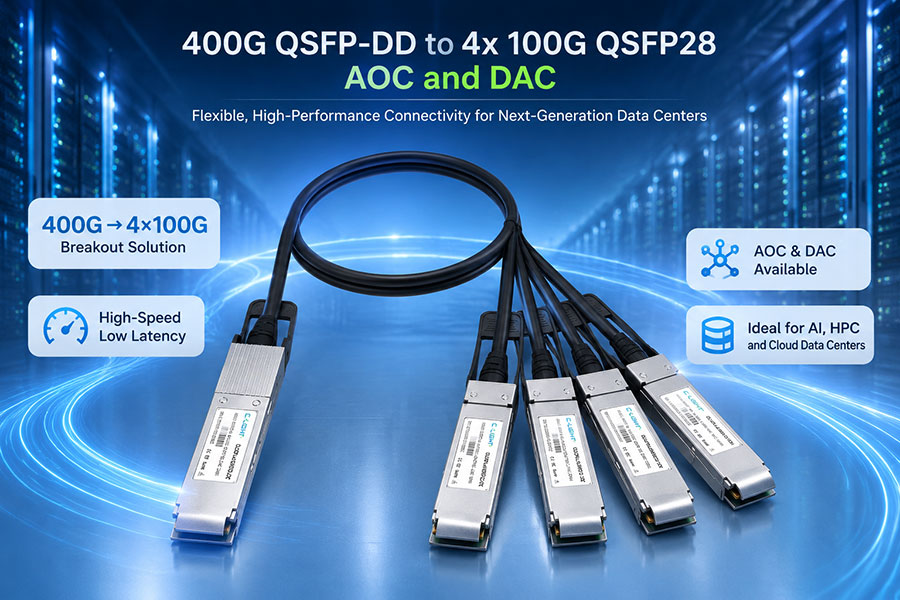
QSFP-DD (400G)
One of the mainstream 400G solutions.
Key features:
High port density
8-lane architecture
Suitable for Spine-Leaf networks
OSFP (800G)
Mainstream form factor for the 800G era.
Key features:
Stronger thermal performance
Higher power support
Optimized for AI switches
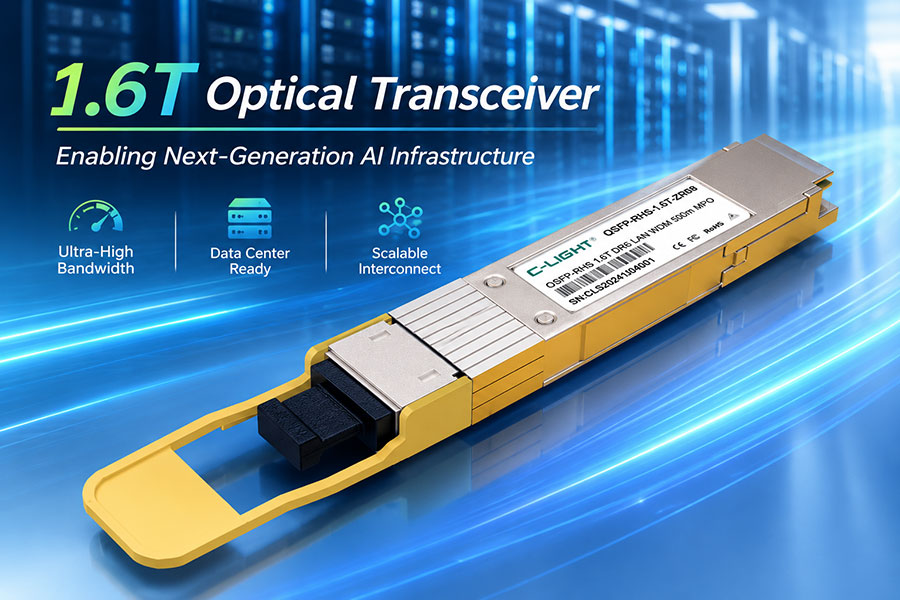
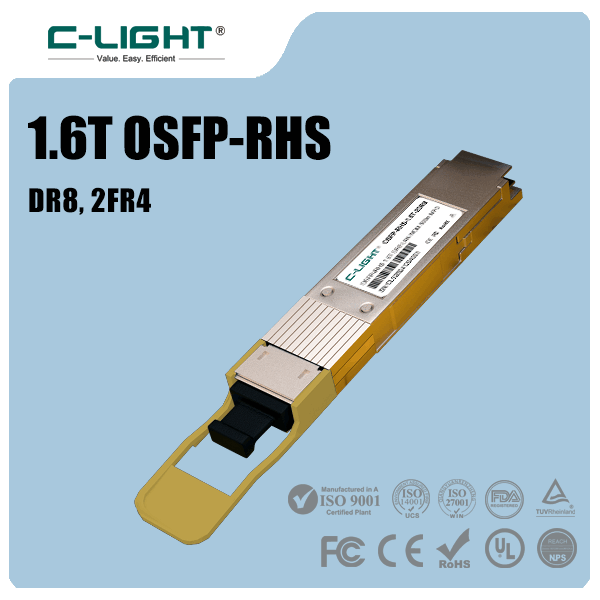
OSFP-XD / 1.6T
Designed for next-generation 1.6T networks.
Supports:
16 lanes of 112G/224G PAM4
Ultra-high bandwidth architecture
4. Optical Transceiver Technology Trends
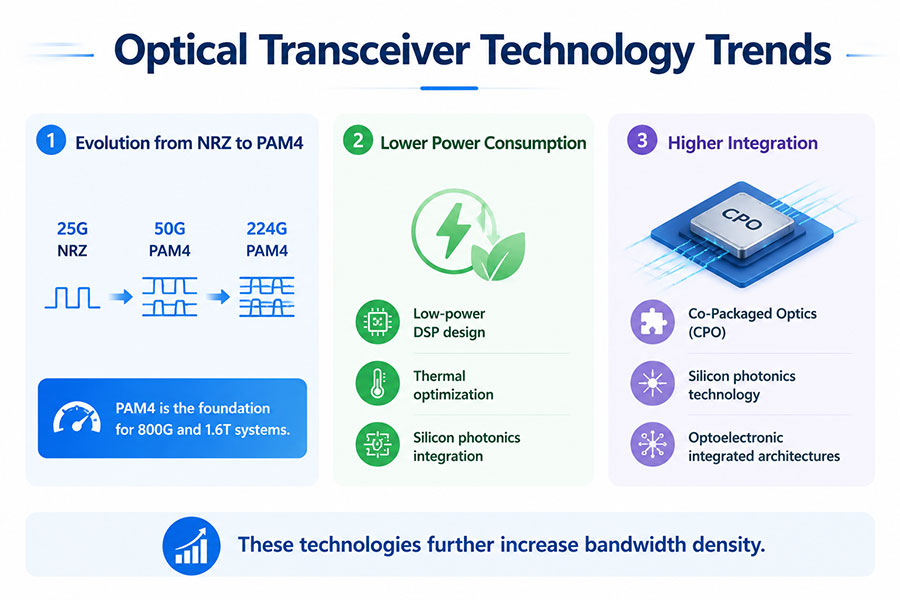
4.1 Evolution from NRZ to PAM4
High-speed development drives modulation upgrades:
25G NRZ → 50G PAM4
100G PAM4 → 224G PAM4
PAM4 has become the foundational technology for 800G and 1.6T systems.
4.2 Lower Power Consumption
AI data centers are extremely sensitive to power efficiency.
Future optical transceivers focus on:
Low-power DSP design
Thermal optimization
Silicon photonics integration
4.3 Higher Integration
Future trends include:
Co-Packaged Optics (CPO)
Silicon photonics technology
Optoelectronic integrated architectures
These technologies further increase bandwidth density.
5. DAC (Direct Attach Cable) Technology Classification
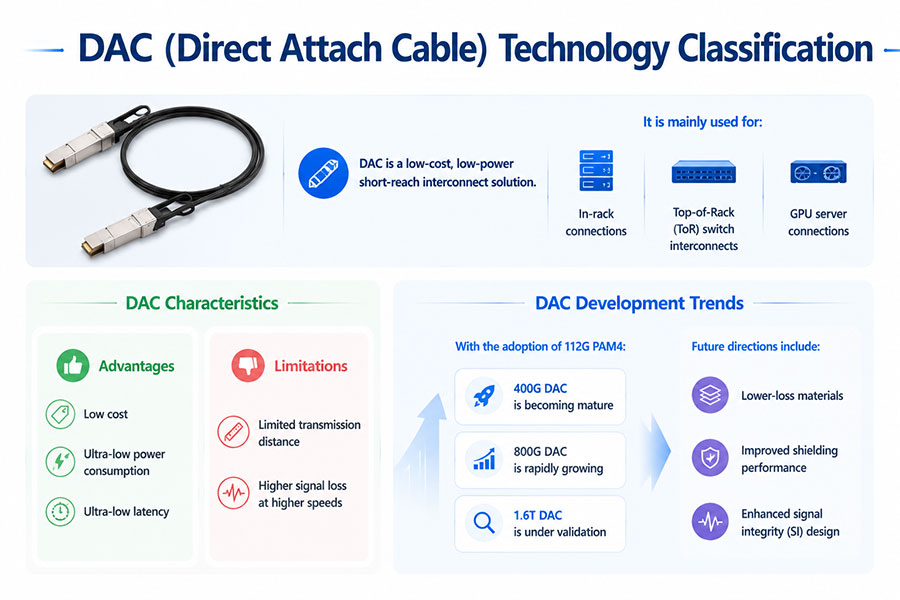
DAC is a low-cost, low-power short-reach interconnect solution.
It is mainly used for:
In-rack connections
Top-of-Rack (ToR) switch interconnects
GPU server connections
DAC Characteristics
Advantages:
Low cost
Ultra-low power consumption
Ultra-low latency
Limitations:
Limited transmission distance
Higher signal loss at higher speeds
DAC Development Trends
With the adoption of 112G PAM4:
400G DAC is becoming mature
800G DAC is rapidly growing
1.6T DAC is under validation
Future directions include:
Lower-loss materials
Improved shielding performance
Enhanced signal integrity (SI) design
6. AOC (Active Optical Cable) Technology Classification
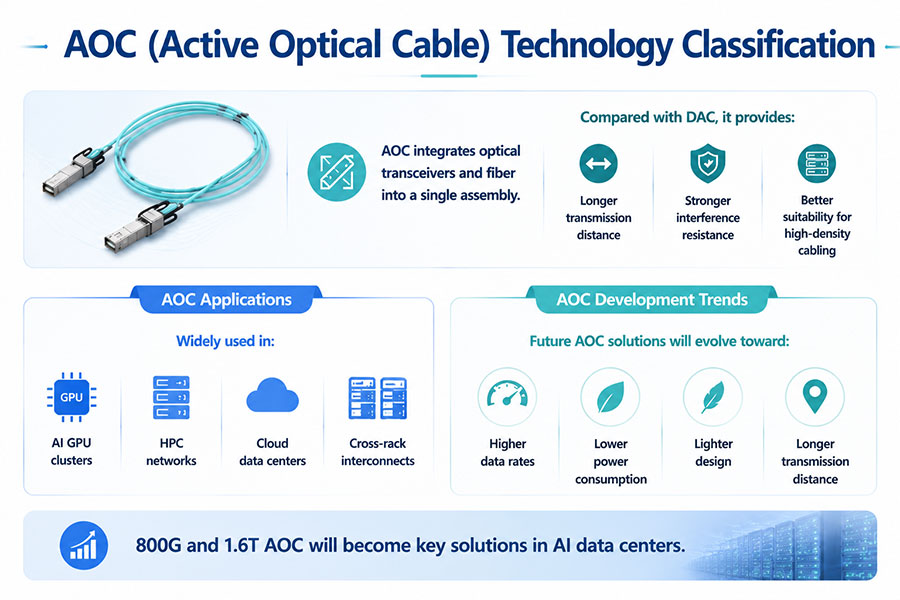
AOC integrates optical transceivers and fiber into a single assembly.
Compared with DAC, it provides:
Longer transmission distance
Stronger interference resistance
Better suitability for high-density cabling
AOC Applications
Widely used in:
AI GPU clusters
HPC networks
Cloud data centers
Cross-rack interconnects
AOC Development Trends
Future AOC solutions will evolve toward:
Higher data rates
Lower power consumption
Lighter design
Longer transmission distance
800G and 1.6T AOC will become key solutions in AI data centers.
7. AEC (Active Electrical Cable) Technology Classification
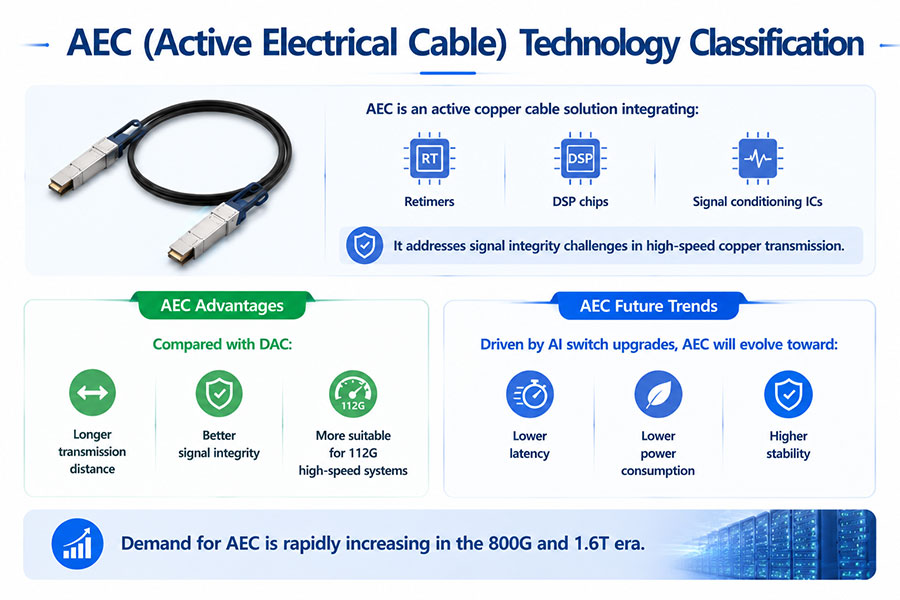
AEC is an active copper cable solution integrating:
Retimers
DSP chips
Signal conditioning ICs
It addresses signal integrity challenges in high-speed copper transmission.
AEC Advantages
Compared with DAC:
Longer transmission distance
Better signal integrity
More suitable for 112G high-speed systems
AEC Future Trends
Driven by AI switch upgrades, AEC will evolve toward:
Lower latency
Lower power consumption
Higher stability
Demand for AEC is rapidly increasing in the 800G and 1.6T era.
8. C-LIGHT High-Speed Interconnect Product Portfolio
C-LIGHT has established a comprehensive interconnect product ecosystem covering:
Optical Transceivers
100G QSFP28
200G QSFP56
400G QSFP-DD
800G OSFP
1.6T next-generation roadmap
DAC Series
400G DAC
800G DAC
AI GPU interconnect DAC
AOC Series
400G AOC
800G AOC
High-speed AI cluster AOC
AEC Series
400G AEC
800G AEC
High-density switch interconnect solutions
9. C-LIGHT Professional Testing System
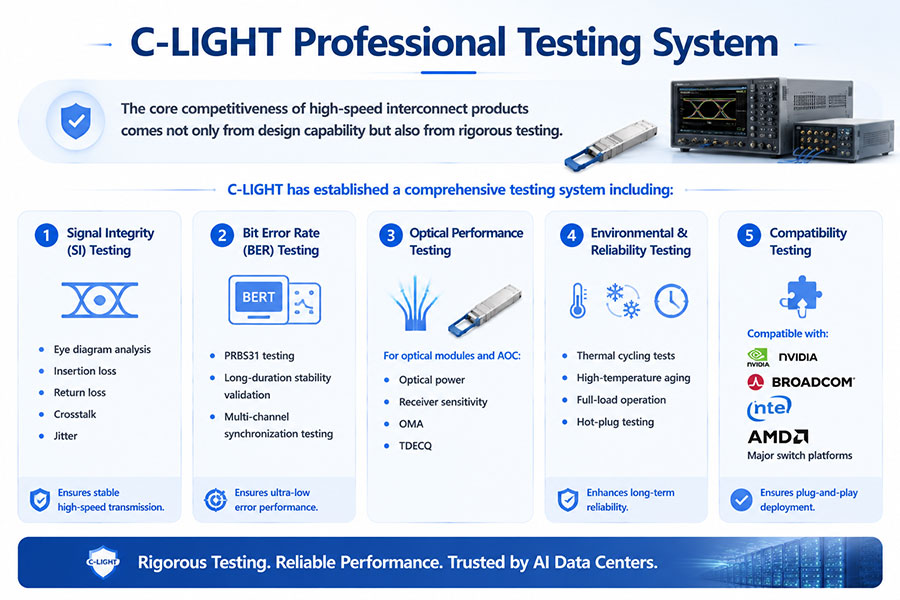
The core competitiveness of high-speed interconnect products comes not only from design capability but also from rigorous testing.
C-LIGHT has established a comprehensive testing system including:
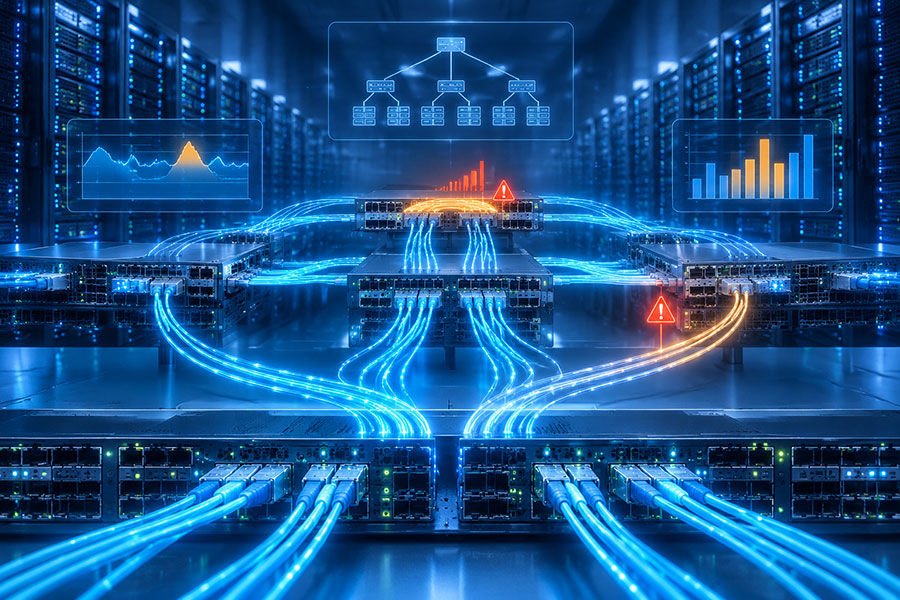
9.1 Signal Integrity (SI) Testing
Eye diagram analysis
Insertion loss
Return loss
Crosstalk
Jitter
Ensures stable high-speed transmission.
9.2 Bit Error Rate (BER) Testing
Using professional BERT equipment:
PRBS31 testing
Long-duration stability validation
Multi-channel synchronization testing
Ensures ultra-low error performance.
9.3 Optical Performance Testing
For optical modules and AOC:
Optical power
Receiver sensitivity
OMA
TDECQ
9.4 Environmental & Reliability Testing
Includes:
Thermal cycling tests
High-temperature aging
Full-load operation
Hot-plug testing
Enhances long-term reliability.
9.5 Compatibility Testing
Compatible with:
NVIDIA
Broadcom
Intel
AMD
Major switch platforms
Ensures plug-and-play deployment.
10. AI Era Driving Continuous Evolution of High-Speed Interconnects
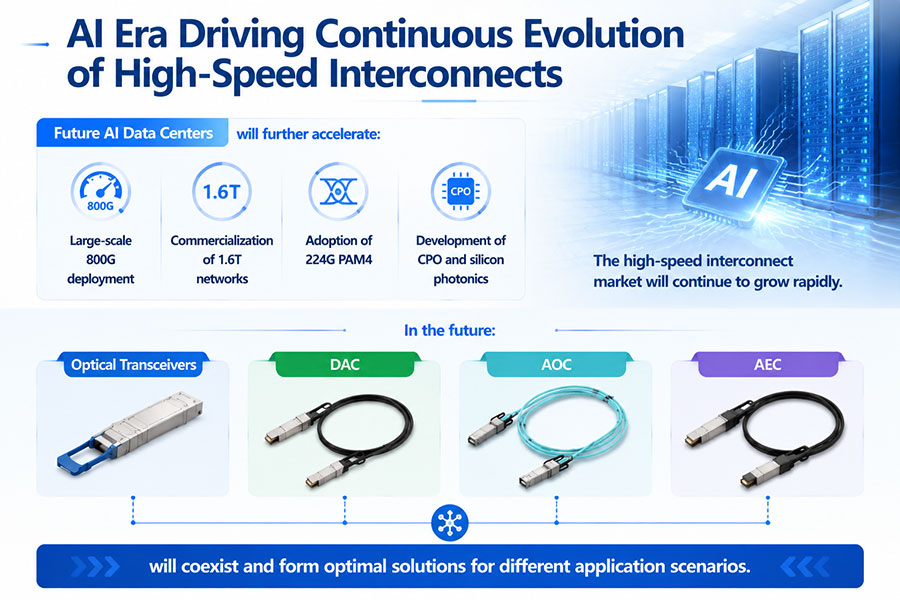
Future AI data centers will further accelerate:
Large-scale 800G deployment
Commercialization of 1.6T networks
Adoption of 224G PAM4
Development of CPO and silicon photonics
The high-speed interconnect market will continue to grow rapidly.
In the future:
Optical transceivers
DAC
AOC
AEC
will coexist and form optimal solutions for different application scenarios.
11. Conclusion
Driven by the rapid growth of AI computing power, high-speed interconnect has become one of the most critical infrastructures in modern data centers.
From 400G to 800G and toward 1.6T, optical transceivers and DAC/AOC/AEC technologies continue to drive the evolution of AI data center networks.
With a complete product portfolio and advanced testing system, C-LIGHT continues to deliver high-performance and high-reliability interconnect solutions to global customers, enabling the next generation of AI data center infrastructure.
12. Data Center Optical Transceivers & DAC/AOC/AEC Solutions FAQ
Q1: What are data center high-speed interconnect solutions?
A: Data center high-speed interconnect solutions include optical transceivers, DAC, AOC, and AEC cables. They are designed to support different transmission distances, bandwidth requirements, power consumption levels, and network architectures in modern data centers.
Optical transceivers for flexible long-distance optical connectivity
DAC cables for low-cost, low-power short-reach connections
AOC cables for longer reach and flexible high-density cabling
AEC cables for improved electrical signal integrity at high speeds
These solutions are widely used in AI data centers, cloud computing, HPC systems, and high-performance networking environments.
Q2: What is the difference between optical transceivers, DAC, AOC, and AEC?
A: Optical transceivers, DAC, AOC, and AEC are designed for different data center interconnect requirements.
Optical Transceiver: Provides flexible optical connectivity for medium- and long-distance transmission.
DAC: Provides low-cost, low-power copper connectivity for short-distance links.
AOC: Combines optical modules and fiber cable to provide longer reach and better EMI resistance.
AEC: Uses active electrical components such as retimers and DSPs to improve high-speed signal quality.
The optimal solution depends on transmission distance, bandwidth, power consumption, and deployment requirements.
Q3: What optical transceiver speeds does C-LIGHT support?
A: C-LIGHT provides a complete portfolio of high-speed optical transceivers covering current and next-generation data center networking requirements.
QSFP28 — 100G optical transceivers
QSFP56 — 200G optical transceivers
QSFP-DD — 400G optical transceivers
OSFP — 800G optical transceivers
OSFP-XD — 1.6T next-generation optical solutions
These solutions are designed for AI clusters, cloud data centers, HPC networks, and high-density Ethernet infrastructures.
Q4: What are the advantages of DAC cables?
A: DAC (Direct Attach Copper) cables provide a cost-effective and energy-efficient solution for short-distance data center connections.
Low cost compared with optical solutions
Low power consumption
Ultra-low latency transmission
Simple plug-and-play installation
Ideal for short-reach server and switch connections
DAC cables are commonly used for GPU server connections, Top-of-Rack (ToR) switching, and in-rack interconnect applications.
Q5: What are the advantages of AOC cables?
A: AOC (Active Optical Cable) integrates optical transceivers and fiber into a single cable assembly, providing longer reach and better flexibility than traditional copper solutions.
Longer transmission distance than DAC
Better resistance to electromagnetic interference
Lightweight and flexible cabling design
High-density deployment capability
Suitable for AI and HPC networking
AOC cables are widely used in AI GPU clusters, cloud data centers, HPC systems, and cross-rack interconnect applications.
Q6: What is AEC and when should it be used?
A: AEC (Active Electrical Cable) is an active copper interconnect solution that integrates retimers, DSPs, and signal-conditioning technologies to improve high-speed electrical transmission performance.
Improved signal integrity
Extended copper transmission distance
Support for higher-speed networking
Lower cost compared with some optical solutions
Suitable for 800G and future 1.6T networks
AEC is mainly used when passive DAC cannot meet the required signal quality or transmission distance.
Q7: How do you choose the right data center interconnect solution?
A: Selecting the right interconnect solution depends on network architecture, transmission requirements, and deployment environment.
Transmission distance
Required data rate
Power consumption requirements
Fiber or copper infrastructure
Deployment cost
Switch and platform compatibility
DAC is usually preferred for short-distance connections, AOC and optical transceivers are suitable for longer links, while AEC is recommended for high-speed copper applications requiring enhanced signal performance.
Q8: Why choose C-LIGHT high-speed interconnect solutions?
A: C-LIGHT provides a complete range of high-speed interconnect products, including optical transceivers, DAC, AOC, and AEC solutions from 100G to 800G and future 1.6T networks.
Complete optical and electrical interconnect portfolio
Support for AI data centers and HPC applications
High-speed solutions from 100G to 1.6T
Comprehensive testing including SI, BER, optical performance, and reliability validation
Excellent platform compatibility
C-LIGHT solutions provide reliable, scalable, and high-performance connectivity for next-generation data center networks.
 >
>

 >
>
 >
>
 >
>
 >
>
 >
>
 >
>
 >
>